Setting up a polytetrafluoroethylene (PTFE) production plant in India presents a compelling investment case driven by rising demand across the chemical processing industry, electrical and electronics sector, automotive and transportation, industrial machinery and equipment production, and the aerospace industry. PTFE is a high-performance fluoropolymer celebrated for its exceptional chemical inertness, thermal stability, non-stick surface properties, and low coefficient of friction – a unique combination that makes it indispensable in environments where conventional materials fail. From corrosion-resistant linings in chemical plants to wire insulation in advanced electronic systems and precision seals in automotive components, PTFE serves as a critical engineering material across India’s most capital-intensive and technically demanding industries.
India’s structural advantages make this a strategically sound investment. The country’s annual infrastructure spending exceeded INR 12 lakh crore in 2025–2026, marking a six-fold rise since 2014 – a sustained policy focus on development that is directly accelerating demand for durable, high-performance materials including PTFE used in construction coatings, industrial applications, and chemical processing equipment. The rapid expansion of India’s electrical and electronics production base, the growth of its automotive sector, and the Government of India’s Make in India initiative are simultaneously generating multi-sector demand that a domestic PTFE production plant is well-positioned to serve. Gujarat Fluorochemicals Ltd. (GFL), one of the world’s leading PTFE producers, is already headquartered in India – confirming the country’s viability as a world-class fluoropolymer production location.
India’s six-fold increase in infrastructure spending, rapid electrical and electronics sector expansion, and growing demand for high-performance polymer materials across chemical processing, automotive, and industrial applications make a PTFE production plant a financially sound and strategically well-timed investment. With gross margins of 30–40%, net margins of 15–22%, and a global PTFE market growing from USD 2.9 billion in 2025 to USD 4.1 billion by 2034, the demand foundation for domestic production is structurally durable and commercially compelling.
What is Polytetrafluoroethylene (PTFE)?
Polytetrafluoroethylene (PTFE) is a high-performance fluoropolymer composed of carbon and fluorine atoms, known for its exceptional non-stick properties, chemical inertness, and high thermal resistance. It exhibits excellent dielectric strength, a low coefficient of friction, and remarkable stability across a wide temperature range, making it suitable for demanding industrial environments. PTFE is widely available in various forms – granular resin, fine powder, and aqueous dispersions – enabling its use in diverse processing techniques including moulding, extrusion, and coating.
The material is highly resistant to corrosive chemicals, moisture, and UV radiation, ensuring long-term durability and reliability in aggressive service environments. Its unique combination of properties makes PTFE indispensable in applications requiring non-reactive surfaces, electrical insulation, and high-performance sealing solutions across multiple industries. The product is used in non-stick coatings, gaskets and seals, wire and cable insulation, bearings and bushings, chemical linings, and high-performance industrial components.
The primary production method is emulsion polymerisation of tetrafluoroethylene (TFE), coagulation, drying, fine powder processing or granulation, sintering, and finishing, followed by packaging and labelling – a technically precise multi-stage process that converts TFE monomer into a finished, specification-compliant fluoropolymer product. End-use industries served include the chemical processing industry, the electrical and electronics industry, the automotive and transportation sector, industrial machinery and equipment production, and the aerospace industry.
Cost of Setting Up a PTFE Production Plant in India
The cost of establishing this facility depends on capacity, technology selection, plant location, degree of automation, and regulatory compliance requirements.
1. Capital Expenditure (CapEx)
Total capital investment for a polytetrafluoroethylene production plant in India covers land acquisition, site preparation, civil construction, process machinery, and pre-operative expenses. The cost of land and site development – including charges for land registration, boundary development, and other related expenses – forms a substantial part of the overall investment. This allocation ensures a solid foundation for safe and efficient plant operations. Investors can reduce land costs by locating the unit in a Chemical Zone, PCPIR (Petroleum, Chemicals and Petrochemicals Investment Region) cluster, or Special Economic Zone (SEZ), which also provide shared utility infrastructure and potential fiscal incentives.
Civil works and construction encompass the main polymerisation and processing building, raw material storage for TFE monomer and initiators, finished product storage, a quality control laboratory, and an administrative block. Given that TFE monomer is a flammable, reactive gas that requires pressurised containment, civil and structural elements must comply with hazardous area electrical classification, explosion-proof construction, and comprehensive ventilation standards throughout the facility.
Machinery costs account for the largest portion of total capital expenditure. Key machinery required includes:
- Polymerisation reactors
- Agitation systems
- Drying units
- Sintering furnaces
- Milling equipment
- Packaging systems
Other capital costs include the effluent treatment plant (ETP), advanced process monitoring and leak detection systems, pre-operative expenses, trial production costs, and commissioning charges. Where specialised polymerisation reactor or sintering equipment is sourced internationally, applicable customs duties must be incorporated into the CapEx plan.
Request a Sample Report for In-Depth Market Insights: https://www.imarcgroup.com/polytetrafluoroethylene-production-plant-project-report/requestsample
2. Operational Expenditure (OpEx)
The operating cost structure of a polytetrafluoroethylene production plant is primarily driven by raw material consumption. Tetrafluoroethylene (TFE) monomer – the sole primary feedstock – accounts for approximately 60–70% of total operating expenses (OpEx), making TFE procurement strategy the single most critical determinant of production economics and margin protection. Initiators are the secondary raw material input. Securing long-term supply agreements with reliable TFE monomer producers and minimising transportation costs through proximity to fluorochemical supply chains is essential for cost stability and uninterrupted production.
Utility costs – comprising electricity consumed by polymerisation reactors, sintering furnaces, agitation systems, and drying units, as well as water and steam – account for 15–20% of total OpEx, reflecting the energy-intensive nature of high-temperature sintering and drying operations. Other ongoing operating costs include transportation, packaging, salaries and wages for plant operators, quality control personnel, maintenance staff, and safety supervisors; equipment repairs and maintenance; regulatory compliance; waste management and ETP operations; and depreciation and applicable taxes.
By the fifth year of operations, the total operational cost is expected to increase substantially due to factors such as inflation, market fluctuations, and potential rises in the cost of key materials. Additional factors including supply chain disruptions, rising consumer demand, and shifts in the global economy are expected to contribute to this increase.
3. Plant Capacity
The proposed production facility is designed with an annual production capacity ranging between 5,000 and 15,000 tons, enabling economies of scale while maintaining operational flexibility. Capacity can be customised per investor requirements based on target end-use markets, available capital, and chosen polymerisation technology. Profitability improves materially with higher capacity utilisation, making off-take agreements with chemical processing companies, wire and cable manufacturers, and automotive component producers a commercial priority from the commissioning stage.
4. Profit Margins and Financial Projections
The project demonstrates healthy profitability potential under normal operating conditions. Gross profit margins typically range between 30–40%, supported by stable demand and value-added applications. Net profit margins range between 15–22%. A comprehensive financial model covering NPV (net present value), IRR (internal rate of return), payback period, liquidity analysis, uncertainty analysis, sensitivity analysis, and a full five-year profit and loss account provides investors with a rigorous analytical framework for assessing financial viability and long-term sustainability across different capacity and pricing scenarios.
Why Set Up a PTFE Plant in India?
Growing Demand for High-Performance Polymers Across Multiple Sectors. Increasing industrialisation and demand for durable, chemically resistant materials are driving adoption of PTFE across the chemical processing industry, electrical and electronics production, automotive, industrial machinery, and aerospace sectors. This multi-sector demand profile provides diversified revenue streams and reduces dependency on any single end-use industry, creating financial resilience across the plant’s operating lifetime.
India’s Six-Fold Infrastructure Spending Surge. India’s annual infrastructure spending exceeded INR 12 lakh crore in 2025–2026, marking a six-fold rise since 2014. This sustained policy focus on development is directly accelerating demand for durable materials including PTFE used in construction coatings, chemical processing plant linings, and industrial applications embedded across India’s infrastructure build-out – creating a large and growing institutional procurement channel for domestic PTFE producers.
Expanding Electrical and Electronics Sector. The rising need for high-quality insulation materials that can withstand high temperatures and harsh environments is supporting PTFE consumption in advanced electronic systems across India’s expanding electronics production ecosystem. Wire and cable insulation, electronic component coatings, and semiconductor processing applications are all growing demand categories aligned with India’s PLI-driven electronics production expansion.
Exceptional Material Properties Ensure Consistent Demand. PTFE offers unmatched chemical resistance, thermal stability, and non-stick characteristics that no competing polymer can fully replicate. This performance differentiation ensures consistent specification of PTFE in safety-critical and technically demanding applications across chemical processing, automotive, aerospace, and industrial machinery – markets where performance reliability outweighs cost as the primary procurement criterion.
Scalable Production and Strong Margin Profile. Advanced polymerisation technologies enable efficient large-scale production with competitive cost structures. The 5,000 to 15,000 ton capacity range allows investors to scale progressively as domestic and export demand grows, with gross margins of 30–40% providing a strong financial foundation for production cost recovery and return generation across the investment lifecycle.
Latest Industry Developments Validating Material Relevance. In December 2025, a research study published by the Surfaces and Interfaces Journal highlighted advanced surface engineering approaches focused on coating performance, durability, and interfacial behaviour under varied conditions. The findings emphasised improved chemical resistance, reduced friction, and enhanced thermal stability – directly aligning with PTFE’s core industrial value proposition. In November 2025, a research study published by Springer Nature highlighted recent advancements in surface treatment technologies improving adhesion, wettability, and functionalisation of fluoropolymer surfaces through plasma, chemical, and radiation-based modification techniques – enabling broader industrial applicability of PTFE across coatings, electronics, and biomedical interfaces, and addressing the material’s traditional surface inertness challenges.
Production Process – Step by Step
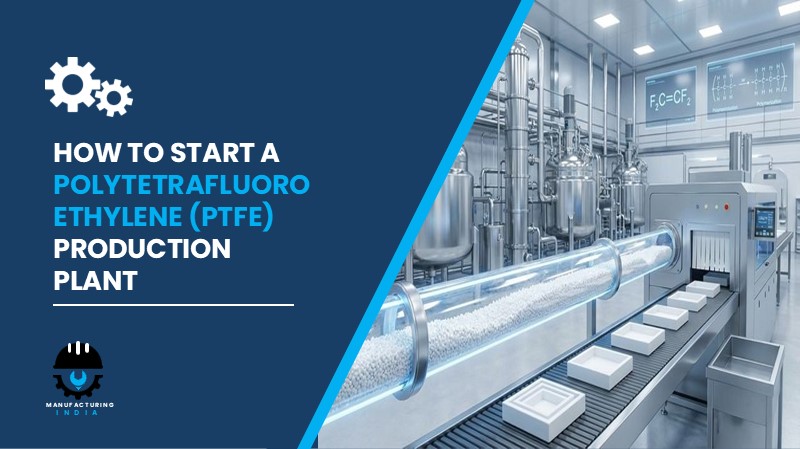
The polytetrafluoroethylene production process uses emulsion polymerisation of tetrafluoroethylene (TFE), coagulation, drying, fine powder processing or granulation, sintering, and finishing as the primary production method. Each stage is precision-controlled to ensure molecular weight consistency, particle size distribution, and compliance with the purity and performance specifications demanded by chemical processing, electrical, automotive, and aerospace customers.
- Raw Material Receipt and Inspection: Tetrafluoroethylene (TFE) monomer and initiators are received at the facility and subjected to incoming quality checks for purity, moisture content, and specification compliance. TFE is stored in pressurised vessels under strictly controlled conditions due to its reactive and flammable nature.
- Emulsion Polymerisation: TFE monomer and initiators are fed in controlled ratios into polymerisation reactors equipped with agitation systems operating under controlled temperature and pressure conditions. In the presence of water, surfactant, and initiator, TFE undergoes free-radical polymerisation to form a PTFE latex – a stable aqueous dispersion of fine PTFE particles.
- Coagulation: The PTFE latex is subjected to mechanical or chemical coagulation to aggregate the fine polymer particles from the aqueous dispersion into a coagulated PTFE mass that can be further processed into fine powder or granular resin grades.
- Drying: Coagulated PTFE is processed through drying units to remove residual water content to within the specification limit required for downstream processing and end-use application performance.
- Fine Powder Processing or Granulation: Dried PTFE is either processed into fine powder form for paste extrusion applications or granulated to produce free-flowing granular resin suitable for compression moulding and ram extrusion. Milling equipment reduces particle size and controls particle size distribution to the target specification for each product grade.
- Sintering: For certain PTFE product forms and finished component applications, sintering furnaces are used to heat the compacted polymer above its crystalline melt point and then cool it in a controlled manner, developing the final mechanical properties, void-free microstructure, and dimensional stability of the sintered PTFE part.
- Quality Inspection and Testing: Finished PTFE – in granular resin, fine powder, or aqueous dispersion form – is subjected to analytical testing for molecular weight, specific gravity, particle size, bulk density, and dielectric properties to confirm grade compliance before release for dispatch.
- Packaging and Dispatch: Approved PTFE is filled into lined bags, drums, or bulk containers using packaging systems and dispatched to end-use customers across the chemical processing industry, electrical and electronics industry, automotive and transportation sector, industrial machinery and equipment production, and the aerospace industry.
Key Applications
The PTFE production plant serves a diverse and technically critical range of industries across India’s industrial economy.
- Chemical Processing Industry: PTFE is widely used in linings, gaskets, and seals where superior chemical resistance and durability are essential for handling aggressive media including strong acids, alkalis, and oxidising agents in chemical reactors, pipelines, and storage vessels.
- Electrical and Electronics Industry: Applied in wire and cable insulation and electronic components due to its excellent dielectric properties and thermal stability – making it the insulation material of choice for high-frequency cables, aerospace wiring, and advanced circuit board coatings.
- Automotive and Transportation Sector: PTFE components enhance performance through reduced friction, improved wear resistance, and extended service life in moving parts including seals, bearings, piston rings, and fuel system components across passenger vehicle and commercial vehicle applications.
- Industrial Machinery and Equipment: Used in bearings, bushings, and coatings to improve operational efficiency, reduce maintenance requirements, and extend service life in pumps, valves, compressors, and other industrial rotating and sliding equipment.
- Non-Stick Coatings: PTFE aqueous dispersions are applied as non-stick coatings on cookware, bakeware, industrial rolls, and processing equipment where food-grade or release-surface performance is required.
- Aerospace Industry: Specified in high-reliability sealing, insulation, and structural coating applications across aerospace platforms where thermal stability across extreme temperature ranges and long service life under demanding conditions are non-negotiable performance requirements.
Leading Manufacturers
The global polytetrafluoroethylene industry is served by several established multinational producers with extensive production capacities and diverse application portfolios. Key players operating in this market include:
- Chemours Company
- Daikin Industries, Ltd.
- Solvay S.A.
- AGC Inc.
- Gujarat Fluorochemicals Ltd. (GFL)
All of these producers serve end-use sectors including the chemical processing industry, the electrical and electronics industry, the automotive and transportation sector, industrial machinery and equipment production, and the aerospace industry – the same markets that a domestic Indian PTFE production plant can target as local demand accelerates.
Timeline to Start the Plant
Investors should plan for a structured pre-production and commissioning phase covering the following key stages:
- Feasibility study and project report preparation
- Land acquisition and site development
- Regulatory approvals and environmental clearances
- Factory licence and fire safety compliance
- Machinery procurement and installation
- Raw material supplier agreements and supply chain setup
- Trial production and quality testing
- Commercial production launch
Licences and Regulatory Requirements
Starting a polytetrafluoroethylene production unit in India requires several approvals:
- Business registration (Proprietorship, LLP, or Private Limited Company)
- Factory Licence under the Factories Act
- Environmental Clearance from the State Pollution Control Board
- GST Registration
- Fire Safety NOC
- Hazardous chemical compliance for storage and handling of TFE monomer and initiators under the Manufacture, Storage and Import of Hazardous Chemical Rules
- Effluent Treatment Plant (ETP) operational clearance
- Occupational Health and Safety compliance
Key Challenges to Consider
High Capital Requirements. Establishing a fully equipped polytetrafluoroethylene production plant – with pressure-rated polymerisation reactors, agitation systems, sintering furnaces, milling equipment, and a comprehensive ETP – involves significant upfront capital investment. Access to chemical sector term financing, MSME credit-linked subsidies, and PCPIR cluster infrastructure support can help investors manage the capital requirement.
Raw Material Price Volatility. TFE monomer – accounting for 60–70% of total OpEx – is derived from fluorochemical feedstocks whose prices are linked to global fluorspar supply chains and HF (hydrofluoric acid) production economics. Price fluctuations can materially compress margins without proactive hedging strategies and long-term supply contracts with reliable domestic or international TFE producers.
High Utility Cost Intensity. Utilities – at 15–20% of total OpEx – represent a substantial ongoing cost driven by the energy demands of sintering furnaces and drying operations. Securing reliable and cost-competitive electricity supply, ideally from industrial estate grid infrastructure or open access renewable power arrangements, is a key site selection criterion for managing operating cost efficiency.
Regulatory Compliance. TFE monomer is a flammable, reactive gas subject to extensive storage, handling, and transportation regulations under India’s Hazardous Chemicals Rules. Advanced monitoring systems must be installed throughout the facility to detect leaks or process deviations. Effluent treatment systems, stack emission monitoring, and regular safety audits are mandatory – requiring dedicated environmental, health, and safety management resources throughout operations.
Competition from Global Players. Established international producers – including Chemours Company, Daikin Industries Ltd., Solvay S.A., and AGC Inc. – set high benchmarks for product purity, consistency, and technical support. Domestic Indian manufacturers must compete by leveraging proximity to end-users, lower landed cost compared to imports, supply chain reliability, and the ability to offer customised PTFE grades for India-specific applications.
Skilled Manpower. Operating polymerisation reactors, sintering furnaces, milling equipment, and precision quality testing instruments in a hazardous chemical environment requires certified chemical process engineers, fluoropolymer processing specialists, and quality assurance personnel. Recruiting, training, and retaining qualified technical staff is a recurring operational challenge in India’s competitive specialty chemicals labour market.
Frequently Asked Questions
1. How much does it cost to set up a PTFE production plant in India?
Total setup cost depends on plant capacity, location, technology selection, and automation level. Key cost components include land and site development, hazardous-rated civil construction, process machinery (polymerisation reactors, agitation systems, sintering furnaces, milling equipment, packaging systems), and pre-operative expenses. A detailed feasibility study is recommended to generate accurate project-specific cost estimates.
2. Is PTFE production profitable in India in 2026?
Yes. The project delivers strong financial performance, with gross profit margins of 30–40% and net profit margins of 15–22% under normal operating conditions. The global PTFE market was valued at USD 2.9 billion in 2025 and is projected to reach USD 4.1 billion by 2034 at a CAGR of 3.66% according to IMARC Group estimates, with India’s infrastructure investment surge and electronics production expansion representing fast-growing domestic demand drivers.
3. What machinery is required for a PTFE plant in India?
Essential equipment includes polymerisation reactors, agitation systems, drying units, sintering furnaces, milling equipment, and packaging systems.
4. What licences and approvals are required to start a PTFE plant in India?
Required approvals include business registration, Factory Licence, Environmental Clearance from the State Pollution Control Board, GST Registration, Fire Safety NOC, hazardous chemical compliance under the Hazardous Chemicals Rules for TFE monomer and initiator handling, ETP operational clearance, and Occupational Health and Safety compliance.
5. What raw materials are needed for PTFE production?
The primary raw materials are tetrafluoroethylene (TFE) monomer and initiators. TFE monomer is the dominant cost driver, accounting for 60–70% of total operating expenses, and requires pressurised storage and stringent safety management throughout the production process.
6. What are the environmental compliance requirements for a PTFE plant in India?
The facility must obtain Environmental Clearance, operate an approved ETP, and comply with the Hazardous Chemicals Rules for TFE monomer storage and handling. Advanced monitoring systems must be installed to detect leaks or process deviations. Regular effluent monitoring, air emission reporting, and hazardous waste documentation are mandatory throughout operations.
7. What is the best location to set up a PTFE plant in India?
Locations offering access to TFE monomer supply chains, reliable industrial-grade utilities, and proximity to chemical processing, electrical, and automotive end-user clusters are preferred. PCPIR clusters in Gujarat, Andhra Pradesh, Odisha, and Rajasthan – which offer fluorochemical supply chain infrastructure – are particularly well-suited, with Gujarat being the most established fluorochemical production hub in India.
8. What is the break-even period for this type of plant in India?
The break-even period depends on plant capacity, total capital investment, product pricing, and capacity utilisation rate. A comprehensive financial analysis covering NPV, IRR, payback period, and uncertainty and sensitivity analysis is the most reliable method for generating project-specific break-even timelines.
9. What government incentives are available for manufacturers in India?
PTFE and fluoropolymer manufacturers in India can access the Production Linked Incentive (PLI) scheme for chemicals and specialty materials, MSME credit-linked capital subsidy schemes, state government investment promotion subsidies within Chemical and PCPIR Zone locations, and export promotion incentives under schemes administered by the Ministry of Commerce and Industry.
Key Takeaways for Investors
A polytetrafluoroethylene production plant in India offers a well-grounded investment opportunity anchored by growing demand across the chemical processing industry, electrical and electronics sector, automotive and transportation, industrial machinery and equipment production, and the aerospace industry – all of which depend on PTFE as a critical, non-substitutable high-performance polymer. The project is financially viable across the 5,000 to 15,000 ton annual capacity range, with gross margins of 30–40% and net margins of 15–22% providing a strong return framework for investors at multiple capital scales. According to IMARC Group estimates, the global PTFE market is set to grow from USD 2.9 billion in 2025 to USD 4.1 billion by 2034 at a CAGR of 3.66%, and India’s infrastructure spending surge – exceeding INR 12 lakh crore annually in 2025–2026 and representing a six-fold rise since 2014 – is independently accelerating domestic demand for durable, high-performance polymer materials. With Gujarat Fluorochemicals Ltd. already operating as a globally competitive PTFE producer from India, and with active research advances in fluoropolymer surface engineering confirming the material’s expanding application scope, the long-term demand sustainability for domestically produced PTFE is structurally sound across all investment planning horizons.
About the Author