Introduction
A Bill of Materials looks like paperwork until it is wrong and by then it has already cost money.
Once procurement has placed orders, tooling has been committed, and the production line is running against a released BOM, the gaps surface in the worst possible way: a missing component that stalls a work order, a quantity error that leaves the line short of a critical part, an unspecified material grade that passes incoming inspection but fails in the field, a multi-level structure that does not match how the product is actually assembled on the shop floor.
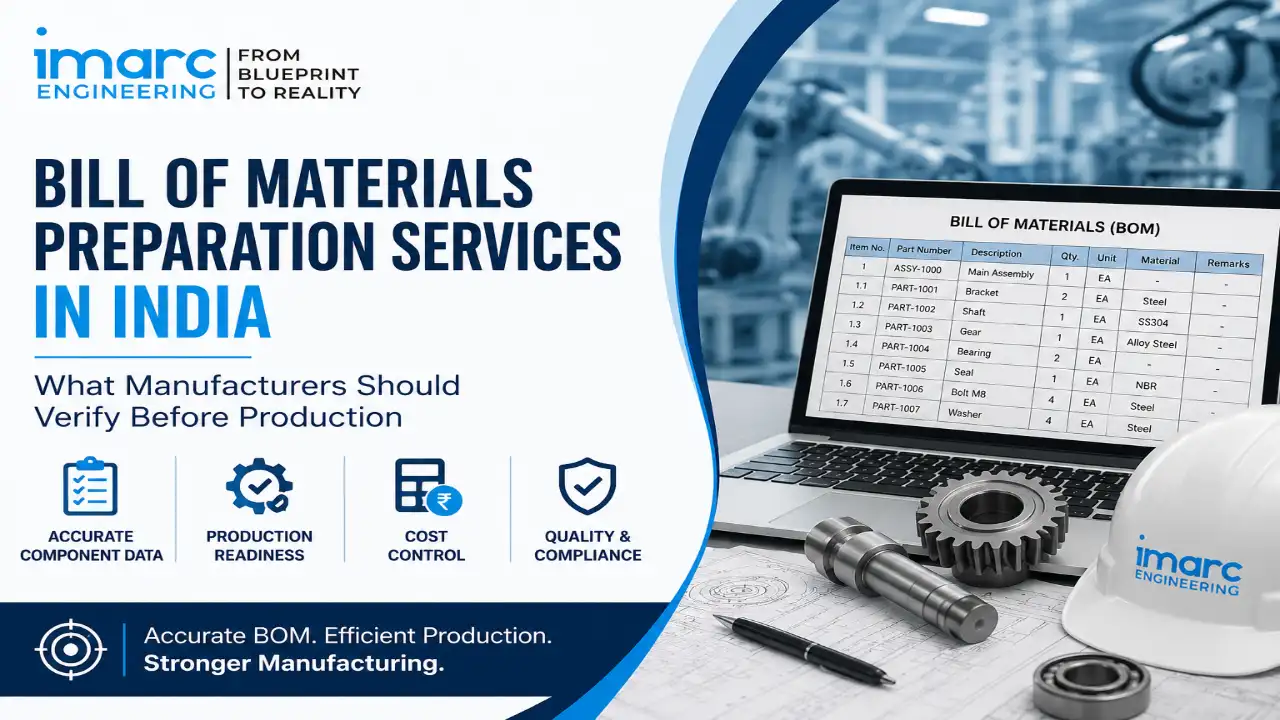
These errors are rarely visible in a spreadsheet review. They surface on the production floor, in a stockout, in a rejected batch, or in a regulatory audit that asks for traceability the BOM was never built to support. This is why Bill of Materials Preparation Services in India are becoming increasingly important for manufacturers seeking production-ready documentation that supports procurement accuracy, cost control, compliance, and efficient shop-floor execution.
“IMARC Engineering prepares Bills of Materials for manufacturers, project developers, and industrial operators setting up new production lines or formalising existing ones across India. This article explains what a production-ready BOM needs to contain, the verification points that protect manufacturers before production begins, and why BOM preparation is an engineering discipline, not a data-entry task.”
Contact Us: https://www.imarcengineering.com/contact?service=bill-of-materials-preparation
Why BOM Accuracy Is Becoming Critical for Manufacturers in India in 2026
As Indian manufacturing scales across sectors, the cost of an inaccurate Bill of Materials is rising in step with production volume and regulatory scrutiny.
Manufacturing Growth Is Outpacing Manual BOM Practices
Manufacturing value added grew 9.1% in Q2 FY2025‑26, per MOSPI’s quarterly GDP estimates, and the sector now contributes close to 17% of India’s Gross Value Added. As production volumes rise, manufacturers still managing BOMs on spreadsheets are exposed to data fragmentation between engineering, procurement, and the shop floor the leading cause of material shortages and costly rework.
PLI-Linked Capacity Expansion
The Production Linked Incentive scheme carries a ₹1.97 lakh crore outlay across 14 sectors, with cumulative investment crossing ₹2.16 lakh crore and 836 applications approved as of December 2025, per PIB. Every PLI-backed capacity expansion requires a validated BOM to support cost claims, component sourcing disclosures, and production audits.
China+1 Diversification Raising Documentation Standards
Global OEMs shifting production to India under China+1 diversification expect engineering documentation including multi-level BOMs that matches the standards of their existing supply base. A BOM built loosely for a domestic buyer rarely satisfies a global OEM’s supplier qualification process.
Export Growth and Traceability Requirements
Combined goods and services exports touched a record US$863 billion in FY2025‑26, per the Ministry of Commerce and Industry. Pharmaceutical exports reached US$30.47 billion in FY2025, with India supplying 57% of WHO-prequalified APIs globally a sector where BOM-linked batch traceability is a regulatory requirement, not a convenience.
Sector-Specific Complexity
- Auto components: industry turnover of US$80.2 billion in FY2025, with multi-level BOMs needed to support PPAP and IATF 16949 documentation
- Electronics: exports rose 32.46% in FY2025 to ₹3,31,904 crore, with BOM accuracy directly affecting SMT line changeover and component obsolescence management
- Pharmaceuticals and medical devices: BOM-linked batch records are foundational to GMP and ISO 13485 traceability obligations
ERP Adoption Is Accelerating, but Migration Errors Are Common
As more Indian manufacturers move from spreadsheets to ERP systems such as SAP, Oracle, and Tally-integrated platforms, BOM data migration has become a common failure point inconsistent units of measure, duplicate part numbers, and broken parent-child links frequently surface only after go-live.
The opportunity to scale is real. The risk is treating the BOM as a formality rather than the document every downstream function procurement, production, costing, and compliance actually runs on.
Why an Inaccurate BOM Creates Risk That Is Difficult to Reverse
Most BOM failures are not caused by a single dramatic error. They accumulate from narrow data entry, missing engineering-to-procurement handoff, and a lack of structured validation before the BOM is released to production. As manufacturing complexity increases, Bill of Materials Preparation Services in India are becoming essential for manufacturers seeking production-ready BOMs that support accurate procurement, efficient planning, regulatory compliance, and reliable shop-floor execution.
The categories of risk that surface once an inaccurate BOM reaches the shop floor:
- Production stoppages: A missing component or wrong quantity halts a work order mid-run, with the cost of idle labour and machine time compounding by the hour.
- Procurement misalignment: Incomplete specifications lead buyers to order the wrong grade, tolerance, or substitute material, creating quality failures that surface only at assembly or in the field.
- Costing errors: A BOM that does not reflect actual material consumption produces unreliable standard costs, distorting pricing decisions and margin analysis.
- Inventory distortion: Inaccurate BOM-driven MRP calculations cause simultaneous stockouts of critical items and excess inventory of items the BOM overstates.
- Compliance and traceability gaps: In regulated sectors, an incomplete BOM cannot support batch traceability, technical file submissions, or supplier qualification audits.
- Engineering change chaos: Without version control, a design change update reaches production, procurement, and costing teams at different times, with each function working from a different reality.
Structured BOM preparation prevents these outcomes by validating every component, quantity, specification, and structural link before the BOM is released not after the first production run exposes the gap.
Key Criteria for BOM Preparation in India
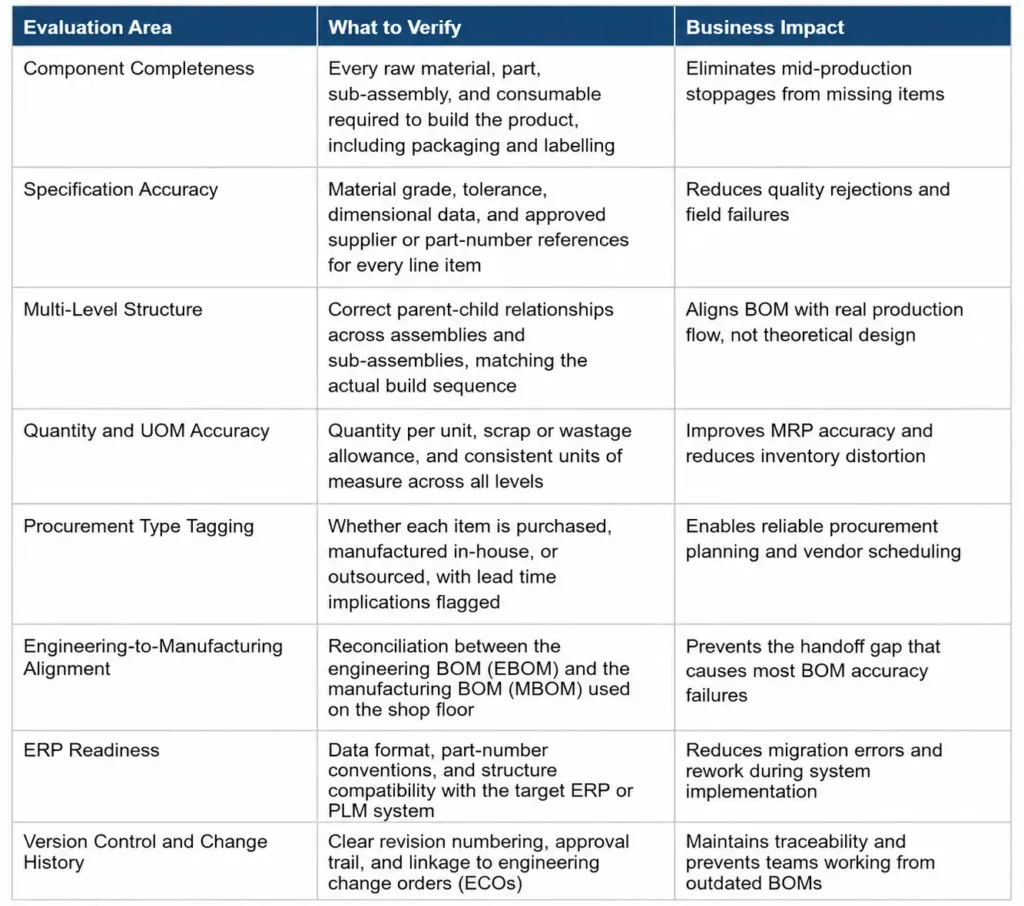
A production-ready BOM is built across six interconnected dimensions. A gap in any one of them undermines the reliability of the entire document.
1. Component Completeness
- Every raw material, purchased part, manufactured component, sub-assembly, and consumable required to build one unit of the finished product
- Packaging materials, labels, and any item consumed during assembly but not visible in the final product
- Spare and service components where the product requires after-sales support
A BOM that excludes consumables or packaging looks complete on review and fails the moment procurement places an order against it.
2. Specification Accuracy
- Material grade, dimensional tolerance, and finish specified against an approved standard, not a generic description
- Approved supplier and part-number references, including approved alternates
- Drawing or revision references linking each line item back to its engineering source
Specification accuracy is verifiable against engineering drawings and approved vendor lists. The only failure mode is not checking.
3. Multi-Level Structure
- Correct parent-child relationships across assemblies, sub-assemblies, and components
- Structure that reflects the actual build sequence used on the shop floor, not a simplified theoretical hierarchy
- Phantom assemblies correctly flagged where components are consumed directly without separate inventory tracking
A flat or shallow BOM structure for a complex assembly is a common shortcut that breaks down the moment production scales.
4. Quantity and Unit of Measure Accuracy
- Quantity per unit calculated against actual consumption, including realistic scrap and wastage allowances
- Consistent units of measure across every level of the BOM and across the ERP system it feeds
- Quantity validation against a sample or pilot production run wherever possible
Quantity errors are the most common driver of MRP-generated stockouts and excess inventory, because the planning system is only as accurate as the BOM behind it.
5. Procurement Type and Sourcing Classification
- Each item classified as purchased, manufactured in-house, or outsourced
- Lead time and minimum order quantity flagged for long-lead or single-source items
- Make-versus-buy logic documented where sourcing decisions affect cost or capacity
Procurement type tagging is what allows an ERP system to generate purchase orders, work orders, and subcontract orders correctly from a single BOM.
6. Engineering-to-Manufacturing Alignment and Version Control
- Reconciliation between the Engineering BOM (EBOM) and the Manufacturing BOM (MBOM), since they rarely match by default
- A documented revision history with each change linked to an engineering change order or approval record
- A single source of truth that production, procurement, and costing teams all reference, rather than parallel versions in different systems
How IMARC Engineering Prepares Bills of Materials in India
IMARC Engineering’s BOM preparation process is built around verified component data and structural validation at every level replacing ad-hoc spreadsheet entries with an engineering-reviewed, production-ready document.
- Component listing and take-off: Extracting every raw material, part, sub-assembly, and consumable from engineering drawings, specifications, and product designs.
- Multi-level structuring: Building the parent-child hierarchy that matches the actual assembly sequence, including phantom assemblies where applicable.
- Specification mapping: Verifying material grade, tolerance, and approved supplier references for every line item against engineering and quality requirements.
- Quantity validation: Confirming quantity-per-unit, scrap allowances, and unit-of-measure consistency, validated against pilot or trial production data where available.
- EBOM-to-MBOM reconciliation: Aligning the design-stage BOM with the version that production, procurement, and costing teams will actually use.
- ERP and PLM integration support: Structuring BOM data to match the target system’s part-numbering conventions, fields, and import requirements to reduce migration errors.
- Documentation for cost and compliance: Structured BOM documentation to support cost estimation, regulatory technical files, and supplier qualification audits where required.
IMARC Engineering prepares BOMs across pharmaceuticals, food processing, chemicals, FMCG, electronics, medical devices, automotive components, and general engineering manufacturing sectors where component complexity, regulatory documentation, and traceability requirements differ significantly, and where a generic BOM template is rarely sufficient.
Contact IMARC Engineering’s team for Bill of Materials preparation support across India.
→https://www.imarcengineering.com/contact?service=bill-of-materials-preparation
Common Mistakes in BOM Preparation
- Treating the BOM as a one-time document: A BOM that is not updated through engineering change orders quickly diverges from what is actually being built, and production ends up working from an outdated version.
- Copying the engineering BOM directly into manufacturing: The EBOM describes design intent. Without reconciliation, the MBOM inherits gaps that only surface on the shop floor.
- Skipping quantity validation against real production: Theoretical quantity calculations without a pilot run check consistently understate scrap and wastage, distorting both costing and material planning.
- Inconsistent units of measure: Mixing units across levels or systems is one of the most common causes of MRP miscalculation and silently wrong purchase quantities.
- Omitting packaging and consumables: A BOM that stops at the physical product misses the materials procurement still needs to order before the product can ship.
- No version control or change history: Without a clear revision trail, teams cannot tell which BOM version is current, leading to production runs against superseded specifications.
Conclusion
India’s manufacturing base is scaling quickly across regulated and high-volume sectors alike, and the documents that connect engineering intent to shop-floor execution are under growing scrutiny from customers, regulators, and ERP systems that depend on clean data.
Component completeness, specification accuracy, multi-level structuring, quantity validation, procurement classification, and version control all determine whether a Bill of Materials functions as a reliable operating document or becomes a recurring source of production delay and cost distortion.
Through component take-off, multi-level structuring, specification mapping, quantity validation, and ERP-ready documentation, IMARC Engineering helps manufacturers build Bills of Materials that hold up under production volume, procurement scrutiny, and regulatory review across India.
Contact Us:
IMARC Engineering
Phone: +91-120-433-0800
Email: sales@imarcengineering.com
India: C-130, Sector 2, Noida, Uttar Pradesh 201301
LinkedIn: https://www.linkedin.com/showcase/imarc-engineering/
About the Author