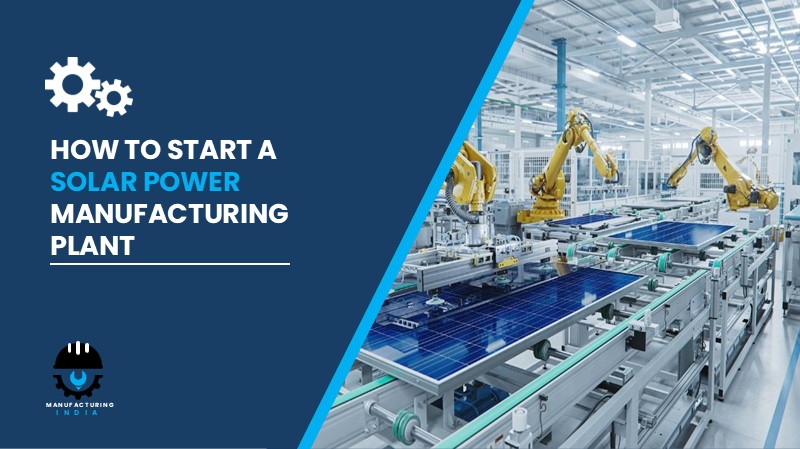
Setting up a solar power manufacturing plant in India presents a compelling investment case driven by the rising demand for clean and sustainable energy sources, as governments and corporations adopt renewable energy solutions at unprecedented scale. Solar power – energy harnessed from the sun’s radiation and converted into electricity using solar panels or photovoltaic (PV) systems – is a renewable, clean, and sustainable source of energy that has become a key component in reducing reliance on fossil fuels and mitigating environmental impacts such as climate change. India sits at the very heart of the global solar energy expansion: according to the Ministry of New and Renewable Energy (MNRE), India added a record 44.5 GW of renewable energy capacity in 2025, with solar power driving the dominant share of this addition – a domestic deployment pace that is creating exceptional and policy-backed demand for domestically manufactured solar modules, cells, and associated components at industrial scale.
India’s structural advantages make this investment strategically compelling. The Asia-Pacific region, led by China and India, is expected to remain the dominant player in the global solar power market, while North America and Europe continue to focus on large-scale solar installations and grid integration. India’s combination of government incentives, renewable energy mandates, a 500 GW non-fossil fuel target by 2030, and rapidly falling solar installation costs has created one of the world’s most active and commercially validated solar module procurement markets – directly supporting the commercial viability of new domestic manufacturing capacity. The global solar power market was valued at USD 170.23 billion in 2025 and is expected to reach USD 468.28 billion by 2034, exhibiting a CAGR of 11.9% from 2026 to 2034 according to IMARC Group estimates – positioning a domestic solar power manufacturing plant in India at the intersection of one of the fastest-growing global energy markets and one of the world’s most ambitious renewable energy deployment programmes.
India’s record 44.5 GW renewable energy addition in 2025 per MNRE, Asia-Pacific’s dominance in the global solar market, and a global solar power market growing from USD 170.23 billion in 2025 to USD 468.28 billion by 2034 make a solar power manufacturing plant a high-growth, policy-backed, and financially well-supported industrial investment. With gross margins of 10–20% and net margins of 4–10% across a 500 MW annual module capacity, the project delivers consistent returns anchored by India’s world-scale renewable energy deployment pipeline.
What is Solar Power?
Solar power is the energy harnessed from the sun’s radiation, which is converted into electricity using solar panels or photovoltaic (PV) systems. The energy is collected by solar cells that convert sunlight directly into electrical energy. Solar power is a renewable, clean, and sustainable source of energy, making it a key component in reducing reliance on fossil fuels and mitigating environmental impacts, such as climate change.
Solar power manufacturing encompasses the complete production chain from silicon wafer processing and solar cell fabrication through module assembly, quality testing, and packaging – producing the photovoltaic panels that convert sunlight into electricity across residential rooftops, commercial installations, utility-scale solar farms, and off-grid applications. The integration of solar power across construction, automotive, residential, commercial, and utility-scale power generation makes it one of the most broadly applicable and institutionally supported energy technologies in the world today.
The primary production method is solar cell manufacturing, module assembly, quality testing, and packaging – supported by ingot casting, wire sawing, texturing and doping, screen printing, tabbing and stringing, laminating, framing, and simulation testing at each key manufacturing stage. End-use industries served include renewable energy, construction, automotive, residential, commercial, and utility-scale power generation.
Cost of Setting Up a Solar Power Manufacturing Plant in India
The cost of establishing this facility depends on capacity, technology selection, plant location, degree of automation, and regulatory compliance requirements.
1. Capital Expenditure (CapEx)
Total capital investment for a solar power manufacturing plant in India covers land acquisition, site preparation, civil construction, machinery, and pre-operative expenses. The cost of land and site development – including charges for land registration, boundary development, and other related expenses – forms a substantial part of the overall investment. This allocation ensures a solid foundation for safe and efficient plant operations. Investors can reduce land acquisition costs by locating the unit in an electronics manufacturing cluster, solar manufacturing SEZ, or Special Economic Zone (SEZ), which also provide shared utility infrastructure and potential state-level fiscal incentives aligned with India’s solar manufacturing push under the PLI scheme for solar PV modules.
Civil works and construction encompass the main solar cell fabrication and module assembly production building – which requires cleanroom-adjacent standards for cell processing and controlled humidity for lamination – raw material storage areas for solar cells, EVA encapsulant sheets, tempered glass, backsheet, and aluminium frames, a quality control laboratory, a finished goods warehouse, and an administrative block.
Machinery costs account for the largest portion of total capital expenditure. Key machinery required includes:
- Ingot casters
- Wire saws
- Texturing and doping lines
- Screen printers
- Tabber-stringers
- Laminators
- Module framers
- Testing and simulation stations
- Packaging systems
Other capital costs include the effluent treatment plant (ETP), advanced process monitoring systems, pre-operative expenses, trial production costs, and commissioning charges. All machinery must be high-quality and corrosion-resistant, tailored for solar power production, and must comply with industry standards for safety, efficiency, and reliability.
Request a Sample Report for In-Depth Market Insights: https://www.imarcgroup.com/solar-power-plant-manufacturing-plant-project-report/requestsample
2. Operational Expenditure (OpEx)
The operating cost structure of a solar power manufacturing plant is primarily driven by raw material consumption, particularly solar cells, which account for approximately 85–90% of total operating expenses (OpEx) – reflecting the high intrinsic cost of precision-engineered photovoltaic cell inputs relative to the module assembly value chain. EVA encapsulant sheets, tempered glass, backsheet, and aluminium frames are the secondary raw material inputs. Securing long-term supply agreements with reliable solar cell producers and component suppliers is essential to mitigate price volatility and ensure consistent production quality. Long-term contracts should be negotiated to stabilise pricing and ensure a steady supply throughout production cycles.
Utility costs – comprising electricity for ingot casters, texturing and doping lines, screen printers, laminators, and testing and simulation stations, as well as water – account for 5–8% of total OpEx. Other ongoing operating costs include transportation, packaging, salaries and wages, depreciation, taxes, equipment repairs and maintenance, and other miscellaneous expenses.
In the first year of operations, the operating cost for the solar power manufacturing plant is projected to be significant, covering raw materials, utilities, depreciation, taxes, packing, transportation, and repairs and maintenance. By the fifth year, the total operational cost is expected to increase substantially due to factors such as inflation, market fluctuations, and potential rises in the cost of key materials. Additional factors, including supply chain disruptions, rising consumer demand, and shifts in the global economy, are expected to contribute to this increase.
3. Plant Capacity
The proposed manufacturing facility is designed with an annual production capacity of 500 MW modules, enabling economies of scale while maintaining operational flexibility. Capacity can be customised per investor requirements based on target utility, commercial, residential, or export market segments, available capital, and chosen cell technology – mono PERC, TOPCon, HJT, or standard polycrystalline. Profitability improves materially with higher capacity utilisation, making domestic off-take agreements with EPC contractors, government solar procurement agencies, and commercial rooftop solar installers a commercial priority from the commissioning stage.
4. Profit Margins and Financial Projections
The project demonstrates consistent profitability potential under normal operating conditions. Gross profit margins typically range between 10–20%, supported by stable demand and the structural scale of India’s solar power deployment pipeline. Net profit margins range between 4–10%. A comprehensive financial model covering NPV (net present value), IRR (internal rate of return), payback period, liquidity analysis, uncertainty analysis, sensitivity analysis, and a full five-year profit and loss account provides investors with a rigorous analytical framework for assessing financial viability and long-term sustainability across different capacity and pricing scenarios.
Why Set Up a Solar Power Plant in India?
India’s Record Renewable Energy Capacity Addition Driving Module Demand. According to the Ministry of New and Renewable Energy, India added a record 44.5 GW of renewable energy capacity in 2025, with solar power driving the dominant share of this addition. This unprecedented pace of solar deployment creates a large and government-backed domestic procurement market for solar modules – making India one of the world’s most commercially compelling destinations for solar manufacturing capacity investment, where government deployment targets and domestic content requirements provide sustained and visible demand visibility for domestic producers.
Exceptional Global Market Growth at 11.9% CAGR. The global solar power market was valued at USD 170.23 billion in 2025 and is projected to reach USD 468.28 billion by 2034, growing at a CAGR of 11.9% from 2026 to 2034 according to IMARC Group estimates – one of the fastest growth rates across all energy and manufacturing sectors globally. This exceptional trajectory reflects the accelerating global transition to clean energy and the structural shift away from fossil fuels that is being driven by government policy, corporate net-zero commitments, and falling solar technology costs worldwide.
Government Policies and Incentives Creating Direct Financial Support. Policies such as tax incentives, subsidies, and renewable energy mandates are significantly enhancing the attractiveness of solar power projects. India’s PLI (Production Linked Incentive) scheme for high-efficiency solar PV modules and the domestic content requirement (DCR) framework for government solar procurement directly support investment in domestic solar manufacturing capacity – reducing effective capital cost and improving project IRR for qualifying Indian solar module producers.
Asia-Pacific Dominance Positioning India as a Manufacturing Hub. The Asia-Pacific region, led by China and India, is expected to remain the dominant player in the global solar power market. With governments and private organisations investing heavily in green technologies, demand for solar panels is poised to continue growing, especially in markets like India. India’s combination of competitive manufacturing cost base, growing technical skill pool, and world-scale domestic procurement market creates a strong foundation for becoming a globally significant solar module exporter as well as a domestic supply leader.
Global Megatrends of Electrification and Decarbonisation Sustaining Long-Term Demand. The move towards electrification, energy independence, and decarbonisation is fuelling growth in the solar industry across residential, commercial, and utility-scale applications. Solar energy’s ability to reduce carbon footprints and provide cost-effective energy solutions is attracting investments in both residential and commercial sectors, creating an expanding and diversified demand base across all end-use segments that ensures long-term procurement volume for domestic solar module manufacturers.
Active India-Specific Industry Developments Confirming Manufacturing Momentum. In February 2025, Vikram Solar Limited successfully increased its manufacturing capacity with a 1 GW expansion at its Falta facility in West Bengal, while also upgrading manufacturing lines at its Oragadam facility in Chennai, Tamil Nadu, to produce more efficient technology modules including TOPCon and HJT – boosting Vikram Solar’s annual nameplate production capacity to 4.5 GW and marking a significant step forward in the company’s growth trajectory within the renewable energy sector. In September 2024, TP Solar Ltd. announced the commencement of commercial production from the 2 GW solar cell line at its state-of-the-art manufacturing facility in Tirunelveli, Tamil Nadu – the country’s largest single-location solar cell and module plant – confirming the scale and pace of active investment in domestic solar manufacturing capacity across India.
Manufacturing Process – Step by Step
The solar power manufacturing process uses solar cell manufacturing, module assembly, quality testing, and packaging as the primary production method. Each stage is precision-controlled to ensure photovoltaic conversion efficiency, module structural integrity, and full compliance with the international performance and safety standards required by utility, commercial, and residential solar installation customers.
- Raw Material Receipt and Inspection: Solar cells, EVA encapsulant sheets, tempered glass, backsheet, and aluminium frames are received at the facility and subjected to incoming quality checks for cell efficiency binning, encapsulant specification, glass strength, and dimensional compliance before entering the production line.
- Ingot Casting: Silicon feedstock is melted and solidified in ingot casters to produce monocrystalline or multicrystalline silicon ingots of the required crystalline structure, dimensions, and electrical grade for the target solar cell specification.
- Wire Sawing: Silicon ingots are sliced into thin wafers using wire saws with diamond wire or abrasive slurry, producing silicon wafers of the required thickness, flatness, and surface finish for cell processing.
- Texturing and Doping: Silicon wafers are processed through texturing and doping lines where surface texturing improves light trapping, and controlled dopant diffusion creates the p-n junction essential for photovoltaic current generation.
- Screen Printing: Metallic contacts – silver front grid lines and aluminium rear contact – are applied to the textured and doped wafers using screen printers, with precise contact geometry controlling series resistance and fill factor.
- Cell Testing and Sorting: Processed solar cells are tested under standard test conditions (STC) and sorted into efficiency bins for matched module assembly, ensuring consistent power output and performance rating across each finished module.
- Tabbing and Stringing: Sorted solar cells are interconnected in series strings using tabber-stringers that solder copper ribbon busbars to each cell’s contact grid, building the electrical interconnection structure of the module.
- Lamination: Cell strings, EVA encapsulant sheets, tempered glass, and backsheet are assembled in the correct layered sequence and processed through laminators at elevated temperature and pressure to produce a void-free, weather-sealed module laminate.
- Module Framing: Laminated modules are fitted with aluminium frames using module framers to provide the structural rigidity, mechanical protection, and installation mounting points required for field deployment.
- Testing and Simulation: Finished modules are evaluated on testing and simulation stations – including electroluminescence imaging, flash testing under simulated sunlight, and insulation resistance testing – to verify rated power output, efficiency, and electrical safety before release for packaging.
- Packaging and Dispatch: Approved solar modules are packaged using packaging systems and dispatched to end-use customers across renewable energy project developers, EPC contractors, commercial rooftop installers, and residential solar distribution channels.
Key Applications
The solar power manufacturing plant serves a diverse and commercially significant range of end-use sectors across India’s energy and infrastructure economy.
- Solar Panel Manufacturing: Interconnections between solar cells, busbars, and module wiring – forming the core photovoltaic assembly that converts sunlight to electricity across all installation categories.
- Inverter and Power Electronics: DC/AC connections, grounding components, and internal wiring for solar inverters and power conditioning equipment integrated into solar energy systems.
- Energy Storage Systems: Battery interconnects, grounding straps, and flexible connectors for solar batteries – serving the growing hybrid solar-plus-storage project market driven by India’s grid stability and renewable integration requirements.
- Solar Power Infrastructure: Grounding, bonding jumpers, and flexible conductors for mounting systems and power distribution in utility-scale solar farms, commercial rooftop systems, and residential installations.
- Utility-Scale Power Generation: Large-scale solar module supply to ground-mounted solar parks and grid-connected utility projects – India’s largest volume procurement channel for domestic solar module manufacturers.
- Residential and Commercial Rooftop Solar: Module supply for rooftop solar installations across residential housing, commercial buildings, and industrial facilities – a fast-growing distributed generation segment supported by net metering regulations and government subsidies.
Leading Manufacturers
The global solar power manufacturing industry is served by several established multinational manufacturers with extensive production capacities and diverse application portfolios. Key players operating in this market include:
- First Solar
- Trina Solar
- JinkoSolar
- Canadian Solar
- LONGi Green Energy
All of these manufacturers serve end-use sectors including renewable energy, construction, automotive, residential, commercial, and utility-scale power generation – the same markets that a domestic Indian solar power manufacturing plant can target, alongside the growing number of Indian solar manufacturers including Vikram Solar and TP Solar who are actively expanding domestic production capacity.
Timeline to Start the Plant
Investors should plan for a structured pre-production and commissioning phase covering the following key stages:
- Feasibility study and project report preparation
- Land acquisition and site development
- Regulatory approvals and environmental clearances
- Factory licence and fire safety compliance
- Machinery procurement and installation
- Raw material supplier agreements and supply chain setup
- Trial production and quality testing
- Commercial production launch
Licences and Regulatory Requirements
Starting a solar power manufacturing unit in India requires several approvals:
- Business registration (Proprietorship, LLP, or Private Limited Company)
- Factory Licence under the Factories Act
- Environmental Clearance from the State Pollution Control Board
- GST Registration
- Fire Safety NOC
- BIS (Bureau of Indian Standards) product certification for solar PV modules under IS 14286 and related standards
- Effluent Treatment Plant (ETP) operational clearance
- Occupational Health and Safety compliance
Key Challenges to Consider
High Capital Requirements. Establishing a fully equipped solar power manufacturing plant – with ingot casters, wire saws, texturing and doping lines, screen printers, tabber-stringers, laminators, module framers, testing and simulation stations, and packaging systems – at 500 MW annual capacity requires significant upfront capital investment. Access to PLI scheme incentives for solar PV modules, MSME credit-linked subsidy schemes, and solar manufacturing SEZ infrastructure support can help manage this requirement.
Raw Material Price Volatility. Solar cells – accounting for 85–90% of total OpEx – are directly linked to global polysilicon and wafer pricing cycles, which can be highly volatile and subject to supply concentration risks. EVA encapsulant and tempered glass prices are similarly subject to petrochemical and energy cost movements. Long-term procurement contracts with reliable solar cell and component suppliers, and diversified sourcing strategies, are the primary risk mitigation measures for managing this dominant cost driver.
Technology Evolution Pressure. The global solar market is rapidly transitioning from standard PERC cells to higher-efficiency TOPCon and HJT technologies – as demonstrated by Vikram Solar’s February 2025 upgrade of its Oragadam facility to TOPCon and HJT manufacturing capability. Domestic manufacturers must plan their technology selection and capex programmes to remain competitive with the evolving efficiency benchmarks that project developers and government procurement specifications increasingly require.
Regulatory Compliance. Solar power manufacturing facilities must comply with BIS product certification for solar PV modules, factory safety norms, and environmental compliance for chemical effluents from cell texturing and doping operations. Effluent treatment systems for chemical process wastewater and advanced monitoring systems for process deviations are mandatory environmental compliance requirements throughout operations.
Competition from Global and Domestic Players. Established global manufacturers – First Solar, Trina Solar, JinkoSolar, Canadian Solar, and LONGi Green Energy – set high efficiency benchmarks, low cost structures, and strong track records that influence project developer procurement decisions. Domestic Indian manufacturers including Vikram Solar (4.5 GW nameplate capacity) and TP Solar (2 GW solar cell line in Tamil Nadu) are also expanding aggressively, requiring new entrants to compete through technology selection, PLI scheme qualification, and efficient cost management.
Skilled Manpower. Operating ingot casters, wire saws, texturing and doping lines, screen printers, and high-precision lamination and testing equipment in a solar module manufacturing environment requires trained semiconductor process technicians, quality engineers, and equipment maintenance specialists. Recruiting, training, and retaining qualified technical staff – particularly for cell efficiency optimisation and module quality testing – is a recurring operational challenge in India’s growing solar manufacturing sector.
Frequently Asked Questions
1. How much does it cost to set up a solar power manufacturing plant in India?
Total setup cost depends on plant capacity, technology selection (PERC, TOPCon, or HJT cell technology), location, and automation level. Key cost components include land and site development, civil construction with cleanroom-adjacent production areas, machinery (ingot casters, wire saws, texturing and doping lines, screen printers, tabber-stringers, laminators, module framers, testing and simulation stations, packaging systems), and pre-operative expenses. A detailed feasibility study is recommended to generate accurate project-specific cost estimates.
2. Is solar power manufacturing profitable in India in 2026?
Yes. The project delivers consistent financial performance, with gross margins of 10–20% and net profit margins of 4–10% under normal operating conditions. The global solar power market is projected to grow from USD 170.23 billion in 2025 to USD 468.28 billion by 2034 at a CAGR of 11.9% according to IMARC Group, and India’s record 44.5 GW renewable energy capacity addition in 2025 per MNRE confirms the scale of domestic module procurement demand that supports new manufacturing investment.
3. What machinery is required for a solar power manufacturing plant in India?
Essential equipment includes ingot casters, wire saws, texturing and doping lines, screen printers, tabber-stringers, laminators, module framers, testing and simulation stations, and packaging systems.
4. What licences and approvals are required to start a solar power manufacturing plant in India?
Required approvals include business registration, Factory Licence, Environmental Clearance from the State Pollution Control Board, GST Registration, Fire Safety NOC, BIS product certification for solar PV modules, ETP operational clearance, and Occupational Health and Safety compliance.
5. What raw materials are needed for solar power manufacturing?
The primary raw materials are solar cells, EVA encapsulant sheets, tempered glass, backsheet, and aluminium frames. Solar cells are the dominant cost driver, accounting for 85–90% of total operating expenses, and must be sourced from suppliers meeting the efficiency binning and electrical specification requirements of the target module power rating.
6. What are the environmental compliance requirements for a solar power manufacturing plant in India?
The facility must obtain Environmental Clearance from the State Pollution Control Board, operate an approved ETP for chemical process wastewater from cell texturing and doping operations, and install advanced monitoring systems to detect leaks or deviations in the manufacturing process. Regular effluent monitoring and compliance documentation are mandatory throughout operations.
7. What is the best location to set up a solar power manufacturing plant in India?
The location must offer easy access to key raw materials such as solar cells, EVA encapsulant sheets, tempered glass, backsheet, and aluminium frames, while proximity to target markets minimises distribution costs. Tamil Nadu – home to TP Solar’s 2 GW Tirunelveli plant – West Bengal (Vikram Solar’s Falta facility), Gujarat, and Rajasthan offer established solar manufacturing ecosystems, skilled technical labour, and proximity to major solar project development corridors.
8. What is the break-even period for this type of plant in India?
The break-even period depends on plant capacity, total capital investment, module selling price, and capacity utilisation rate. PLI scheme incentives, government procurement off-take agreements, and export opportunities to international solar markets can accelerate the break-even timeline. A comprehensive financial analysis covering NPV, IRR, payback period, and uncertainty and sensitivity analysis is the most reliable method for project-specific break-even estimation.
9. What government incentives are available for manufacturers in India?
Solar power manufacturers in India can access the Production Linked Incentive (PLI) scheme for high-efficiency solar PV modules, which provides per-watt financial incentives for qualifying domestic manufacturers. Additional incentives include domestic content requirements (DCR) in government solar procurement that favour Indian-made modules, MNRE renewable energy manufacturing development programmes, MSME credit-linked capital subsidy schemes, and solar manufacturing SEZ benefits offering customs duty exemptions on imported capital equipment.
Key Takeaways for Investors
A solar power manufacturing plant in India offers a high-growth and deeply policy-supported investment opportunity anchored by the country’s record-breaking renewable energy deployment pace – with 44.5 GW added in 2025 alone per MNRE – and the government’s ambitious 500 GW non-fossil fuel target by 2030 that ensures a large and visible domestic procurement pipeline for solar modules over the coming decade. The project delivers consistent financial performance across a 500 MW annual module production capacity, with gross margins of 10–20% and net margins of 4–10% supported by the scale economics and PLI scheme incentives available to qualifying domestic manufacturers. According to IMARC Group estimates, the global solar power market is set to grow from USD 170.23 billion in 2025 to USD 468.28 billion by 2034 at a CAGR of 11.9% – one of the highest sectoral growth rates in the global manufacturing landscape – with Asia-Pacific led by India positioned at the centre of this expansion. With active domestic manufacturing capacity scale-up confirmed by Vikram Solar’s 4.5 GW nameplate milestone in February 2025 and TP Solar’s 2 GW solar cell line launch in Tamil Nadu in September 2024, the long-term demand sustainability for domestically produced solar power modules is structurally sound across all investment planning horizons.
About the Author