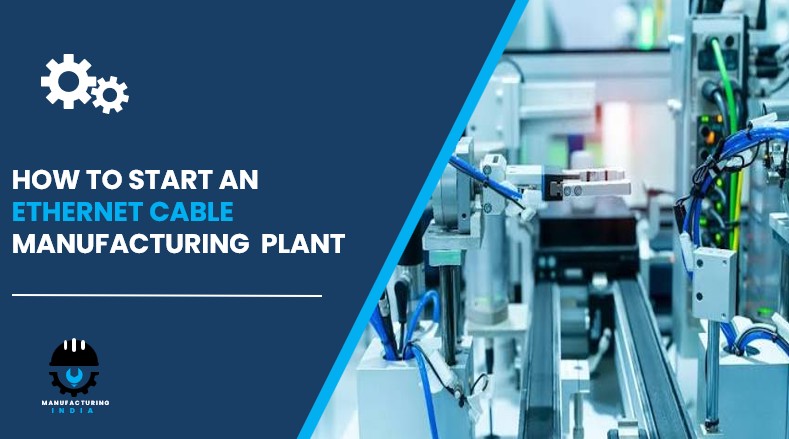
Setting up an ethernet cable manufacturing plant in India represents a highly attractive investment opportunity driven by the global surge in digital infrastructure deployment, rapid data center expansion, rising broadband penetration, 5G network rollout, and accelerating enterprise and industrial automation. Ethernet cables spanning Cat5e, Cat6, Cat6a, Cat7, and Cat8 variants form the foundational physical layer of virtually every contemporary communication network, from residential broadband and enterprise IT systems to hyperscale data centers and industrial IoT installations. As connectivity becomes an essential infrastructure service globally, and as bandwidth demand scales with cloud computing, video streaming, remote work, and smart city deployment, Ethernet cables occupy an indispensable and structurally expanding position in the global networking supply chain. This growth trajectory, combined with diversified demand across telecommunications, IT, construction, industrial automation, and government infrastructure, creates a highly favourable manufacturing environment for new entrants with robust quality systems and competitive cost structures.
What is Ethernet Cable?
Ethernet cables are networking cables that establish wired connections between devices such as computers, routers, network switches, servers, and access points, enabling high-speed data transmission across local area networks (LAN) and wide area networks (WAN). They transmit data through twisted pairs of insulated copper conductors in copper-based variants, or through fibre-optic strands in fibre ethernet configurations, with the twisted pair design specifically engineered to minimise electromagnetic interference (EMI) and crosstalk between adjacent conductor pairs.
The most widely deployed Ethernet cable categories include Cat5e (supporting up to 1 Gbps at 100 MHz), Cat6 (up to 1 Gbps at 250 MHz with reduced crosstalk), Cat6a (up to 10 Gbps at 500 MHz), Cat7 (up to 10 Gbps at 600 MHz with individual pair shielding), and Cat8 (up to 40 Gbps at 2000 MHz for high-density data centre applications). Key performance parameters include bandwidth frequency, attenuation, near-end crosstalk (NEXT), alien crosstalk (ANEXT), return loss, and propagation delay characteristics, all regulated under TIA/EIA-568, ISO/IEC 11801, and applicable IEC/EN standards for structured cabling systems.
The global Ethernet cable market was valued at USD 38.55 Billion in 2025. According to IMARC Group estimates, the market is expected to reach USD 83.04 Billion by 2034, exhibiting a CAGR of 8.9% from 2026 to 2034, driven by data center proliferation, 5G infrastructure deployment, enterprise digital transformation, and smart building and smart city development globally.
Cost of Setting Up an Ethernet Cable Manufacturing Plant
The total capital investment required to establish an Ethernet cable manufacturing plant is shaped by several key parameters: annual production capacity (measured in kilometres of cable), product mix complexity (Cat5e and Cat6 commodity variants versus Cat6a, Cat7, and Cat8 high-performance variants), degree of manufacturing automation, facility specification, copper and raw material sourcing strategy, shielding and jacketing technology requirements, and applicable quality and regulatory compliance investments. Below is a structured breakdown of all major cost components.
1. Capital Expenditure (CapEx)
Total capital investment in an Ethernet cable manufacturing plant covers the following major heads:
Land and Site Development
This encompasses land acquisition or lease, site preparation, boundary development, utility connectivity, and logistics infrastructure. Site selection should prioritise proximity to copper wire rod suppliers, polymer resin (HDPE, LLDPE, PVC) distributors, and connector and hardware suppliers to minimise inbound logistics costs. Access to reliable high-capacity electrical power supply for wire drawing, annealing, and extrusion operations; strong road connectivity for both raw material inbound and finished goods outbound dispatch to distributor and OEM networks; and availability of a trained industrial workforce in wire and cable manufacturing are critical site selection factors. Compliance with industrial zoning regulations, electrical and cable manufacturing environmental standards, effluent and waste management frameworks, and fire safety regulations governing polymer processing must be assessed from project initiation.
Civil Works and Construction
Building costs cover the main production facility including wire drawing and annealing shop, insulation and jacket extrusion lines, pair twisting and cabling sections, shielding and armoring stations (for shielded and armoured cable variants), reel and drum winding areas, quality control and testing laboratory, raw material warehousing, finished goods storage and dispatch infrastructure, utility infrastructure including power distribution, compressed air, cooling water, and effluent treatment, and administrative and welfare block. Construction must comply with factory act requirements, electrical safety regulations, fire safety norms, and quality management system infrastructure standards for international cable certification compliance.
Machinery and Equipment
Machinery represents the single largest CapEx component. Key equipment required for an Ethernet cable manufacturing plant includes:
- Wire Drawing Machines: Multi-pass continuous wire drawing machines for reducing copper rod (typically 8 mm diameter) to fine conductor diameters (0.4–0.65 mm) required for Cat5e through Cat8 Ethernet cable specifications, with integrated lubrication, die monitoring, and automated take-up systems
- Annealing Equipment: Continuous annealing furnaces or inline annealing systems to restore conductor ductility and conductivity following cold-work hardening during wire drawing, achieving target resistivity and elongation specifications
- Insulation Extrusion Lines: High-speed precision extruders for applying polyethylene (PE), foamed polyethylene (FPE), or fluoropolymer (FEP/PTFE for high-performance Cat7/Cat8) primary insulation around individual conductors with precise diameter and concentricity control
- Pair Twisting Machines: High-speed bunching and pair twisting machines for twisting insulated conductor pairs to specified lay lengths a critical parameter for crosstalk performance across Ethernet categories
- Cabling and Stranding Machines: Multi-pair cabling machines for laying twisted pairs into the cable core with precise geometry for optimal electrical balance and crosstalk isolation, including separator and drain wire integration for shielded variants
- Shielding Application Equipment: Automated aluminium-polyester foil wrapping machines and braiding machines for applying individual pair shields (SFTP/SSTP configurations in Cat7/Cat8) and overall cable shields for electromagnetic interference protection
- Outer Jacket Extrusion Lines: High-speed jacket extrusion lines applying PVC, LLDPE, LSZH (Low Smoke Zero Halogen), or plenum-rated (CMP) jacket compounds over the complete cable assembly, with integrated spark testing and diameter monitoring
- Spark Testers: High-voltage spark testing equipment for 100% continuous insulation integrity testing during production to detect pinhole insulation defects before jacketing
- Electrical Test and Certification Equipment: Automated cable test systems for measuring attenuation, NEXT, FEXT, return loss, impedance, propagation delay, and DC resistance to TIA-568 and ISO/IEC 11801 specification requirements for each Ethernet category
- Drum and Reel Winding Machines: Automated cable winding machines for winding finished cable onto shipping reels, bulk drums, or patch cord lengths with precise metre counting and reel labelling
- Patch Cord Assembly Lines: Automated RJ-45 connector crimping, stripping, and termination equipment for converting bulk cable into finished patch cords and cross-connect cables
- Material Handling Systems: Overhead creel systems for copper wire supply to drawing machines, automated conveyor and reel transport systems, and FIFO-controlled finished goods warehousing
Other Capital Costs
These include pre-operative expenses, commissioning charges, import duties on specialised extrusion and wire drawing equipment, staff training and competency development for cable manufacturing operations, initial copper wire rod and polymer inventory for production commissioning, regulatory compliance setup including UL Listing, ETL certification, CE Marking (EU), and RoHS compliance, ISO 9001:2015 quality management system establishment, structured cabling system certification under TIA-568 and ISO/IEC 11801 for product category claims, and fire safety rating certifications (CMP, CMR, CM) for applicable North American markets.
Request a Sample Report for In-Depth Market Insights: https://www.imarcgroup.com/ethernet-cable-manufacturing-plant-project-report/requestsample
2. Operational Expenditure (OpEx)
Raw materials principally copper wire rod for conductor manufacturing and polymer compounds (PVC, HDPE, LLDPE, LSZH) for insulation and jacketing constitute the dominant operating cost, typically representing 75–85% of total OpEx, with copper alone accounting for the majority of this cost given its commodity price sensitivity and high-volume consumption. Utility costs, driven primarily by the substantial electrical energy consumption of wire drawing machines, annealing furnaces, and extrusion lines, account for 5–10% of OpEx. Labour, maintenance, quality testing consumables, connector and hardware procurement, reel and packaging materials, transportation logistics, and overhead costs constitute the remainder of the operating cost base.
3. Plant Capacity
The proposed Ethernet cable manufacturing facility is designed with an annual production capacity ranging between 100,000–500,000 kilometres of cable, enabling economies of scale while maintaining operational flexibility across product categories. This capacity range supports a diversified product portfolio spanning Cat5e, Cat6, Cat6a, Cat7, and Cat8 cables in bulk reel, patch cord, and armoured configurations serving residential, enterprise, data centre, industrial, and telecommunications end-use segments across domestic and export markets.
4. Profit Margins and Financial Projections
The project demonstrates strong profitability under normal operating conditions. Financial projections encompass capital investment, operating costs, capacity ramp-up schedule, product mix between commodity Cat5e/Cat6 and premium Cat6a/Cat7/Cat8 variants, and forward demand outlook underpinned by global data center expansion, 5G infrastructure rollout, and enterprise network modernisation. A comprehensive feasibility analysis includes sensitivity analysis, Net Present Value (NPV), Internal Rate of Return (IRR), and Payback Period calculations. Gross margins for Ethernet cable manufacturing typically range from 25–35%, supported by stable structural demand, improving product mix toward higher-value shielded and high-category cable variants, and the cost advantages of vertically integrated wire drawing from copper rod through to finished cable. Net profit margins of 12–20% are achievable with disciplined cost management, optimal capacity utilisation, and strong branded, OEM, or system integrator supply chain positioning.
Why Set Up an Ethernet Cable Manufacturing Plant?
Explosive Data Center and Cloud Infrastructure Expansion
The global hyperscale data center market is undergoing unprecedented structural expansion, driven by cloud computing platform growth from providers including AWS, Microsoft Azure, Google Cloud, and Alibaba Cloud, enterprise digital transformation initiatives, AI and machine learning workload hosting, and streaming content delivery network deployment. Each hyperscale data center facility requires millions of metres of structured cabling primarily Cat6a and Cat8 for high-density top-of-rack and row-level connectivity creating sustained, concentrated, and technically demanding demand for high-performance Ethernet cable. The shift to higher data rates within data centers (25G, 40G, 100G) is driving rapid adoption of Cat8 and high-performance Cat6a cabling that commands significantly higher average selling prices and gross margins than commodity residential Cat5e and Cat6 variants.
5G Network Deployment and Backhaul Infrastructure
The global deployment of 5G networks requires extensive fibre and Ethernet cable backhaul infrastructure to connect cell towers, small cells, and distributed antenna systems (DAS) to core network infrastructure. India alone had achieved over 99% district coverage with 5G by late 2025, with continued densification of small cell deployments in urban environments requiring structured cabling infrastructure for each small cell backhaul connection. The high-density small cell architecture of 5G networks requiring vastly more backhaul connection points than 4G macro-cell deployments creates structurally incremental demand for Ethernet cabling across telecommunications network deployments globally.
Enterprise Network Modernisation and Wi-Fi 6/7 Deployment
Enterprise organisations globally are upgrading their structured cabling infrastructure to support Wi-Fi 6 (802.11ax) and Wi-Fi 7 (802.11be) access point deployments, which require Cat6a or higher category cabling to support Multi-Gigabit (2.5G and 5G) PoE++ power delivery and backhaul bandwidth. Office building renovations, workplace technology upgrades, smart campus deployments, and hybrid work infrastructure investments are driving replacement of legacy Cat5e infrastructure with Cat6 and Cat6a cabling. Each enterprise network upgrade project represents a significant structured cabling volume demand event creating predictable, project-driven revenue opportunities for Ethernet cable manufacturers with established contractor and systems integrator distribution channels.
Smart Building and Smart City Infrastructure Development
Structured cabling systems are being specified as fundamental infrastructure components in modern commercial buildings, hospitals, educational institutions, airports, metro rail systems, and government facilities as part of integrated building management system (BMS), access control, IP surveillance, and smart building automation deployments. India’s smart city development programme, commercial real estate expansion, and infrastructure investment pipeline encompassing airports, metro rail, data centres, and healthcare facilities are creating sustained specification-driven demand for certified structured cabling systems meeting TIA-568 and ISO/IEC 11801 standards. Smart building requirements for Power over Ethernet (PoE) delivery for LED lighting, IP cameras, and IoT sensors are driving adoption of higher category cables capable of supporting the required power and data bandwidth simultaneously.
Industrial Automation and Industry 4.0 Connectivity
Manufacturing plants, process industries, and logistics and warehousing facilities implementing Industry 4.0 automation, robotics, machine vision, and real-time data acquisition systems require reliable, high-bandwidth, EMI-resistant network cabling infrastructure for machine-to-machine communication and operational technology (OT) network integration. Industrial Ethernet applications demand shielded cable variants (S/FTP, SF/UTP) with robust jacket compounds (LSZH, PVC, or polyurethane for flexible applications) capable of withstanding industrial environments with elevated temperature, chemical exposure, vibration, and mechanical stress. The accelerating adoption of Industrial IoT (IIoT) platforms and connected manufacturing systems across India and global emerging markets is creating structurally growing demand for industrial-grade shielded Ethernet cable.
Residential Broadband and Home Network Infrastructure
Rising broadband penetration, fibre-to-the-home (FTTH) and fibre-to-the-building (FTTB) deployments, and increasing consumer demand for high-speed, stable wired connectivity for gaming, 4K/8K video streaming, remote work, and smart home automation are driving demand for residential structured cabling. Cat6 and Cat6a in-home cabling installations are increasingly specified in new residential construction and renovation projects as builders and homeowners seek future-proof connectivity infrastructure. Government broadband access programmes in India, BharatNet fibre infrastructure expansion, and broadband penetration initiatives across emerging markets are creating large-volume demand for Cat5e and Cat6 cable through telecommunications service provider and infrastructure contractor supply channels.
Export Market Access and Global OEM Supply Chains
India has emerged as a cost-competitive manufacturing base for wire and cable products, supplying export markets across the Middle East, Africa, Southeast Asia, and developed markets in Europe and North America. Ethernet cable manufacturers with internationally recognised certifications including UL Listing, ETL certification, CE Marking, and ISO/IEC 11801 compliance are well positioned to access global OEM supply chains, international infrastructure project tender supply, and branded product export channels. The combination of cost-competitive manufacturing economics, improving product quality and testing capabilities, and proximity to high-growth export markets in the Middle East and Southeast Asia creates a compelling case for export-oriented Ethernet cable manufacturing investment in India.
Make in India and PLI Policy Support
India’s Production Linked Incentive (PLI) scheme for Telecommunications and Networking Products, the government’s push for domestic electronics and component manufacturing, and state-level industrial investment incentives provide meaningful financial support for qualified Ethernet cable manufacturers. Import substitution policies aimed at reducing dependence on imported networking infrastructure components particularly from China are creating protected domestic demand opportunities for Indian manufacturers investing in certified, quality-compliant Ethernet cable production capabilities. BIS mandatory certification requirements for networking cables used in government infrastructure projects are creating structured demand channels accessible to Indian manufacturers with compliant production and certification systems.
Manufacturing Process Overview
The Ethernet cable manufacturing process transforms copper wire rod, polymer compounds, and accessory materials into finished, certified structured cabling products through a sequence of precision forming, coating, assembly, quality testing, and packaging operations. The key process stages are:
- Wire drawing: Electrolytic tough pitch (ETP) or oxygen-free (OFC) copper rod (typically 8 mm diameter) for conductor drawing; HDPE, LLDPE, FPE, or fluoropolymer resin for primary insulation; PVC, LSZH, or plenum-rated compounds for outer jacketing; aluminium-polyester foil tape, tinned copper braid, and drain wire for shielded variants; RJ-45 connectors, boots, and strain reliefs for patch cord production. All incoming materials are inspected against specification for conductivity, purity, resin melt flow, and compound fire performance.
Material Selection and Procurement:
- ETP copper rod is drawn through a sequence of progressively smaller tungsten carbide dies on multi-pass continuous wire drawing machines to achieve target conductor diameter. Lubricant application and die geometry are controlled to achieve smooth surface finish, target tensile strength, and conductivity. Drawn wire is taken up on large-diameter annealing reels or passed directly to inline annealing.
Wire Drawing:
- Cold-drawn copper conductors are passed through continuous annealing furnaces or inline annealing systems to restore ductility, softness, and electrical conductivity following work hardening during wire drawing. Annealing atmosphere and temperature profile are precisely controlled to achieve target elongation and resistivity to IEC 60228 specification.
Annealing:
- Annealed conductors are coated with primary insulation solid polyethylene (PE) for Cat5e/Cat6, foamed polyethylene (FPE) for Cat6a/Cat7 dielectric performance, or FEP/PTFE fluoropolymer for high-performance applications using precision crosshead extruders. Inline capacitance monitoring, spark testing, and diameter measurement ensure insulation integrity and dimensional conformance throughout production.
Insulation Extrusion:
- Insulated conductors are twisted into balanced pairs at precisely controlled lay lengths using high-speed pair twisting machines. Lay length is a critical manufacturing parameter varying lay lengths between pairs are engineered to minimise pair-to-pair crosstalk (NEXT and FEXT) to meet Ethernet category performance specifications.
Pair Twisting:
- Twisted pairs are assembled into the cable core on multi-pair cabling machines, with pair geometry, separator materials (Spline or cross-filler for Cat6/Cat6a), and drain wire placement controlled to achieve the target electrical balance and crosstalk isolation for the cable category.
Cabling and Core Assembly:
- For shielded cable variants (F/UTP, S/FTP, SF/UTP), aluminium-polyester foil tape is applied over individual pairs or the overall core, followed by tinned copper braid braiding for additional EMI protection in SF/UTP and S/FTP configurations. Shielding coverage, foil overlap, and braid coverage are monitored to specification.
Key Applications of Ethernet Cables
The Ethernet cable market serves several major end-use segments across telecommunications, IT infrastructure, construction, industrial, and residential sectors:
- Ethernet cables form the structured cabling backbone of broadband access networks, FTTH distribution points, 5G small cell and macro-cell backhaul connections, telephone exchange and central office installations, and wireless access point distribution infrastructure for mobile network operators.
- High-performance Cat6a and Cat8 cables support top-of-rack (ToR) and row-level server connectivity, storage area network (SAN) cabling, high-density patch panel and cross-connect infrastructure, and KVM and management network cabling in hyperscale and enterprise data center environments requiring 10G, 25G, and 40G connectivity.
- Cat5e, Cat6, and Cat6a cables provide structured in-building cabling for broadband distribution, Wi-Fi access point backhaul, IP telephone systems, IP surveillance cameras, building access control systems, and smart home automation device connectivity in homes, apartments, hotels, hospitals, and commercial office buildings.
- Shielded S/FTP and SF/UTP Ethernet cables with LSZH or polyurethane jackets support machine-to-machine communication, robot control systems, SCADA data acquisition networks, programmable logic controller (PLC) connectivity, and industrial IoT sensor networks in manufacturing, process, and utilities environments requiring high EMI resistance and mechanical durability.
- Structured cabling systems support traffic management systems, IP surveillance networks, intelligent transportation systems (ITS), public Wi-Fi infrastructure, integrated command and control centre connectivity, and smart utility metering systems across smart city development projects.
Global Ethernet Cable Market Outlook
The global Ethernet cable market was valued at USD 38.55 Billion in 2025. According to IMARC Group estimates, the market is expected to reach USD 83.04 Billion by 2034, exhibiting a CAGR of 8.9% from 2026 to 2034. Key structural demand drivers include:
- Hyperscale data center construction and capacity expansion by major cloud platform providers globally driving concentrated high-volume demand for Cat6a and Cat8 high-performance cabling
- 5G network densification and small cell deployment requiring structured Ethernet cabling for each backhaul connection point, creating large incremental demand volumes across telecom infrastructure build programmes
- Enterprise network modernisation and Wi-Fi 6/7 deployment driving replacement of legacy Cat5e with Cat6 and Cat6a in commercial and institutional environments
- Smart building specification requirements for PoE-capable structured cabling driving adoption of higher-category cables in commercial construction projects globally
- Industrial IoT and Industry 4.0 automation driving demand for shielded industrial Ethernet cable in manufacturing and process industry applications
- Residential broadband infrastructure investment and FTTH deployment creating sustained high-volume demand for Cat5e and Cat6 in access network and in-home wiring applications
- Government digital infrastructure investment, national broadband programmes, and smart city development providing policy-supported demand volumes in emerging market geographies
Major players in the global Ethernet cable market include Belden Inc., Nexans S.A., Prysmian Group, Legrand S.A., Siemon Company, CommScope, Panduit Corporation, Leviton Manufacturing, Superior Essex, and Southwire Company, serving telecommunications, IT infrastructure, commercial construction, industrial automation, and government end-use sectors globally.
Licenses and Regulatory Requirements
Establishing an Ethernet cable manufacturing unit requires a range of approvals and certifications, which may vary by country and jurisdiction, including:
- Business registration and company incorporation under applicable company law
- Factory License under applicable state Factories Act provisions for manufacturing operations
- BIS (Bureau of Indian Standards) certification for networking cables under applicable Quality Control Orders for structured cabling and connectivity products
- ISO 9001:2015 Quality Management System Certification for quality management infrastructure compliance
- ISO 14001 Environmental Management System Certification for environmental compliance in polymer processing operations
- Pollution Control Board Clearances Consent to Establish (CTE) and Consent to Operate (CTO) for manufacturing operations involving polymer extrusion, solvent-based lubricants, and cable production effluents
- UL Listing (UL 444 Standard for Communications Cables) for North American market access and fire safety rating compliance (CMP, CMR, CM classifications)
- ETL or CSA certification as alternative recognised third-party certifications for North American market access
- CE Marking and compliance with EU Low Voltage Directive (LVD) and EMC Directive for European market access
- RoHS (Restriction of Hazardous Substances) compliance certification restricting lead, cadmium, mercury, and other hazardous substances in cable compounds mandatory for EU market access
- REACH compliance documentation for chemical substance management in polymer and lubricant compounds
- TIA-568 (ANSI/TIA) and ISO/IEC 11801 channel and component performance certification for structured cabling category claims (Cat5e, Cat6, Cat6a, Cat7, Cat8)
- IEC 60332 flame propagation and IEC 60754 halogen content compliance for LSZH cable variants
- Export-Import Code (IEC) for international market access
- Trademark and Brand Registration for proprietary branded product launch
- Occupational Health and Safety management compliance (ISO 45001 / Factories Act provisions) for manufacturing worker safety in wire drawing and extrusion environments
Key Challenges to Consider
Copper Price Volatility and Raw Material Cost Risk
Copper wire rod typically accounts for 60–70% of total material cost and is directly linked to London Metal Exchange (LME) copper futures prices, which are subject to significant volatility driven by global macroeconomic conditions, Chinese industrial demand cycles, mining supply disruptions, and energy cost movements. A significant upward copper price movement can rapidly compress gross margins if price increases cannot be passed through to customers on existing contract supply agreements. Effective raw material cost risk management requires forward purchasing strategies, copper price pass-through clauses in key customer contracts, physical hedging through LME forward contracts where feasible, and continuous monitoring of material efficiency metrics (copper yield and scrap recovery rates) throughout the drawing and manufacturing process.
Technology Transition Risk Higher Category Cable Adoption
The structured cabling market is in a continuous technology upgrade cycle from Cat5e to Cat6, Cat6a, Cat7, and now Cat8 as data center bandwidth requirements and enterprise network speeds escalate. Manufacturers invested in tooling and processes optimised for Cat5e and Cat6 commodity production face the challenge of upgrading extrusion precision, pair twisting accuracy, and shielding capabilities to meet the tighter electrical and dimensional tolerances required for Cat6a, Cat7, and Cat8 production. Each category upgrade requires investment in higher-specification extrusion dies, pair twisting machine calibration, shielding equipment, and advanced category performance test equipment. Failure to maintain technological currency with leading cable categories risks marginalisation in the highest-growth and highest-margin market segments.
Certification and Standards Compliance Complexity
Ethernet cable products sold into professional and government markets require compliance with multiple, sometimes overlapping standards frameworks TIA-568 (North America), ISO/IEC 11801 (international), EN 50173 (Europe), and country-specific standards across multiple cable categories and fire performance classifications. Achieving and maintaining UL Listing, ETL certification, CE Marking, and applicable fire performance ratings requires ongoing investment in third-party testing, factory audits, surveillance testing programmes, and production process discipline to ensure consistent conformance to certification requirements across all production batches. Any certification suspension or non-conformance identified during surveillance audits can block access to professional and government supply channels and damage brand credibility with systems integrators and structured cabling specifiers.
Commodity Market Pricing Pressure
Cat5e and Cat6 Ethernet cable markets are characterised by intense price competition driven by large-scale production from established Chinese manufacturers with significant cost advantages from integrated copper processing operations, low-cost labour, and high-volume economies of scale. Competing in commodity cable segments on pure price is structurally challenging for new entrants without equivalent scale and integration. Effective market positioning must emphasise product quality, certification compliance, lead time reliability, domestic supply chain resilience, and value-added services (custom lengths, pre-terminated patch cords, branded packaging) to support sustainable margin realisation above commodity import pricing. Moving up the product mix toward Cat6a, Cat7, Cat8, and specialised industrial cable variants provides structurally superior margin opportunities versus commodity Cat5e competition.
Distribution Channel Development in a Specification-Driven Market
The structured cabling market is served through a complex multi-tier distribution and specification channel encompassing national distributors, structured cabling systems integrators, electrical contractors, IT resellers, e-commerce platforms, and direct OEM supply channels to telecommunications and data center operators. Structured cabling products for professional installations are frequently specified by architects, consulting engineers, and structured cabling system (SCS) vendors requiring manufacturers to achieve approved vendor or recommended component status within specific SCS warranty programmes. Building distribution coverage, achieving system integrator channel penetration, and securing SCS approval from major structured cabling system vendors require sustained investment in sales team development, technical support capability, and certification compliance documentation.
Frequently Asked Questions (FAQs)
1. How much does it cost to set up an Ethernet cable manufacturing plant?
The total investment depends on plant capacity (100,000–500,000 km per annum), product mix complexity (commodity Cat5e/Cat6 versus high-performance Cat6a/Cat7/Cat8 and shielded industrial variants), automation level of wire drawing, extrusion, and winding operations, facility specification, location, and target market certifications. Costs cover land, civil construction (wire drawing shop, extrusion hall, quality laboratory, warehousing, utilities), machinery (wire drawing machines, annealing equipment, insulation and jacket extruders, pair twisting machines, shielding equipment, drum winders), quality certifications (UL, ETL, CE, TIA-568, ISO/IEC 11801), working capital, and regulatory compliance. A comprehensive feasibility study from IMARC Group provides detailed, capacity-specific cost estimates covering all CapEx and OpEx components.
2. Is Ethernet cable manufacturing a profitable business in 2026?
Yes. Sustained and structurally growing demand from data center expansion, 5G network deployment, enterprise network modernisation, smart building development, and industrial IoT adoption, combined with gross margins of 25–35% and net profit margins of 12–20%, makes Ethernet cable manufacturing financially attractive. The ongoing product mix transition toward premium Cat6a, Cat7, Cat8, and shielded industrial cable variants offers margin expansion beyond commodity Cat5e economics. Break-even periods of 4–6 years are achievable with disciplined capacity ramp-up, strong channel or OEM positioning, and effective copper cost management.
3. What machinery and equipment are required for an Ethernet cable manufacturing plant?
Key equipment includes multi-pass continuous wire drawing machines, continuous annealing furnaces, insulation extrusion lines (PE, FPE, or fluoropolymer), high-speed pair twisting machines, multi-pair cabling machines, foil wrapping and braid shielding equipment (for shielded variants), outer jacket extrusion lines, continuous spark testers, electrical category performance test systems (TIA-568 / ISO/IEC 11801 compliant), drum and reel winding machines with metre counters, and patch cord RJ-45 crimping and testing lines. High-performance category production (Cat7, Cat8) additionally requires enhanced extrusion precision control, advanced pair twisting calibration, and comprehensive RF performance test capabilities.
4. What licenses and approvals are required?
Required approvals include company registration, Factory License, BIS certification for applicable Indian standards on structured cabling products, ISO 9001 quality management certification, Pollution Control Board clearances for polymer extrusion operations, and export market certifications including UL Listing (UL 444), CE Marking, RoHS compliance, and TIA-568 / ISO/IEC 11801 category performance certification. North American market supply additionally requires UL or ETL Listing and applicable fire performance rating compliance (CMP, CMR, CM classifications) under NFPA 70 (National Electrical Code).
5. How long does it take to commission an Ethernet cable manufacturing plant?
Typically, 18–30 months from project initiation to commercial production launch, depending on project scale, civil construction timeline, wire drawing machine and extrusion equipment procurement lead times, regulatory approvals, product certification timelines, and OEM or channel customer qualification requirements. UL Listing and TIA-568 category certification processes typically require 3–6 months including laboratory testing and factory audit and should be initiated early in the project timeline to avoid delays to commercial launch and distribution channel access.
6. What are the key raw materials for Ethernet cable manufacturing?
Primary raw materials include electrolytic tough pitch (ETP) copper wire rod (8 mm diameter) for conductor drawing; high-density polyethylene (HDPE), linear low-density polyethylene (LLDPE), foamed polyethylene (FPE), or fluoropolymer (FEP/PTFE) resins for primary conductor insulation; PVC compound, LSZH (Low Smoke Zero Halogen) compound, or CMP/CMR-rated plenum compound for outer jacketing; aluminium-polyester foil tape for foil shielding; tinned copper braid wire for overall braided shielding; drain wire; cross-filler or separator materials (for Cat6 and Cat6a); RJ-45 connectors, boots, and strain reliefs for patch cord production; and shipping reel and packaging materials.
7. What is the break-even period for an Ethernet cable manufacturing plant?
The break-even period generally ranges from 4–6 years for well-positioned plants, depending on capacity utilisation ramp-up trajectory, product mix between commodity Cat5e/Cat6 and premium Cat6a/Cat7/Cat8 variants, channel positioning (branded versus OEM), copper cost management effectiveness, and distribution channel development pace. Securing long-term supply agreements with telecommunications operators, data center developers, government infrastructure programmes, or structured cabling system OEM partners significantly improves revenue predictability and accelerates break-even achievement.
8. What are the main types of Ethernet cables and their applications?
Primary product categories include Cat5e (1 Gbps / 100 MHz, standard residential and SME networking), Cat6 (1 Gbps / 250 MHz, enhanced crosstalk performance for enterprise and commercial applications), Cat6a (10 Gbps / 500 MHz, data center and enterprise 10G infrastructure), Cat7 (10 Gbps / 600 MHz with individual pair shielding, industrial and high-EMI environments), and Cat8 (25G–40 Gbps / 2000 MHz, high-density data center and server room applications). Shielded variants (F/UTP, S/FTP, SF/UTP) serve industrial and EMI-sensitive environments, while LSZH and plenum-rated variants serve fire safety-regulated commercial and public building installations.
9. What government incentives are available for Ethernet cable manufacturers?
Manufacturers may benefit from Production Linked Incentive (PLI) schemes for Telecom and Networking Products under the Ministry of Electronics and Information Technology (MeitY), state industrial investment incentives and capital subsidies for electronics and cable manufacturing, export promotion benefits through the Electronics and Computer Software Export Promotion Council (ESC) and FIEO, technology upgrade fund schemes for modernisation of wire and cable manufacturing, and infrastructure support in designated Electronic Manufacturing Clusters (EMCs) and Special Economic Zones (SEZs). BharatNet and other national broadband infrastructure programmes create structured government procurement demand accessible to Indian manufacturers with compliant product certifications.
10. How does Ethernet cable manufacturing compare to other cable manufacturing in terms of setup?
Compared to power cable manufacturing, Ethernet cable manufacturing requires higher precision in conductor dimension control, pair twisting geometry, and electrical performance testing but typically involves lighter gauge copper conductors and lower voltage insulation specifications. Compared to fibre optic cable manufacturing, Ethernet copper cable manufacturing has lower technology barriers and does not require the cleanroom and precision fibre drawing environments characteristic of fibre manufacturing. The manufacturing infrastructure for Cat5e and Cat6 commodity production supports high production volumes from relatively accessible facilities, while Cat6a, Cat7, and Cat8 production requires progressively more precise extrusion control, shielding capabilities, and advanced electrical performance testing infrastructure. Vertical integration of wire drawing from copper rod provides significant cost advantages and supply chain control compared to an assembly operation dependent on pre-drawn conductor supply.
Key Takeaways for Investors
The Ethernet cable manufacturing industry represents a high-growth, structurally robust, and financially compelling investment opportunity positioned at the convergence of global digital infrastructure expansion, 5G network deployment, enterprise IT modernisation, industrial automation, and smart city development. Robust and diversified demand from data centers, telecommunications operators, enterprise networking, residential broadband, industrial IoT, and government digital infrastructure provides resilience against single-sector demand volatility and multiple simultaneous revenue growth pathways.
The ongoing product mix transition toward high-performance Cat6a, Cat7, Cat8, and shielded industrial cable variants offers margin expansion above commodity Cat5e and Cat6 economics, with premium category cables commanding 3–6x the average selling price of comparable commodity residential cables. The global data center construction pipeline, 5G network densification programmes, and enterprise Wi-Fi 6/7 deployment waves provide sustained, policy-supported volume demand growth across all Ethernet cable categories for the foreseeable future.
UL Listing, ETL certification, TIA-568, and ISO/IEC 11801 compliance requirements create meaningful competitive barriers protecting certified manufacturers against non-compliant competition in professional, commercial, and government supply channels. India’s cost-competitive manufacturing economics, improving technical capabilities, and strategic position for export market supply to the Middle East, Africa, and Southeast Asia create a compelling case for export-oriented Ethernet cable manufacturing investment. Make in India PLI scheme support, Electronic Manufacturing Cluster infrastructure, and import substitution policies provide financial incentives and structured domestic demand opportunities for qualified Ethernet cable manufacturers investing in certified, high-quality production capabilities.
About the Author