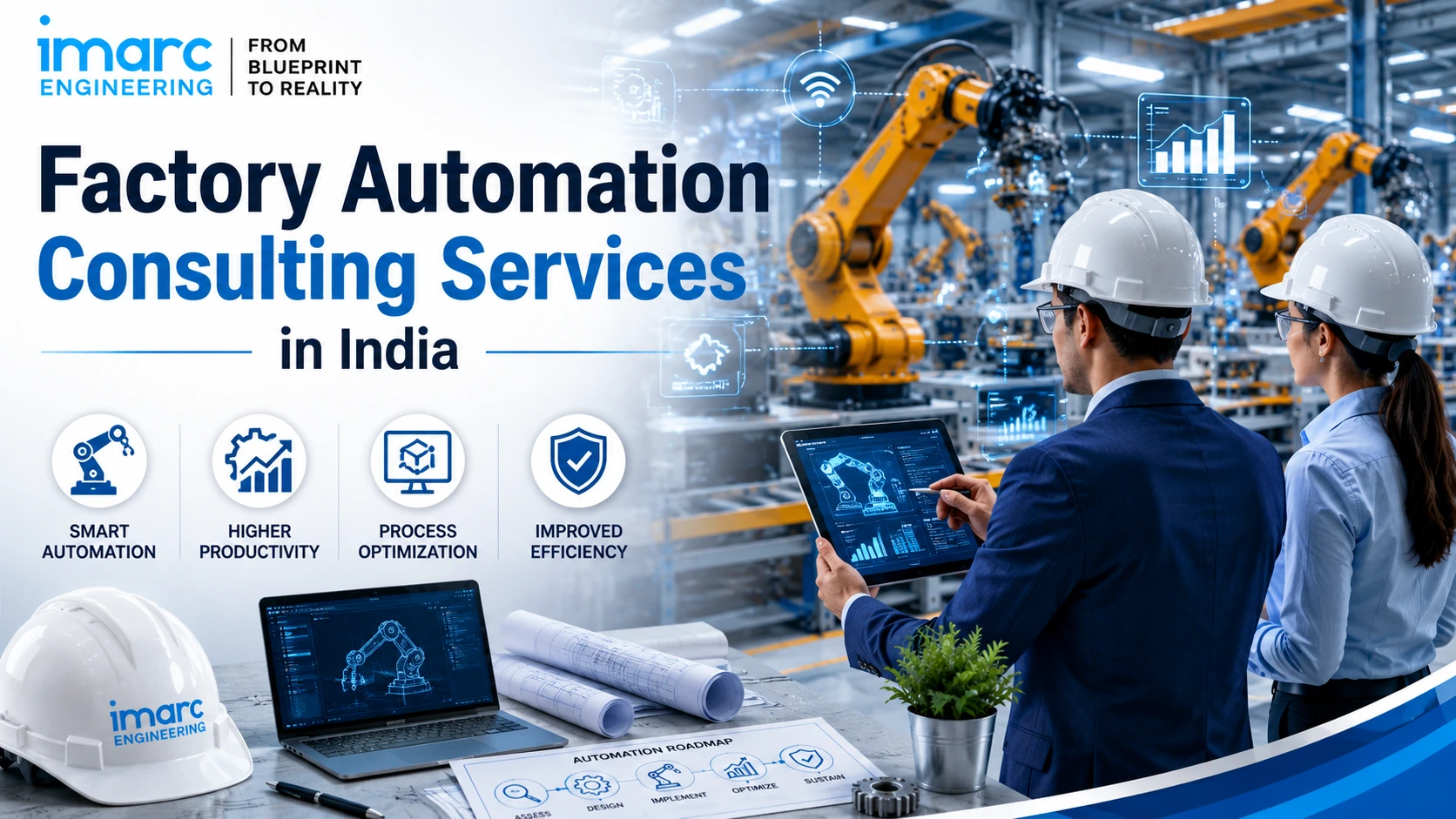
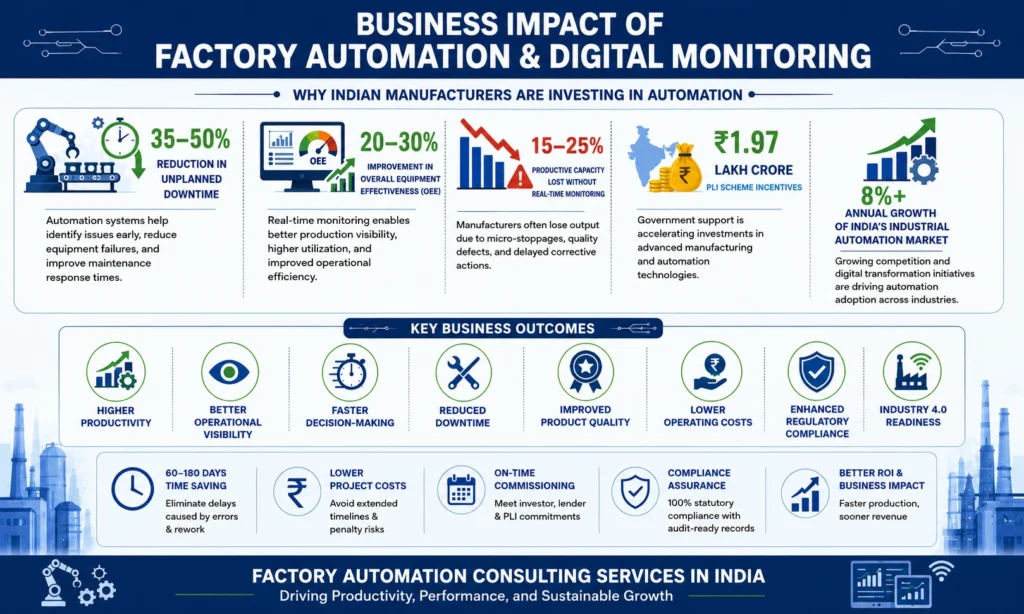
India’s manufacturing sector is at a decisive turning point. With the government’s Production Linked Incentive (PLI) scheme injecting over INR 1.97 lakh crore into key industries and the industrial automation market growing at more than 8% annually, the pressure on manufacturers to modernize is no longer optional. It is existential. Yet despite this urgency, one of the most consequential decisions a plant owner or operations head makes is often the most poorly evaluated: choosing the right factory automation consulting partner.
This article is a practical guide for Indian manufacturers across sectors including pharmaceuticals, food processing, chemicals, FMCG, and engineering to cut through the noise and identify what truly matters when selecting a factory automation consultant.
Why Factory Automation Consulting Has Become Critical in India
Automation is no longer about replacing workers on an assembly line. Modern factory automation consulting services in India integrate PLC (Programmable Logic Controller) systems, SCADA (Supervisory Control and Data Acquisition), IIoT (Industrial Internet of Things) platforms, and real-time digital monitoring dashboards to give manufacturers 360-degree visibility and control of their operations.
The numbers justify the investment:
- Automation can reduce unplanned downtime by 35% to 50%, a figure with enormous implications for high-throughput facilities running 20+ hour shifts.
- Properly implemented digital monitoring systems deliver 20% to 30% improvement in Overall Equipment Effectiveness (OEE), one of the most reliable indicators of manufacturing efficiency.
- According to industry estimates, Indian manufacturers operating without real-time monitoring lose between 15% and 25% of productive capacity to preventable inefficiencies, including micro-stoppages, quality rejections, and delayed maintenance responses.
The right automation consulting partner translates these numbers from potential to reality. The wrong one installs technically impressive systems that operators never use, or worse, systems that create compliance liabilities.
Key Criteria to Evaluate a Factory Automation Consulting Partner
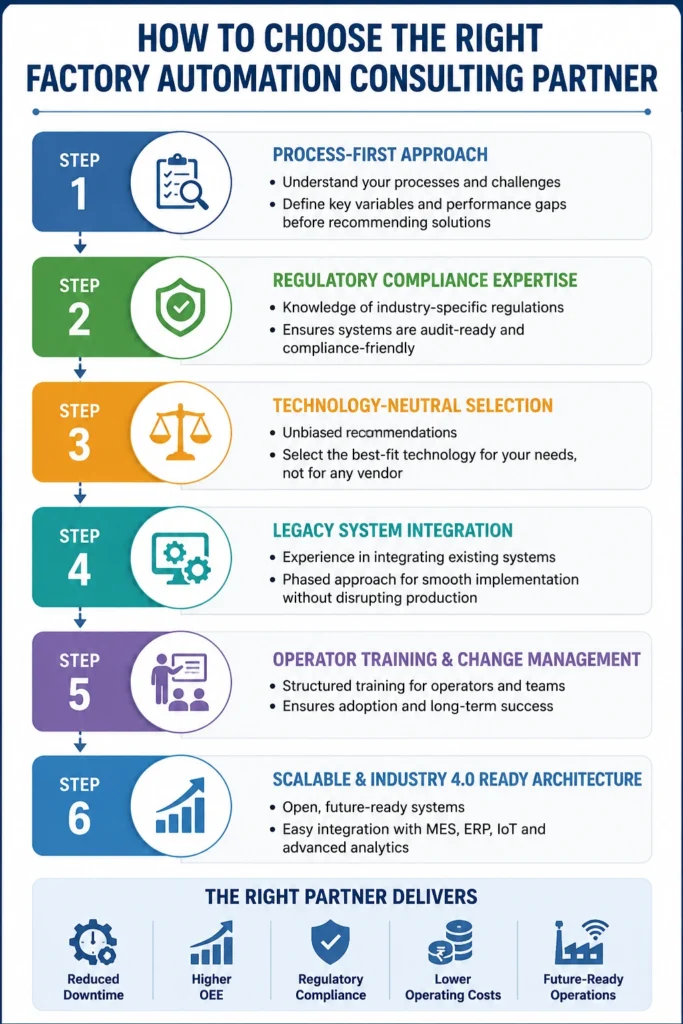
1. Process-First Approach, Not Technology-First
One of the most common failure modes in Indian industrial automation projects is when a technology provider or system integrator designs a solution around their product portfolio rather than the client’s actual process needs. The result is automation that measures the wrong variables, automates sequences with built-in inefficiencies, and floods operators with data they cannot act on.
The right partner starts with your process. Before specifying a single sensor or control system, a capable automation consultant should conduct a detailed assessment of your current operations, control systems, data collection practices, and performance gaps. Only after defining key process variables, control requirements, and decision support needs should they determine what hardware and software architecture is appropriate.
Ask this question directly during vendor evaluation: “What process data will you collect first, and why?” If the answer leads with a product name rather than your production challenges, walk away.
2. Deep Regulatory Compliance Knowledge
Indian regulated manufacturing sectors carry compliance requirements that go well beyond operational efficiency. Choosing an automation partner unfamiliar with these requirements can create serious legal and business exposure.
Consider the sector-specific complexity:
- Pharmaceutical manufacturing requires 21 CFR Part 11-compliant electronic documentation with audit trails for GMP process parameters, alongside CDSCO inspection-ready systems.
- Chemical plants regulated by PESO (Petroleum and Explosives Safety Organisation) require ATEX/IECEx-certified intrinsically safe instrumentation for hazardous classified areas following IS/IEC 60079 standards.
- Large-scale industries must comply with CPCB mandates for Continuous Emission Monitoring Systems (CEMS), with real-time data fed directly to CPCB servers using specified communication protocols.
- Food processing facilities must meet FSSAI hygienic design standards for all food-contact equipment.
A competent automation consulting firm builds compliance into the system architecture from day one, eliminating the expensive and disruptive parallel manual recording systems that defeat the purpose of automation.
3. Technology-Neutral Vendor Selection
A hidden but costly bias in the Indian automation consulting market is OEM lock-in. System integrators who represent specific brands of PLCs, SCADA platforms, or sensor manufacturers will naturally write specifications that favor their suppliers, regardless of whether those products are the best fit for your needs.
The right partner creates specifications in a technology-neutral fashion, based on your process requirements, operating conditions, maintenance capability, and total cost of ownership. When multiple technologies can meet the requirement, they conduct a transparent, competitive evaluation across vendors.
Practically, this means your automation partner should be able to work with Siemens, Allen-Bradley, Schneider, Honeywell, and ABB systems based on merit for each application, not commercial preference. Demand to see their evaluation methodology before contract.
4. Legacy System Integration Capability
A large proportion of Indian manufacturing plants operate with mixed infrastructure: newly installed automated lines running alongside older manually operated or partially instrumented equipment. This is the reality in brownfield expansions, unit mergers, and plants that have grown organically over 15 to 25 years.
Many automation firms specialize in greenfield projects and lack the structured methodology to handle legacy integration. The result is either costly full-system replacement that disrupts production for months, or an automation layer that cannot communicate with existing equipment and provides incomplete visibility.
Evaluate your prospective partner’s specific experience in:
- Analyzing legacy PLC hardware and communication protocol compatibility
- Developing interface strategies using protocol converters, OPC servers, and edge computing nodes
- Creating phased implementation plans that maintain production continuity during rollout
A phased approach that delivers initial monitoring coverage within 6 to 12 weeks for smaller scopes, scaling to full PLC and SCADA integration over 4 to 12 months for larger projects, is a realistic benchmark for experienced partners.
5. Operator Training and Change Management
Technical installation alone does not generate ROI. Operators who do not understand system outputs, distrust the data, or continue with old habits regardless of automation signals will capture only a fraction of the efficiency gains available.
Studies from industrial manufacturing environments consistently show that adoption gaps erode 40% to 60% of projected automation benefits in the first year post-implementation. This is not a technology problem. It is a people problem.
The right automation consulting partner treats training and change management as integral components of every implementation, not optional add-ons. Specifically, look for:
- Customized operator training sessions designed for skill levels on your floor
- Management-level engagement for dashboard-based production decisions
- Post-go-live monitoring of system adoption to identify residual manual processes that automation should have replaced
6. Scalable, Industry 4.0-Ready Architecture
An automation investment made today should not become a roadblock to digital transformation in three years. Closed architectures, proprietary communication protocols, and systems not designed for future MES or ERP integration are expensive mistakes that Indian manufacturers frequently encounter.
The right partner designs automation architectures with open communication standards including OPC-UA, MQTT, and standard industrial Ethernet, ensuring future compatibility with Manufacturing Execution Systems (MES), ERP platforms, and cloud-based analytics as your digital maturity evolves.
This matters because Industry 4.0 adoption in India is not a distant horizon. The Indian Smart Manufacturing market is projected to grow significantly through the remainder of this decade, and manufacturers integrating scalable architectures today are positioning themselves for advanced capabilities including predictive maintenance, AI-driven quality control, and digital twin deployment without starting over.
Optimize your plant with automation experts: https://www.imarcengineering.com/contact?service=automation-digital-monitoring-setup
The Technology Stack: What a Complete Automation and Monitoring System Looks Like
Understanding the technology layers helps you evaluate proposals with informed judgment:
- Control hardware layer: PLCs for discrete and sequential processes, DCS for continuous process control, PAC for hybrid environments.
- Sensing layer: Process instrumentation covering temperature, pressure, flow, level, pH, and conductivity; machine condition sensors for vibration, current, and thermal monitoring; vision inspection systems.
- Communication layer: Industrial Ethernet, Profibus, Modbus, HART, and OPC-UA protocols connecting devices to supervisory systems.
- Monitoring and supervisory layer: SCADA systems, HMI displays, IoT analytics platforms, and cloud dashboards providing centralized visibility and control.
The sophistication of each layer should match your operational context. A single-line compact plant may operate effectively with PLC and HMI alone. A multi-unit chemical complex distributing processes across large areas warrants full SCADA implementation. A seasoned automation consultant sizes each layer to actual need, not upsell potential.
Red Flags to Avoid During Partner Evaluation
- The consultant proposes a solution before completing a process audit
- No documented experience in your specific industry’s regulatory requirements
- Inability to demonstrate legacy system integration experience
- Single-OEM technical specifications without competitive justification
- No structured training or post-implementation support program included in the scope
- Timeline proposals that seem implausibly fast for the scope described
Why IMARC Engineering Stands Out as a Factory Automation Consulting Partner in India
IMARC Engineering brings a distinctive process-first methodology to automation and digital monitoring setup in India. Operating from its corporate headquarters in Noida, Uttar Pradesh, the firm combines deep manufacturing process knowledge with multi-sector regulatory expertise across pharmaceuticals, food processing, chemicals, FMCG, and engineering manufacturing.
Their structured four-phase implementation methodology covers requirement assessment and process evaluation, system design and technology integration, implementation and commissioning, and training with continuous support. Critically, their technology-neutral vendor selection approach ensures that system specifications are driven by client needs and competitive bidding, not OEM relationships.
For manufacturers looking to implement real-time PLC, SCADA, and IoT-enabled monitoring systems that deliver measurable reductions in unplanned downtime and verifiable OEE improvements, IMARC Engineering provides end-to-end capability from initial assessment through post-commissioning performance validation.
Contact Us:
IMARC Engineering
Phone: +91-120-433-0800
Email: sales@imarcengineering.com
India: C-130, Sector 2, Noida, Uttar Pradesh 201301
LinkedIn: https://www.linkedin.com/showcase/imarc-engineering/
About the Author