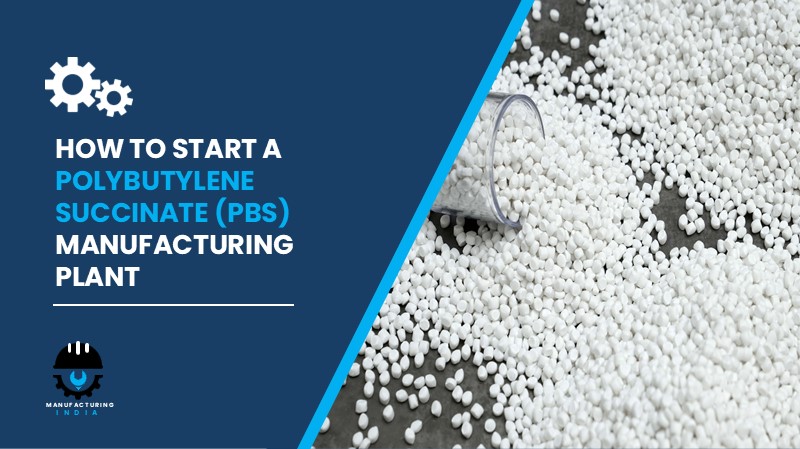
Setting up a polybutylene succinate (PBS) manufacturing plant in India presents a compelling investment case grounded in the country’s rapidly expanding demand for biodegradable and sustainable packaging alternatives, the growing regulatory pressure on single-use plastics, rising consumer preference for eco-friendly products, and the broad-based shift across packaging, agriculture, automotive, and medical sectors toward materials that combine the performance of conventional plastics with full biodegradability and compostability. Polybutylene succinate (PBS) – a biodegradable polymer made from renewable resources such as plant-based sugars and succinic acid – offers similar properties to conventional plastics such as polypropylene while being fully compostable under the right conditions. Known for excellent biodegradability, high mechanical strength, and versatility across injection moulding, blow moulding, films, and fibres, PBS is emerging as one of the most commercially important materials in the global transition away from petroleum-based single-use plastics. The global polybutylene succinate market was valued at USD 419.04 million in 2025 and is projected to reach USD 1,073.67 million by 2034 at a CAGR of 11.0% – one of the strongest growth rates in the entire bioplastics and specialty polymer manufacturing landscape.
India’s structural advantages make it a strategically well-positioned location for establishing a PBS manufacturing facility. The country’s growing regulatory framework restricting single-use plastics, rising consumer awareness of environmental sustainability, and rapidly expanding packaging, agricultural, and food processing industries collectively create a large and structurally growing domestic demand environment for biodegradable polymer alternatives. According to EPA-published research, bioplastics are emerging as a viable alternative with production projected to rise from less than 1% to 20% in the next five years – a trajectory that directly expands the addressable market for Indian PBS manufacturers serving both domestic and export customers. Government support for green manufacturing under Make in India, PLI incentives for specialty chemicals, and state-level investment schemes in Gujarat, Maharashtra, and Andhra Pradesh provide investors with competitive land costs, chemical supply chain access, and favourable policy conditions for building commercially competitive PBS production capacity.
A polybutylene succinate (PBS) manufacturing plant in India is positioned within a global market valued at USD 419.04 million in 2025 growing at 11.0% CAGR toward USD 1,073.67 million by 2034, driven by biodegradable plastics demand growth, single-use plastic bans, and rising consumer preference for eco-friendly products. With gross margins of 30–40% and net margins of 15–22% at 10,000–30,000 MT annual capacity, and bioplastics production set to reach 20% of total plastics within five years, this investment delivers strong, sustainability-megatrend-backed returns.
What is Polybutylene Succinate (PBS)?
Polybutylene succinate (PBS) is a biodegradable polymer made from renewable resources such as plant-based sugars and succinic acid. It is known for its excellent biodegradability, high mechanical strength, and versatility in various applications. PBS offers similar properties to conventional plastics such as polypropylene (PP) but is fully compostable under the right conditions. The polymer has low toxicity, making it suitable for food packaging and medical products. PBS can be used in injection moulding, blow moulding, films, and fibres, and is ideal for applications where biodegradability and sustainability are key requirements.
The primary production method involves synthesis of succinic acid, polymerisation, blending and modifying, extrusion and moulding, and quality control – a multi-step chemical manufacturing process integrating monomer preparation, controlled polycondensation, polymer modification, and quality verification at each stage. Raw materials required are succinic acid, butanediol, and catalysts. End-use industries served include packaging, agriculture, automotive, medical, and consumer goods – covering applications from biodegradable films and containers and mulch films through to automotive interior components, biodegradable medical devices, and eco-friendly bags.
Cost of Setting Up a Polybutylene Succinate Manufacturing Plant in India
The total investment required to establish a polybutylene succinate manufacturing plant in India depends on plant capacity, technology selection, geographic location, level of automation, and compliance with chemical safety and environmental regulatory requirements. Investors must account comprehensively for both one-time capital expenditure and recurring operational costs when preparing a feasibility study or detailed project report (DPR).
1. Capital Expenditure (CapEx)
Land and Site Development constitutes a substantial foundational investment. The cost of land and site development – including charges for land registration, boundary development, and other related expenses – forms a substantial part of the overall investment, ensuring a solid foundation for safe and efficient plant operations.
Civil Works and Construction encompasses the main polymerisation reactor building, monomer preparation and blending area, extrusion and pelletising facility, quality control laboratory, finished goods storage and packaging hall, effluent treatment facility, and administrative block. The requirements for chemical-resistant construction, containment systems, and ventilation appropriate for polymerisation operations add to civil construction costs relative to standard light manufacturing facilities.
Machinery and Equipment represent the largest portion of total capital expenditure – machinery costs account for the largest portion of total CapEx. Key machinery required for a polybutylene succinate manufacturing plant includes:
- Polymerisation reactors
- Extruders and pelletisers
- Injection moulding machines
- Blending equipment
Other Capital Costs include the effluent treatment plant (ETP) for managing chemical process waste, pre-operative expenses covering regulatory filings and feasibility study preparation, plant commissioning charges, utility connection fees, and import duties applicable to specialised polymerisation reactor vessels or automated extrusion systems sourced internationally.
Request a Sample Report for In-Depth Market Insights: https://www.imarcgroup.com/polybutylene-succinate-manufacturing-plant-project-report/requestsample
2. Operational Expenditure (OpEx)
Raw Material Cost is the overwhelmingly dominant driver of operating expenditure, accounting for approximately 65–75% of total OpEx. The primary and most cost-significant input is succinic acid – the key monomer and the largest single raw material cost line in PBS production. Butanediol and catalysts are the additional critical inputs. Long-term contracts with reliable suppliers will help mitigate price volatility and ensure a consistent supply of these materials. Minimising transportation costs by selecting nearby suppliers is essential, and sustainability and supply chain risks must be regularly assessed.
Utility Costs – covering electricity and steam for polymerisation reactors, extruders, moulding machines, and facility operations – account for approximately 15–20% of total OpEx. The controlled-temperature polymerisation and extrusion operations are the most energy-intensive process steps. Investors in regions with competitive industrial electricity and steam tariffs and reliable utility supply are better positioned to manage this cost component over the plant’s operational life.
Other Operating Costs include outbound transportation to packaging manufacturers, agricultural product companies, automotive component assemblers, medical device producers, and consumer goods manufacturers; packaging materials for PBS pellet bags and bulk containers; employee salaries and wages; equipment maintenance; quality assurance testing; depreciation on civil and machinery assets; and applicable taxes. In the first year of operations, operating costs are projected to be significant. By the fifth year, total operational costs are expected to increase substantially due to inflation, market fluctuations, potential rises in the cost of key materials, supply chain disruptions, rising consumer demand, and shifts in the global economy.
3. Plant Capacity
The proposed polybutylene succinate manufacturing facility is designed with an annual production capacity ranging between 10,000 and 30,000 MT, enabling economies of scale while maintaining operational flexibility across different PBS grades, formulations, and end-use specifications. This capacity range is well-aligned with the requirements of packaging manufacturers, agricultural film producers, automotive component suppliers, medical device formulators, and consumer goods manufacturers. Capacity can be customised based on investor requirements and succinic acid procurement network scale. Profitability improves consistently with higher capacity utilisation, and PBS plants support phased capacity expansion through additional reactor trains and extrusion lines.
4. Profit Margins and Financial Projections
The polybutylene succinate manufacturing plant demonstrates healthy profitability potential under normal operating conditions. Gross profit margins typically range between 30–40%, supported by stable demand and value-added applications across packaging, agriculture, automotive, medical, and consumer goods sectors. Net profit margins range between 15–22%, reflecting the high succinic acid cost concentration in the operating model. A comprehensive financial analysis should include income projections, expenditure forecasts, gross and net margin tracking across Years 1 through 5, net present value (NPV), internal rate of return (IRR), payback period, and a full profit and loss account. Sensitivity analysis and uncertainty analysis are recommended to account for succinic acid price variability and demand fluctuations.
Why Set Up a PBS Manufacturing Plant in India?
Growing Global Demand for Biodegradable Plastics Creating Structural Market Growth. The global polybutylene succinate market is driven by the growing demand for biodegradable plastics, particularly as industries and consumers shift towards environmentally sustainable alternatives. According to EPA-published research, bioplastics are emerging as a viable alternative with production projected to rise from less than 1% to 20% in the next five years – a trajectory that directly and enormously expands the addressable market for PBS as one of the most commercially mature and versatile biodegradable polymers available. This extraordinary production growth projection creates a structural and accelerating demand environment for domestic PBS manufacturers serving India’s own packaging and agricultural industries.
Environmental Sustainability as a Structural Commercial Driver. The growing global demand for sustainability and the reduction of plastic waste has led to an increase in demand for biodegradable alternatives such as PBS. The rising concerns about plastic pollution are further driving product demand across every major end-use sector – from food packaging and agricultural mulch films through to medical devices and consumer product packaging. PBS’s combination of low toxicity, full compostability, and mechanical performance comparable to polypropylene makes it the preferred choice for formulators seeking to transition product lines away from conventional petroleum-based plastics.
Growing Regulatory Pressure Mandating Biodegradable Alternatives. Governments across the world are enforcing strict regulations on single-use plastics, leading to an increase in demand for alternative materials such as PBS in packaging and other disposable products. India’s own progressive restriction of single-use plastics – combined with the country’s Extended Producer Responsibility (EPR) framework for plastics – directly creates regulatory mandated demand for biodegradable polymer alternatives that domestic PBS manufacturers can serve with cost and supply chain advantages over import-dependent buyers.
Consumer Demand for Eco-Friendly Products Expanding the Retail Market. Consumers are becoming increasingly environmentally conscious, and the demand for eco-friendly and biodegradable products is increasing, especially in the packaging, agriculture, and personal care sectors. This consumer-driven demand shift is creating commercial incentives for branded consumer goods companies and food manufacturers to transition their packaging to certified compostable materials – providing PBS manufacturers with a premium-priced consumer goods channel alongside industrial and agricultural volume markets.
Versatility Across Multiple High-Value Industries Reducing Revenue Concentration Risk. PBS’s various applications in packaging, agriculture, and the automotive industry reflect the versatility of the material across diverse end-use sectors. The advancements in production technology and efforts to enhance PBS properties including strength and flexibility are also expanding market growth – enabling manufacturers to develop application-specific grades for premium segments including medical sutures, drug delivery systems, and automotive interior components that command significantly higher per-kilogram selling prices than standard packaging film grades.
Active Global Research Validating Product Innovation and Performance Enhancement. In June 2025, a study published on PBS films coated with hydroxypropyl methylcellulose infused with sea buckthorn extract revealed that, although accelerated aging resulted in some degradation of the PBS, the use of sea buckthorn extract or ethosomes in low amounts reduced this negative effect and improved the oxygen barrier – confirming the active international research investment in enhancing PBS performance for food packaging applications. In January 2025, research published in MDPI on bio-microcapsules of PBS and isocyanates highlighted their potential for sustainable, safer, and more efficient adhesives – demonstrating that PBS is finding new high-value application avenues beyond its established packaging and agricultural markets, expanding the commercial addressable market for Indian PBS manufacturers.
Manufacturing Process – Step by Step
The polybutylene succinate manufacturing process uses synthesis of succinic acid, polymerisation, blending and modifying, extrusion and moulding, and quality control as the primary production method. Below are the main stages involved in the PBS manufacturing process flow:
- Raw Material Receipt and Quality Testing: Succinic acid, butanediol, and catalysts are received, tested for purity, composition, and conformance to process specification, and cleared for production scheduling following quality verification.
- Succinic Acid Preparation: Succinic acid – which can be sourced from petrochemical routes or from bio-based fermentation of plant sugars – is prepared and characterised to the required purity and physical form specification for the polymerisation process. Bio-based succinic acid sourcing is preferred where sustainability certification is required for premium eco-label market access.
- Polymerisation – Polycondensation Reaction: Polymerisation reactors combine succinic acid and butanediol in the presence of catalysts under controlled temperature and vacuum conditions through a polycondensation reaction – initially forming low-molecular-weight oligomers through esterification, then building molecular weight through polycondensation under progressive vacuum to achieve the target intrinsic viscosity and mechanical property specifications for the designated PBS grade.
- Blending and Modifying: Blending equipment combines the base PBS polymer with permitted additives – including chain extenders, nucleating agents, stabilisers, and functional fillers – to modify specific mechanical, thermal, processing, and biodegradation rate properties for application-specific grades targeting packaging, agriculture, automotive, or medical end-uses.
- Extrusion and Pelletising: Extruders and pelletisers process the compounded PBS polymer melt through a die and cutting system to produce uniform cylindrical pellets of the specified dimension and bulk density – the standard commercial form in which PBS is supplied to downstream film converters, injection moulding processors, and compounders.
- Injection Moulding (where applicable): Injection moulding machines convert PBS pellets into finished moulded products – including food containers, agricultural plant pots, and consumer product parts – where the plant includes downstream conversion capability alongside polymer pellet production.
- Quality Inspection and Testing: Quality management systems subject finished PBS pellets and moulded products to comprehensive testing – including melt flow index, intrinsic viscosity, mechanical property testing (tensile strength, elongation at break, flexural modulus), thermal analysis, biodegradation rate testing, and compostability certification testing – with batch release conditional on all parameters meeting the applicable product specification acceptance criteria.
- Packaging and Dispatch: Finished PBS pellets are packaged in moisture-protected bulk bags or 25 kg bags depending on customer requirement, with product certification documentation including intrinsic viscosity, compostability certification, and bio-based carbon content where applicable, before dispatch to packaging film converters, agricultural product manufacturers, automotive component suppliers, medical product formulators, and consumer goods manufacturers.
Key Applications
Polybutylene succinate produced at this type of facility serves five primary end-use sectors with specific PBS grade, mechanical property, and biodegradation certification requirements for each:
- Packaging: PBS is used in the packaging industry to produce biodegradable films and containers for food and other products – providing compostable alternatives to conventional PE and PP films that meet the growing regulatory and consumer demand for certified sustainable food packaging.
- Agriculture: In agriculture, PBS is utilised to create biodegradable mulch films, plant pots, and seed coatings – reducing the environmental impact of plastic waste by replacing non-degradable films that would otherwise require mechanical removal from agricultural fields after the growing season.
- Automotive: In the automotive industry, PBS is employed for the manufacturing of auto parts that need to be highly strong and lightweight and also need to be biodegradable – serving the automotive sector’s growing requirement for sustainable interior materials and trim components.
- Medical: In the medical industry, PBS is employed for the manufacturing of biocompatible and biodegradable products such as sutures and drug delivery systems – leveraging PBS’s low toxicity and controlled biodegradation rate for regulated medical applications requiring material safety documentation.
- Consumer Products: Eco-friendly products such as disposable cutlery, bags, and personal care packaging materials are manufactured using PBS to meet the growing demand for eco-friendly products from consumers and regulatory compliance requirements in single-use product categories.
Leading PBS Manufacturers
The global polybutylene succinate industry is served by a range of specialist producers with growing production capacities and diverse end-use application portfolios. Key players include:
- PTT MCC Biochem Co., Ltd.
- Anhui Sealong Biotechnology Co., Ltd.
- Vizag Chemicals
- Shandong Fuwin New Material Co., Ltd.
- Shandong LanDian Biological Technology Co., LTD
- Xinjiang Blue Ridge Tunhe Sci. & Tech. Co., Ltd.
Timeline to Start the Plant
Investors planning to establish a polybutylene succinate manufacturing plant in India should anticipate the following project development phases:
- Feasibility study and project report preparation
- Land acquisition and site development
- Regulatory approvals and environmental clearances
- Factory licence and fire safety compliance
- Machinery procurement and installation
- Raw material supplier agreements and supply chain setup
- Trial production and quality testing
- Commercial production launch
Licences and Regulatory Requirements
Starting a polybutylene succinate manufacturing unit in India requires several approvals:
- Business registration (Proprietorship, LLP, or Private Limited Company)
- Factory Licence under the Factories Act
- Environmental Clearance from the State Pollution Control Board
- GST Registration
- Fire Safety NOC
- Effluent Treatment Plant (ETP) operational clearance for chemical process wastewater management
- Occupational Health and Safety compliance covering polymerisation reactor operations and chemical handling
- Bureau of Indian Standards (BIS) certification for applicable polymer and packaging product standards where required for institutional supply qualification
- Compostability certification from accredited bodies (CPCB, TÜV Austria, DIN CERTCO) for PBS products marketed as certified compostable to domestic and export buyers
- APEDA export registration where PBS products are targeted for international sustainable packaging and biodegradable materials markets
Key Challenges to Consider
Succinic Acid Price Volatility as the Dominant Cost Variable. Succinic acid – accounting for 65–75% of total OpEx – is the primary cost driver and the most significant risk variable in PBS production economics. Succinic acid pricing is influenced by bio-based feedstock costs and petrochemical feedstock dynamics, and any meaningful price movement directly and materially compresses gross margins. Long-term supply contracts with qualified succinic acid producers and multi-supplier qualification are essential risk mitigation strategies.
Bio-Based Succinic Acid Supply Chain Development. For manufacturers targeting premium eco-label markets that require certified bio-based carbon content in finished PBS, sourcing succinic acid from bio-based fermentation routes – rather than petrochemical synthesis – adds supply chain complexity and potentially higher feedstock costs relative to petrochemical routes. Building reliable bio-based succinic acid supply chains requires early supplier qualification and long-term procurement commitments.
Compostability Certification Requirements for Premium Market Access. Accessing the premium pricing tier in food packaging and agricultural film markets requires internationally recognised compostability certification – including EN 13432 in Europe, ASTM D6400 in North America, and applicable Indian standards for domestic market claims. Obtaining and maintaining these certifications requires testing infrastructure, third-party certification body engagement, and ongoing documentation management that adds pre-market preparation time and compliance overhead.
Competition from Established Global and Emerging Asian Producers. The PBS market is served by established Asian producers including PTT MCC Biochem, Anhui Sealong, and multiple Chinese manufacturers with growing production capacities and competitive pricing. New Indian manufacturers must differentiate through product quality consistency, bio-based certification for premium eco-label segments, application-specific grade development, or cost competitiveness for domestic packaging and agricultural volume buyers who prefer local supply chain reliability over imported alternatives.
Utility Cost Management for Polycondensation Operations. Utility costs at 15–20% of total OpEx reflect the continuous energy requirements of polymerisation reactor operation, vacuum system management for polycondensation, and extrusion line heating. Managing electricity and steam costs through efficient process design and competitive tariff procurement is a material operational priority for protecting gross margins at the 30–40% level.
Skilled Workforce for Polymer Chemistry and Process Operations. Operating polymerisation reactors, extrusion systems, and polymer quality testing laboratories requires chemical engineers and polymer processing technologists with specialised knowledge of polycondensation chemistry, PBS rheology, and biodegradable polymer quality management. Sourcing and retaining qualified personnel for this technically demanding manufacturing category presents an ongoing challenge in India’s current specialty polymer talent market.
Frequently Asked Questions
1. How much does it cost to set up a polybutylene succinate manufacturing plant in India?
The total cost depends on plant capacity (10,000–30,000 MT per annum), technology selection, location, and automation level. CapEx covers land and site development, civil works, and machinery including polymerisation reactors, extruders and pelletisers, injection moulding machines, and blending equipment, along with pre-operative and regulatory costs.
2. Is polybutylene succinate manufacturing profitable in India in 2026?
Yes. With gross margins of 30–40% and net margins of 15–22%, supported by a global market growing at 11.0% CAGR toward USD 1,073.67 million by 2034, bioplastics production projected to rise from less than 1% to 20% within five years, growing regulatory bans on single-use plastics, and rising consumer demand for eco-friendly products, the investment presents a strong sustainability-megatrend-backed profitability case.
3. What machinery is required for a polybutylene succinate manufacturing plant in India?
Key equipment includes polymerisation reactors, extruders and pelletisers, injection moulding machines, and blending equipment. Supporting systems include vacuum systems for polycondensation, quality testing laboratory instruments for mechanical property and biodegradation testing, ETP for process wastewater management, and analytical instruments for product certification compliance.
4. What licences and approvals are required to start a polybutylene succinate manufacturing plant in India?
Required approvals include business registration, Factory Licence, Environmental Clearance, GST Registration, Fire Safety NOC, ETP operational clearance, Occupational Health and Safety compliance, BIS certification where applicable, compostability certification from accredited bodies for certified compostable product marketing, and APEDA export registration where international markets are targeted.
5. What raw materials are needed for polybutylene succinate manufacturing?
The primary raw materials are succinic acid, butanediol, and catalysts. Succinic acid – the largest cost item at 65–75% of total OpEx – can be sourced from petrochemical or bio-based fermentation routes depending on product certification requirements.
6. What are the environmental compliance requirements for a polybutylene succinate manufacturing plant in India?
Environmental Clearance from the State Pollution Control Board is required, along with ETP for chemical process wastewater management, compliance with emission standards applicable to chemical polymer manufacturing operations, and adherence to solid waste management rules for polymer process waste and by-product disposal.
7. What is the best location to set up a polybutylene succinate manufacturing plant in India?
The location must offer easy access to key raw materials including succinic acid, butanediol, and catalysts, with proximity to target markets in packaging, agriculture, and automotive sectors to minimise distribution costs. The site must have robust infrastructure including reliable utilities, waste management systems, and compliance with local zoning laws and environmental regulations.
8. What is the break-even period for this type of plant in India?
The break-even period depends on plant capacity utilisation, succinic acid procurement cost, product mix across packaging, agricultural, automotive, and medical grades, and buyer contract development speed. A full NPV and IRR analysis incorporating sensitivity analysis and uncertainty analysis is recommended for investment-grade financial planning.
9. What government incentives are available for PBS manufacturers in India?
Make in India manufacturing investment incentives, PLI scheme benefits for specialty chemicals and bioplastics where applicable, state-level chemical industrial zone incentive schemes, government plastic waste management rules creating regulatory demand for certified biodegradable alternatives, and export promotion support through chemical and specialty materials export councils provide relevant financial and market access support for qualifying PBS manufacturing investments.
Key Takeaways for Investors
A polybutylene succinate manufacturing plant in India represents a commercially well-positioned investment in one of the specialty polymer sector’s highest-growth and most strategically relevant product categories – backed by a global market valued at USD 419.04 million in 2025 growing at 11.0% CAGR toward USD 1,073.67 million by 2034, driven by biodegradable plastics demand growth, global single-use plastic bans, and the extraordinary projection from EPA-published research that bioplastics production will rise from less than 1% to 20% within the next five years. Financial viability is demonstrated across a production capacity range of 10,000 to 30,000 MT per annum, with gross margins of 30–40% and net margins of 15–22% achievable under competitive succinic acid procurement and efficient polymerisation and extrusion operations. Active global research and innovation – including the June 2025 PBS film study demonstrating improved oxygen barrier performance through sea buckthorn extract coating, and the January 2025 MDPI research on PBS bio-microcapsules for sustainable adhesive applications – confirms the expanding application scope and continued scientific investment that is driving PBS into new high-value end-use markets beyond established packaging and agricultural film categories. With India’s plastic waste management regulations tightening, consumer demand for eco-certified packaging accelerating, and the global bioplastics industry positioned for an extraordinary production growth trajectory, the long-term demand sustainability and commercial opportunity for Indian PBS manufacturing investors are comprehensively and multiply well-supported throughout the decade ahead.
About the Author