Gelatin Manufacturing Plant in India
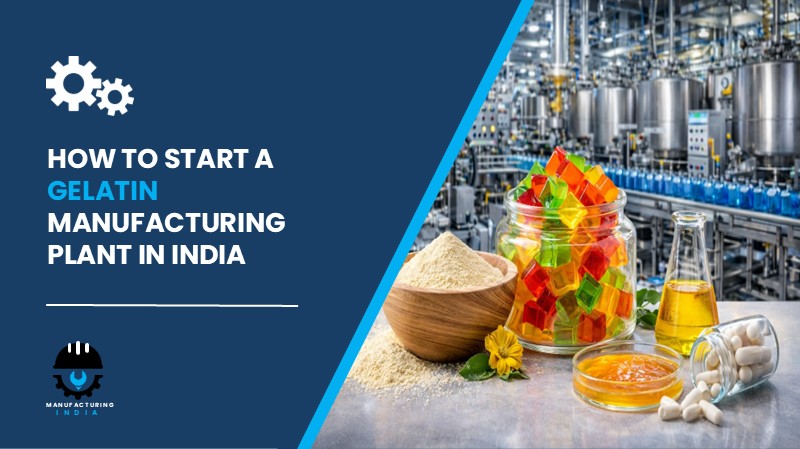
Setting up a gelatin manufacturing plant in India presents a compelling investment case driven by robust and diversified demand across food and beverages, pharmaceuticals, and cosmetics sectors. As a natural protein derived from the hydrolysis of collagen, gelatin plays a critical functional role in confectioneries, nutritional supplements, pharmaceutical capsules, tablets, wound dressings, and personal care products. These sectors collectively form the backbone of India’s fast-growing consumer economy, making domestic gelatin production strategically indispensable for investors seeking stable, multi-sector demand.
India’s structural advantages further reinforce the investment rationale for a gelatin manufacturing plant in India. The country’s expanding food processing and pharmaceutical manufacturing ecosystem, supported by the Make in India initiative and government programs promoting local sourcing, creates a policy environment that rewards domestic producers. States with developed industrial infrastructure including those hosting pharmaceutical and food-grade processing clusters offer ready access to utilities, logistics networks, and skilled labour at competitive costs. With rising consumer preference for protein-rich foods, functional foods, health-oriented snacks, and natural cosmetic ingredients, the demand pipeline for gelatin is both deep and diversifying.
India offers a uniquely favourable environment for gelatin production combining policy support through Make in India, cost-competitive land and labour, and growing demand from food, pharmaceutical, and cosmetics sectors. With gross profit margins of 30–45% and a break-even window of 3–5 years, a well-structured gelatin manufacturing plant in India presents a financially viable and strategically sound investment.
What is Gelatin?
Gelatin is a natural protein that results from the hydrolysis of collagen sourced from animal connective tissues found in bones, skin, and cartilage. The substance functions as a gelling agent, stabilising agent, and thickening agent across multiple sectors. Its unique functional properties dissolving in hot water, forming films, and controlling viscosity make it indispensable across food, pharmaceutical, and cosmetic applications.
The primary production method is extraction, filtration, hydrolysis, drying, and powder processing, which transforms raw animal material into refined, high-purity gelatin. End-use industries served include food and beverages, pharmaceuticals, cosmetics, photography and imaging, technical and industrial uses, and biotechnology and research. Within these sectors, gelatin finds application in confectioneries, marshmallows, desserts, dairy products, nutritional supplements, capsules, tablets, wound dressings, creams, gels, and facial masks.
Cost of Setting Up a Gelatin Manufacturing Plant in India
The total cost of establishing a gelatin manufacturing plant in India depends on capacity, technology, location, level of automation, and regulatory compliance requirements. A careful breakdown of both capital and operating expenditure is essential before committing investment.
1. Capital Expenditure (CapEx)
The largest component of CapEx for a gelatin plant is machinery, followed by land and civil works. Land and site development costs cover land registration, boundary development, and related site preparation charges, forming a substantial part of the overall investment. Investors should evaluate options within Special Economic Zones (SEZs) or established industrial estates, which typically offer infrastructure-ready plots, faster regulatory clearances, and fiscal incentives.
Civil works and construction costs include the production shed, quality control laboratory, raw material storage area, finished goods warehouse, effluent treatment facility, and administrative block. These must be designed to meet food-grade and pharmaceutical-grade hygiene standards where applicable.
Key machinery required for a gelatin manufacturing plant includes:
- Extraction tanks
- Hydrolysis reactors
- Filtration systems
- Dryers
- Powder blenders
- Packaging machines
Other capital costs include the Effluent Treatment Plant (ETP), pre-operative expenses, commissioning charges, and import duties on specialised equipment not manufactured domestically.
Request a Sample Report for In-Depth Market Insights: https://www.imarcgroup.com/gelatin-manufacturing-plant-project-report/requestsample
2. Operational Expenditure (OpEx)
Raw material cost is the dominant operating expense, accounting for 50–60% of total OpEx. The primary raw materials are animal bones/hides (ossein) and acid and alkali for treatment. Investors should negotiate long-term supply contracts with reliable domestic suppliers to mitigate price volatility and ensure consistent feedstock quality and supply continuity. Utility costs — covering electricity, water, and steam required across extraction, hydrolysis, drying, and processing stages — constitute approximately 20–25% of OpEx.
Other operating costs include transportation, packaging, salaries and wages, repairs and maintenance, depreciation, and taxes. By the fifth year of operations, total operational cost is expected to increase substantially due to inflation, market fluctuations, potential rises in the cost of key materials, supply chain disruptions, and shifts in the global economy.
3. Plant Capacity
The proposed manufacturing facility referenced in the IMARC project report is designed with an annual production capacity of 3,000 MT, which enables economies of scale while maintaining operational flexibility. Capacity can be customised based on individual investor requirements — smaller capacities may be appropriate for niche pharmaceutical-grade production, while larger-scale units benefit from improved cost absorption across fixed overheads. Profitability improves meaningfully with higher capacity utilisation rates.
4. Profit Margins and Financial Projections
A gelatin manufacturing plant in India demonstrates healthy profitability potential under normal operating conditions. Gross profit margins typically range between 30–45%, supported by stable multi-sector demand and value-added applications. Net profit margins range between 15–25%. Financial projections cover NPV, IRR, payback period, gross margin, and net margin analyses, developed on the basis of realistic assumptions related to capital investment, operating costs, production capacity utilisation, pricing trends, and demand outlook. Break-even for a gelatin manufacturing unit typically ranges from 3–5 years, depending on production scale, raw material costs, market demand, and operational efficiency.
Why Set Up a Gelatin Plant in India?
Rising Demand from Food and Beverages. The food industry uses gelatin as a vital ingredient for its gelling, stabilising, and thickening functions, which appear in confectioneries, dairy products, desserts, and beverages. Consumer preference for protein-rich foods, functional foods, and health-oriented snacks continues to grow, sustaining long-term product demand.
Expanding Pharmaceutical Sector. Healthcare facilities use gelatin to manufacture capsules, tablets, and wound care products, creating a high level of product adoption throughout the pharmaceutical industry. India’s large and growing generic pharmaceuticals base represents a significant and consistent downstream market for domestic gelatin producers.
Growth in Cosmetics and Personal Care. The cosmetics and personal care industry uses gelatin to create products including creams, gels, and facial masks, owing to its natural and biodegradable characteristics. Rising consumer preference for natural-origin personal care ingredients further supports gelatin demand in this segment.
Policy and Regulatory Tailwinds. Government programmes supporting food processing and pharmaceutical manufacturing create opportunities for businesses to produce within their own communities. The Make in India initiative and associated industrial incentives reduce the cost burden for greenfield manufacturing investments.
Cost-Competitive Manufacturing. India offers competitive land costs within industrial estates, a large skilled and semi-skilled labour pool, and improving logistics infrastructure across major manufacturing states. These structural cost advantages support favourable unit economics relative to importing finished gelatin.
Active Industry Investment. The gelatin sector is witnessing significant capacity expansion globally and in India. In April 2024, Nitta Gelatin India Limited (NGIL) commenced its collagen peptide expansion project at the Kakkanad facility, investing ₹200 crore to enhance production capacity and strengthen its presence in the Indian market. In May 2025, Darling Ingredients and Tessenderlo Group announced plans to combine their collagen and gelatin businesses into a new company, Nextida™, creating a ~$1.5 billion revenue entity. In December 2025, Gelken enhanced its production capabilities to supply high-quality fish and bovine gelatin for food, pharmaceutical, and nutraceutical sectors.
Manufacturing Process – Step by Step
The gelatin manufacturing process uses extraction, filtration, hydrolysis, drying, and powder processing as the primary production method. Each stage is a controlled operation that involves unit operations, material handling, and quality checks.
- Raw Material Collection and Cleaning: Animal bones/hides (ossein) are sourced, cleaned, and inspected to remove impurities before processing begins.
- Pretreatment with Acid or Alkali: Raw materials undergo acid or alkali treatment to break down non-collagen components and prepare the collagen matrix for extraction.
- Extraction in Extraction Tanks: Pretreated material is subjected to hot water extraction in extraction tanks to dissolve collagen into a gelatin-rich liquor.
- Hydrolysis in Hydrolysis Reactors: The extracted liquor is processed through hydrolysis reactors to break collagen peptide bonds, yielding gelatin of the desired molecular weight profile.
- Filtration and Clarification: Filtration systems are used to remove residual bone fragments, fat, and other impurities, producing a clean gelatin solution.
- Concentration and Sterilisation: The clarified solution is concentrated and sterilised to meet food-grade and pharmaceutical-grade safety standards.
- Drying: Dryers convert the concentrated gelatin solution into solid sheet or powder form.
- Grinding, Blending, and Packaging: Powder blenders ensure uniform particle size distribution before finished gelatin is weighed, quality-tested, and dispatched via packaging machines to end-use industries across food and beverages, pharmaceuticals, cosmetics, and other sectors.
Key Applications
Gelatin serves a wide range of industries owing to its functional gelling, stabilising, and thickening properties.
- Food and Beverages: Used in confectioneries, marshmallows, desserts, dairy products, and beverages as a gelling and stabilising agent.
- Pharmaceuticals: Utilised in the manufacture of hard and soft capsules, tablets, and wound dressings.
- Skin Care and Cosmetics: Employed in creams, gels, and facial masks because of its natural and biodegradable characteristics.
- Photography and Imaging: Applied in photographic film and paper emulsions.
- Technical and Industrial Uses: Used across a range of industrial processes requiring binding or film-forming properties.
- Biotechnology and Research: Applied as a growth medium and substrate in cell culture and laboratory research applications.
Leading Manufacturers
The global gelatin industry is served by several multinational companies with extensive production capacities and diverse application portfolios. Key players in the global gelatin market include:
- Gelita AG
- Darling Ingredients Inc.
- Nitta Gelatin, Inc.
- Tessenderlo Group
- Weishardt
- Trobas Gelatine B.V.
- Lapi Gelatine S.p.a.
- Juncà Gelatines SL
- Italgel S.r.l
- Sterling Biotech Ltd.
- Gelnex
Timeline to Start the Plant
Establishing a gelatin manufacturing unit in India typically requires 12 to 24 months from initial planning to commercial launch, depending on regulatory, procurement, and construction timelines.
- Feasibility study and project report preparation
- Land acquisition and site development
- Regulatory approvals and environmental clearances
- Factory licence and fire safety compliance
- Machinery procurement and installation
- Raw material supplier agreements and supply chain setup
- Trial production and quality testing
- Commercial production launch
Licences and Regulatory Requirements
Starting a gelatin manufacturing unit in India requires several approvals:
- Business registration (Proprietorship, LLP, or Pvt Ltd)
- Factory Licence under the Factories Act
- Environmental Clearance from State Pollution Control Board
- GST Registration
- Fire Safety NOC
- Hazardous/Chemical compliance (relevant given the use of acid and alkali for treatment processes)
- Effluent Treatment Plant (ETP) operational clearance
- Occupational Health and Safety compliance
Key Challenges to Consider
High Capital Requirements. Establishing a gelatin manufacturing unit involves substantial investment in land, civil construction, specialised machinery including extraction tanks and hydrolysis reactors, and ETP infrastructure, which creates a significant entry barrier for smaller investors.
Raw Material Price Volatility. The primary raw materials animal bones/hides (ossein) and acid and alkali for treatment are subject to supply and pricing fluctuations driven by livestock market cycles, seasonal availability, and global demand, directly impacting operating margins.
Regulatory Compliance. Operating a food-grade and pharmaceutical-grade gelatin facility requires ongoing adherence to environmental clearances, ETP operational standards, food safety regulations, and pharmaceutical manufacturing norms, which demand dedicated compliance resources.
Technology and Innovation Pressure. The industry is witnessing evolving demand for specialised gelatin types, including fish gelatin and bovine gelatin meeting Halal, Kosher, and Pescatarian standards, as demonstrated by Gelken’s December 2025 production upgrades, requiring continuous quality and process investments.
Competition from Global Players. The market is served by well-capitalised global manufacturers including Gelita AG, Darling Ingredients Inc., and Nitta Gelatin, Inc., which possess cost advantages through scale and long-established supply chains.
Skilled Manpower. Operating hydrolysis reactors, maintaining filtration systems, and managing quality assurance in food and pharmaceutical-grade production requires technically trained staff, whose availability and retention represent an ongoing operational challenge.
Frequently Asked Questions
1. How much does it cost to set up a gelatin manufacturing plant in India? Total investment depends on plant capacity, technology, location, and automation level. Cost components include land, civil construction, machinery such as extraction tanks and hydrolysis reactors, ETP, and working capital. A detailed project report provides specific CapEx and OpEx figures.
2. Is gelatin manufacturing profitable in India in 2026? Yes. The facility demonstrates healthy profitability potential, with gross profit margins of 30–45% and net profit margins of 15–25% under normal operating conditions, supported by stable demand from food, pharmaceutical, and cosmetics sectors.
3. What machinery is required for a gelatin plant in India? Essential machinery includes extraction tanks, hydrolysis reactors, filtration systems, dryers, powder blenders, and packaging machines.
4. What licences and approvals are required to start a gelatin plant in India? Required approvals include business registration, Factory Licence, Environmental Clearance, GST registration, Fire Safety NOC, ETP clearance, chemical handling compliance, and Occupational Health and Safety compliance.
5. What raw materials are needed for gelatin manufacturing? The primary raw materials are animal bones/hides (ossein) and acid and alkali for treatment.
6. What are the environmental compliance requirements for a gelatin plant in India? The unit must obtain Environmental Clearance from the State Pollution Control Board, operate a compliant Effluent Treatment Plant, and adhere to emission and effluent discharge standards applicable to animal-origin processing facilities.
7. What is the best location to set up a gelatin plant in India? Ideal locations offer proximity to raw material supply (animal bones/hides), access to pharmaceutical and food processing clusters, robust transportation and utility infrastructure, and compliance-friendly industrial zoning. Industrial estates and SEZs provide additional fiscal benefits.
8. What is the break-even period for this type of plant in India? Break-even for a gelatin manufacturing unit typically ranges from 3 to 5 years, depending on production scale, raw material costs, market demand, and operational efficiency.
9. What government incentives are available for manufacturers in India? Government programmes supporting food processing and pharmaceutical manufacturing offer capital subsidies, tax exemptions, reduced utility tariffs, export benefits, and interest subsidies. The Make in India initiative provides additional policy support for domestic production investment.
Key Takeaways for Investors
A gelatin manufacturing plant in India represents a multi-sector investment opportunity anchored by durable demand from food and beverages, pharmaceuticals, and cosmetics industries. The financial profile gross margins of 30–45%, net margins of 15–25%, and a break-even window of 3–5 years remains viable across a range of plant capacities, with profitability improving at higher utilisation rates. The global gelatin market was valued at 477,092.61 Tons in 2025 and is projected to reach 535,904.86 Tons by 2034, exhibiting a CAGR of 1.3% from 2026 to 2034, indicating steady and sustained volumetric growth. With active industry investment including NGIL’s ₹200 crore Kakkanad expansion and the formation of Nextida™ as a ~$1.5 billion collagen and gelatin entity the market signals long-term confidence, making India a strategically well-timed location for new capacity establishment.
About the Author