Toffee Manufacturing Plant
Setting up a toffee manufacturing plant in India presents a compelling investment case at a time when the country’s confectionery market is expanding on the back of rising disposable incomes, rapid urbanisation, growing modern retail penetration, and the deep cultural affinity that Indian consumers across all age groups and income brackets maintain for affordable, indulgent sweets. Toffee — the hard or brittle confection made by caramelising sugar or molasses with butter, heated to the hard-crack stage to produce its signature crunchy texture, deep golden colour, and rich flavour — is one of the most widely consumed confectionery items in India, enjoyed by children and adults alike across kirana stores, school canteens, supermarkets, and impulse purchase points from the remotest rural village to the most modern urban mall. As India’s packaged food sector deepens, modern retail and e-commerce channels extend their reach into tier-2 and tier-3 cities, and consumers seek out premium, innovative, and novel confectionery experiences, the domestic requirement for consistently produced, food-safe, and innovatively formulated toffees is growing into a commercially sound and financially accessible manufacturing investment opportunity.
India’s confectionery sector data confirms the scale of this opportunity. According to industrial reports, the Indian chocolate market reached Rs. 25,245 Crore (USD 2.9 Billion) in 2024 — a market scale that reflects the deep and growing commercial appetite for sugar confectionery, chocolate, and related sweet products across the domestic market. India’s domestic sugar industry, centred in Uttar Pradesh, Maharashtra, and Karnataka, provides cost-competitive, domestically sourced access to the primary raw material that defines toffee production economics. The government’s Pradhan Mantri Formalisation of Micro Food Processing Enterprises Scheme and Ministry of Food Processing Industries support programmes are actively encouraging domestic confectionery manufacturing investment, while India’s vast and well-established distribution networks reaching deep into rural and semi-urban markets provide new confectionery producers with access to one of the world’s largest and most geographically diverse impulse snack consumer bases.
Investing in a toffee manufacturing plant in India today aligns a vast domestic consumer base, affordable indulgence megatrend, and expanding modern retail penetration with a global toffee market growing from USD 13.40 Billion in 2025 to USD 22.64 Billion by 2034 at a 6.0% CAGR. With gross profit margins of 35–45% and net profit margins of 18–25% at an annual production capacity of 2,000–8,000 tonnes, the unit economics are commercially attractive, and the investment’s position as an essential everyday confectionery product with universal consumer appeal supports reliable and long-term returns.
What is Toffee?
Toffee is a hard or brittle confection made by caramelising sugar or molasses with butter. The mixture is heated to the hard-crack stage, producing its signature crunchy texture, deep golden colour, and rich flavour. Unlike caramel, which uses milk and is heated to a lower temperature for a soft texture, toffee is primarily fat and sugar, allowing it to harden into a glossy slab. It originated in England and can be customised by adding nuts, vanilla, or coating it in chocolate.
Common variants include English toffee, which often includes butter and nuts, and honeycomb toffee, which uses baking soda for a spongy structure. It is popular as a stand-alone candy or used in desserts and bakery applications. Modern toffee formulations range from classic hard butterscotch varieties to premium gourmet toffees made with organic butter, artisanal flavours, and unique fillings — a premiumisation trend that is tapping into consumers’ growing appetite for luxury sweets alongside the continued strong demand for value-positioned mass-market toffee products across India’s vast confectionery distribution network.
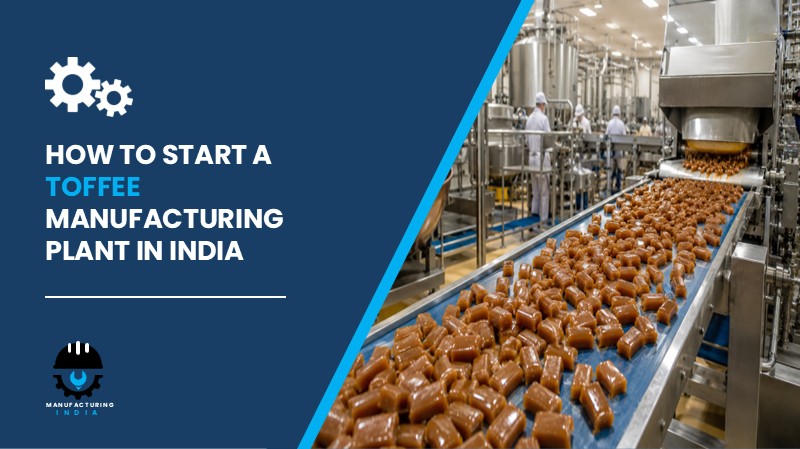
The primary production process covers mixing of ingredients including sugar, butter, and milk, controlled heating and boiling for caramelisation, cooling, forming, cutting, and packaging. End-use industries served include confectionery, bakery, ice cream and frozen desserts, and foodservice. Applications span toffee candies, caramel fillings, chocolate-coated toffees, bakery inclusions, and dessert toppings.
Cost of Setting Up a Toffee Manufacturing Plant in India
The cost of establishing a toffee manufacturing plant in India depends on plant capacity, product mix across hard toffee, butter toffee, chocolate-coated toffee, and premium variants, cooking technology selection between batch and continuous cooker systems, geographic location — particularly proximity to sugar supply and distribution networks — degree of automation, and the FSSAI food safety compliance requirements applicable to confectionery manufactured and sold in India.
1. Capital Expenditure (CapEx)
Land and Site Development forms a foundational component of total capital investment, covering land acquisition charges, site registration, boundary development, drainage infrastructure, and site utilities. The location must offer easy access to key raw materials such as sugar, glucose syrup, milk solids, fats and oils, and flavours. Proximity to target markets — particularly the large wholesale confectionery distribution hubs in Maharashtra, Uttar Pradesh, and Gujarat — minimises distribution costs across India’s extensive and multi-tiered confectionery trade channel. The site must have robust infrastructure including reliable transportation, utilities, and waste management systems. Compliance with local zoning laws and environmental regulations must also be ensured. Confectionery industrial zones in Pune, Nashik, Noida, and Bengaluru offer established FSSAI-compliant food manufacturing infrastructure and distribution network access.
Plant Layout Optimisation is critical for a food-grade toffee manufacturing facility. The layout must be optimised to enhance workflow efficiency, hygiene, and minimise material handling between the mixing, cooking, cooling, forming, cutting, and packaging stages. Separate areas for raw material storage for sugar, glucose syrup, milk solids, fats, and flavours, the cooking and caramelisation production area, cooling and forming operations, cutting and wrapping, quality control testing, finished goods storage, and dispatch must be designated. Space for future capacity expansion must be incorporated to accommodate business growth as distribution network depth and product range diversity develop.
Machinery and Equipment represent the largest single component of total CapEx for a toffee manufacturing plant. Essential equipment includes:
- Batch or continuous cookers
- Mixing vessels
- Vacuum cookers (optional for premium products)
- Cooling conveyors
- Rope sizers
- Cutting and forming machines
- Packaging systems
Other Capital Costs include an effluent treatment plant (ETP) for managing process water and confectionery effluents from cleaning operations, pre-operative expenses, FSSAI licence application costs, commissioning charges, and any import duties on specialised continuous cooker systems or high-speed wrapping machines not available domestically at the required throughput specification.
Request a Sample Report for In-Depth Market Insights: https://www.imarcgroup.com/toffee-manufacturing-plant-project-report/requestsample
2. Operational Expenditure (OpEx)
Raw Material Cost is the overwhelmingly dominant operational expense, accounting for approximately 65–75% of total OpEx. The primary raw materials are sugar, glucose syrup, milk solids, fats and oils, and flavours. Sugar — as the primary carbohydrate feedstock consumed in the largest volumes — drives the vast majority of raw material cost and is priced in correlation with India’s domestic sugarcane production cycles, government minimum support price policies, and seasonal availability. Glucose syrup provides the anti-crystallisation properties essential for toffee texture consistency. Milk solids contribute the dairy richness characteristic of butter toffee formulations. Fats and oils determine the mouthfeel and glossy appearance of finished products. Flavours including vanilla, butterscotch, and fruit variants differentiate product lines and support brand positioning. Long-term contracts with reliable suppliers for all primary raw materials must be negotiated to stabilise pricing and ensure a steady supply across seasonal production cycles.
Utility Cost is the second-largest OpEx component, representing approximately 10–15% of total operating expenses, covering electricity and fuel — LPG or piped natural gas — for batch or continuous cookers and vacuum cookers, electricity for mixing vessels, cooling conveyor systems, cutting machines, and packaging equipment, and water for process cleaning. Cooking energy management is the primary utility cost optimisation lever, with continuous cooker systems offering better energy efficiency per tonne of output than batch systems at commercial production volumes.
Other Operating Costs include transportation and distribution to wholesale confectionery distributors, modern trade retail chains, e-commerce fulfilment centres, bakery ingredient suppliers, and impulse retail channels, packaging materials including primary individual wrappers, secondary display cartons, and export master cartons, salaries and wages for cooking operators and packaging line staff, routine machinery maintenance including cooker cleaning cycles and cutting blade replacement, FSSAI compliance and audit costs, depreciation on production equipment, and applicable taxes. By the fifth year, the total operational cost is expected to increase substantially due to factors such as inflation, market fluctuations, and potential rises in the cost of key materials. Additional factors, including supply chain disruptions, rising consumer demand, and shifts in the global economy, are expected to contribute to this increase.
3. Plant Capacity
The proposed manufacturing facility is designed with an annual production capacity ranging between 2,000 and 8,000 tonnes, enabling economies of scale while maintaining the operational flexibility to serve multiple product lines — from value-positioned hard toffees and butter toffees for the mass retail and kirana store market through to premium gourmet toffees with organic ingredients, chocolate coatings, and artisanal flavours for modern trade and export channels. Plant capacity can be customised per investor requirements and scaled through additional cooker capacity and packaging lines as distribution relationships and brand presence develop. Profitability improves with higher capacity utilisation, making established supply agreements with large wholesale distributors or private-label supply contracts with modern trade retailers a commercial foundation from the outset.
4. Profit Margins and Financial Projections
The financial projections for a toffee manufacturing plant demonstrate healthy profitability potential under normal operating conditions. Gross profit margins typically range between 35–45%, supported by stable demand across confectionery, bakery, ice cream, and foodservice customer segments. Net profit margins are projected at 18–25% — commercially attractive returns that reflect the meaningful value-added cooking and forming conversion of sugar and butter raw materials into a finished, branded, and packaged confectionery product with strong consumer appeal. A comprehensive financial analysis covering NPV (net present value), IRR (internal rate of return), payback period, gross margin progression, and net margin development across a five-year horizon is essential before committing capital.
Why Set Up a Toffee Manufacturing Plant in India?
Essential Everyday Confectionery Product with Universal Consumer Appeal. Toffees are among the most widely consumed confectionery items, enjoyed by children and adults alike. Their long shelf life, easy portability, and universal taste appeal position them as a staple product across retail channels such as kirana stores, supermarkets, school canteens, and impulse purchase points. This universal, non-cyclical demand profile — driven by the deeply ingrained confectionery consumption habit across India’s 1.4 billion consumers — provides a commercial foundation that is more resilient to economic cyclicality than most discretionary food product categories.
India’s Confectionery Market Growing Against a USD 2.9 Billion Chocolate Market Backdrop. The Indian chocolate market reached Rs. 25,245 Crore (USD 2.9 Billion) in 2024, reflecting the depth and growth of consumer spending on confectionery across all segments. Within this broader market context, toffees — as one of the most affordable and accessible confectionery formats — benefit from both the market’s overall growth momentum and the enduring preference of India’s large value-conscious consumer base for accessible sweet indulgences at price points below premium chocolate.
Megatrend Alignment with Rising Snack Consumption and Modern Retail Expansion. Rising disposable incomes, urbanisation, and expanding modern retail are driving higher consumption of affordable snack and confectionery products. The confectionery sector in emerging markets continues to see steady growth, with toffees remaining a high-volume, low-cost indulgence product. E-commerce penetration into tier-2 and tier-3 cities is extending organised confectionery retail reach beyond metro areas, creating new consumer access points for packaged toffee products from organised manufacturers.
Premium Toffee Innovation Creating Higher-Margin Product Opportunities. The rise of premium toffees, often made with high-quality ingredients like organic butter, gourmet flavours, and unique fillings, is tapping into the growing trend for luxury sweets — a market segment where Indian consumers with rising disposable incomes are increasingly willing to pay premium prices for differentiated, premium-positioned confectionery products. In July 2025, Mars, Incorporated announced plans to grow its U.S.-based manufacturing by investing an estimated USD 2 Billion into its operations across the country by the end of 2026 — a scale of investment from the world’s largest confectionery company that confirms the commercial confidence in the global confectionery sector’s long-term growth.
Innovation in Flavours, Packaging, and Health-Aligned Variants. Innovation is key to the toffee market, with brands experimenting with new flavours, textures, and packaging to appeal to health-conscious consumers by offering low-sugar or sugar-free alternatives. Sustainability is also gaining traction, with eco-friendly packaging and responsible sourcing becoming priorities for many companies. Indian toffee manufacturers who invest in flavour innovation, sustainable packaging, and health-aligned product variants — such as jaggery-based toffees, honey toffees, and fortified functional confectionery — can access growing premium consumer segments alongside the established mass market.
Policy and Food Industry Support for Domestic Manufacturing. Government initiatives supporting food processing, MSME manufacturing, and packaged food production — including the Pradhan Mantri Formalisation of Micro Food Processing Enterprises Scheme and Ministry of Food Processing Industries programmes — encourage domestic confectionery manufacturing and infrastructure development for food businesses. In December 2025, Toffee Coffee Roasters raised ₹5 Crore in a Pre-Series A round led by Inflection Point Ventures to support fast-expanding operations — a signal of active investor confidence in India’s branded food and confectionery sector.
Manufacturing Process — Step by Step
The toffee manufacturing process uses mixing of ingredients, controlled heating and boiling for caramelisation, cooling, forming, cutting, and packaging as the primary production method. Each stage requires controlled temperature profiles, consistent formula adherence, and quality verification to deliver toffees meeting the texture, colour, flavour, and hygiene specifications required by confectionery retail, bakery, and foodservice customers.
- Raw Material Weighing and Preparation: Sugar, glucose syrup, milk solids, fats and oils, and flavours are weighed in the specified formula proportions and prepared for loading into the mixing and cooking system, with raw material quality checks for moisture content, purity, and sensory characteristics conducted before each production batch.
- Ingredient Mixing: Weighed sugar, glucose syrup, milk solids, and fat ingredients are combined in mixing vessels with controlled water addition to achieve a uniform solution ready for controlled caramelisation cooking.
- Controlled Heating and Caramelisation (Boiling): The mixed ingredient solution is processed through batch or continuous cookers — or optionally through vacuum cookers for premium products where lower cooking temperatures preserve delicate flavour notes — at precisely controlled temperatures and residence times to achieve the desired degree of caramelisation, develop the characteristic deep golden colour and rich toffee flavour, and reduce moisture content to the hard-crack stage specification required for the product’s target texture profile.
- Flavour Addition: After cooking, flavour essences, vanilla, fruit extracts, or other flavour components are added and homogenised into the toffee mass at the specified addition level, with care taken to avoid excessive temperature at the flavour addition stage to preserve volatile aroma compounds.
- Cooling and Tempering: The hot toffee mass is discharged onto cooling conveyors where controlled ambient air or water-cooled surface cooling reduces temperature to the working range required for forming operations, developing the consistency that enables rope forming and cutting without excessive sticking or crumbling.
- Rope Sizing and Forming: Tempered toffee mass is processed through rope sizers that draw the material into continuous ropes of the specified diameter corresponding to the target toffee piece size, with rope temperature and draw speed controlled to maintain consistent rope diameter and prevent rope breakage or dimensional variation.
- Cutting and Forming: Continuous toffee ropes are processed through cutting and forming machines that cut the rope into individual toffee pieces of the specified length and optionally impart shaped impressions or embossed branding patterns onto the cut pieces, with cutting speed synchronised to rope speed for consistent piece weight.
- Quality Control and Inspection: Finished toffee pieces undergo quality inspection covering weight per piece, moisture content, hardness, colour, flavour intensity, and microbiological compliance against FSSAI specification requirements before release for packaging.
- Packaging: Specification-compliant toffee pieces are individually wrapped in primary packaging — twist wraps, flow wraps, or pillow packs — using packaging systems at high production speeds, then packed into secondary retail display cartons, master export cartons, or bulk containers for dispatch to wholesale confectionery distributors, modern retail chains, e-commerce platforms, bakery ingredient suppliers, and foodservice customers.
Key Applications
Toffee manufactured in India serves a commercially broad and structurally growing range of confectionery and food ingredient applications:
- Confectionery Industry: Manufacturing of chewy toffees, caramel candies, and similar sugar-based treats for retail impulse sale, gifting, and daily snacking consumption across India’s vast kirana and modern retail distribution network.
- Food Processing: Use in the production of flavoured sweets, caramel fillings, and coated confectionery products as ingredients for secondary food manufacturers producing filled chocolates, coated wafers, and confectionery novelties.
- Bakery and Dessert Products: Ingredient in toppings, inclusions, and flavouring components for cakes, pastries, and desserts across India’s expanding organised bakery and QSR sectors.
- Retail and Packaged Foods: Individually wrapped toffees and assorted confectionery products for consumer retail markets across all trade channels, including impulse point-of-sale displays, gifting packs, and premium assortment boxes.
Leading Manufacturers
The global toffee industry is served by a group of large multinational confectionery companies with extensive production capacities and diversified application portfolios across confectionery, bakery, and foodservice segments. Key players in the global market include:
- Mondelez International
- The Hershey Company
- Nestlé S.A.
- Ferrero Group
- Perfetti Van Melle
Timeline to Start the Plant
Establishing a toffee manufacturing plant in India involves a structured multi-phase development sequence. Investors should plan for the following phases:
- Feasibility study and project report preparation
- Land acquisition and site development
- Regulatory approvals and environmental clearances
- Factory licence and fire safety compliance
- Machinery procurement and installation
- Raw material supplier agreements and supply chain setup
- Trial production and quality testing
- Commercial production launch
Licences and Regulatory Requirements
Starting a toffee manufacturing unit in India requires several approvals spanning business registration, food safety, environmental, and industrial compliance domains:
- Business registration (Proprietorship, LLP, or Pvt Ltd)
- Factory Licence under the Factories Act
- Environmental Clearance from the State Pollution Control Board
- GST Registration
- Fire Safety NOC — particularly important given the use of open flame or steam heating in cooking operations and the presence of sugar at high temperatures
- FSSAI (Food Safety and Standards Authority of India) Central or State licence mandatory for commercial manufacture and sale of toffee and sugar confectionery products
- Effluent Treatment Plant (ETP) operational clearance for managing process water and confectionery effluents from CIP cleaning operations
- Occupational Health and Safety compliance including hot surface burn prevention measures for cooking and forming operations
Key Challenges to Consider
Sugar Price Volatility and Seasonal Procurement Cycles. Sugar accounts for approximately 65–75% of total OpEx — the highest raw material cost concentration in food manufacturing — with pricing subject to sugarcane production cycles, monsoon variability, government MSP and export-import policy decisions, and seasonal crushing season supply fluctuations. Managing this cost exposure requires seasonal forward procurement during harvest periods when prices are typically lowest, adequate sugar storage infrastructure to bridge inter-seasonal supply gaps, and customer contract pricing mechanisms that allow material cost pass-through adjustments.
FSSAI Compliance and Food Safety Management. Toffee manufacturing requires comprehensive FSSAI compliance covering facility hygiene, Good Manufacturing Practice (GMP), product formulation documentation, labelling requirements — including ingredient declaration, nutritional information, and FSSAI licence number — and microbiological safety standards. Maintaining these compliance requirements across all production batches demands dedicated quality management infrastructure, laboratory testing capability, and well-trained food safety personnel.
Competitive Market with Established National and Multinational Brands. The Indian confectionery market is served by established multinational players including Perfetti Van Melle (Alpenliebe, Mentos), Mondelez, and Nestlé, alongside strong domestic brands with decades of distribution network depth and consumer loyalty. New entrants must differentiate through product quality consistency, flavour innovation, competitive pricing, regional distribution advantages, or private-label supply agreements to establish commercially meaningful market positions.
Sugar Handling and Hot Process Safety Management. Toffee manufacturing involves handling sugar at extreme temperatures — exceeding 150°C at the hard-crack cooking stage — creating burn risk that requires comprehensive hot surface safety measures, appropriate personal protective equipment, and operator training. Steam or direct-fired cooking systems require pressure vessel compliance and regular safety inspection under factory safety regulations.
Distribution Network Development for Market Reach. India’s confectionery distribution model is complex and geographically dispersed, with effective market reach requiring established relationships across a multi-tier network of stockists, super-stockists, distributors, and retail channel partners across urban, semi-urban, and rural geographies. Building this distribution infrastructure requires sustained investment in sales force, trade promotions, and distributor relationship management that must be developed alongside production capacity.
Product Innovation and Premiumisation Pressure. The toffee market’s evolution toward premium, organic, low-sugar, and sustainably packaged variants creates continuous pressure on manufacturers to invest in product development capability and ingredient innovation — a challenge that requires dedicated food technology resources alongside core production management.
Frequently Asked Questions
1. How much does it cost to set up a toffee manufacturing plant in India?
Capital requirements generally include land acquisition, construction, equipment procurement, installation, pre-operative expenses, and initial working capital. Equipment costs — including batch or continuous cookers, mixing vessels, vacuum cookers, cooling conveyors, rope sizers, cutting and forming machines, and packaging systems — represent a significant portion of capital expenditure. The total amount varies with capacity, technology, and location. A detailed project report with full CapEx and OpEx breakdowns is available on request.
2. Is toffee manufacturing profitable in India in 2026?
Yes. The project demonstrates gross profit margins of 35–45% and net profit margins of 18–25% under normal operating conditions, supported by stable and growing demand from India’s vast confectionery retail market — with the Indian chocolate and confectionery market reaching Rs. 25,245 Crore in 2024 — and the global toffee market’s growth from USD 13.40 Billion in 2025 to USD 22.64 Billion by 2034 at a 6.0% CAGR.
3. What machinery is required for a toffee manufacturing plant in India?
Key machinery includes batch or continuous cookers, mixing vessels, vacuum cookers for premium products, cooling conveyors, rope sizers, cutting and forming machines, and packaging systems. Batch or continuous cookers are the most production-critical equipment, determining cooking consistency, caramelisation degree, and the texture profile that defines the product’s sensory quality and consumer appeal.
4. What licences and approvals are required to start a toffee manufacturing plant in India?
Required approvals include business registration, a Factory Licence under the Factories Act, Environmental Clearance from the State Pollution Control Board, GST registration, a Fire Safety NOC, FSSAI Central or State food safety licence for confectionery manufacturing, ETP operational clearance, and Occupational Health and Safety compliance including hot process safety measures.
5. What raw materials are needed for toffee manufacturing?
The primary raw materials are sugar, glucose syrup, milk solids, fats and oils, and flavours. Sugar accounts for approximately 65–75% of total operating expenses, making sugar procurement strategy, seasonal forward buying, storage infrastructure, and price risk management the most critical cost management levers for the investment.
6. What are the environmental compliance requirements for a toffee manufacturing plant in India?
The unit must obtain Environmental Clearance from the State Pollution Control Board, operate a certified ETP for managing process water and confectionery effluents from CIP cleaning operations, implement solid organic waste management for production trimmings and off-specification product, and maintain monitoring systems for wastewater discharge and any boiler stack emissions in line with applicable state pollution control standards for food processing facilities.
7. What is the best location to set up a toffee manufacturing plant in India?
Optimal locations offer proximity to domestic sugar supply from major producing states, reliable utilities including stable electricity and steam or gas supply for cooking operations, logistics connectivity to large wholesale confectionery distribution hubs, and established food manufacturing industrial infrastructure. Food processing zones in Maharashtra, Uttar Pradesh, Gujarat, and Karnataka are among the most strategically relevant options.
8. What is the break-even period for this type of plant in India?
The break-even period depends on plant capacity, product mix, capacity utilisation rate, sugar pricing trends, and demand conditions across confectionery retail, bakery ingredient, and foodservice customer segments. A detailed financial analysis including payback period, NPV, and IRR projections is included in the full project report, available via the sample request link.
9. What government incentives are available for manufacturers in India?
The Make in India initiative, Pradhan Mantri Formalisation of Micro Food Processing Enterprises Scheme, Ministry of Food Processing Industries support programmes, and state-level food processing zone incentives provide financial and regulatory support for toffee manufacturing investments. Capital subsidies, interest subvention, power tariff concessions, and export promotion benefits for packaged confectionery products may be applicable depending on the chosen plant location and production scale.
Key Takeaways for Investors
A toffee manufacturing plant in India represents a commercially accessible, margin-rich, and demand-stable food manufacturing investment positioned at the intersection of India’s vast and deeply ingrained confectionery consumption culture, rising disposable incomes driving premiumisation, and the expanding modern retail and e-commerce channels that are extending organised confectionery market reach to consumers across the country’s entire geographic and income spectrum. The project demonstrates sound financial viability across annual production capacities of 2,000 to 8,000 tonnes, with gross profit margins of 35–45% and net profit margins of 18–25% confirming commercially attractive unit economics supported by the meaningful value-added caramelisation and forming conversion of sugar and butter into a finished, branded, and packaged confectionery product with universal consumer appeal. The global toffee market, valued at USD 13.40 Billion in 2025, is projected to reach USD 22.64 Billion by 2034, growing at a CAGR of 6.0%, with India’s domestic confectionery market reaching Rs. 25,245 Crore in 2024 confirming the scale and growth momentum of the domestic opportunity. With Mars investing USD 2 Billion in manufacturing expansion by end of 2026 confirming global confectionery sector investment confidence, premium toffee innovation expanding the addressable market upward into gourmet segments, and India’s kirana and modern retail networks providing unmatched distribution reach for established confectionery brands, demand sustainability for India-based toffee manufacturing is structurally robust, consumer habit-driven, and commercially compelling across the full investment horizon.
About the Author