Setting up a surgical adhesive tapes manufacturing plant in India presents a compelling investment case driven by rapidly growing demand across hospitals, clinics, surgical centres, home healthcare, emergency medical services, and pharmaceutical packaging. Surgical adhesive tapes are an indispensable consumable in modern healthcare practice – used for wound care, securing medical devices, post-surgical dressing, first aid, and patient monitoring systems. As India’s healthcare infrastructure expands at an unprecedented pace, the volume of surgical procedures, hospital admissions, and home healthcare services is rising steadily, creating consistent and large-scale institutional demand for reliable, medical-grade adhesive tape products that meet strict biocompatibility and hypoallergenic standards.
India’s structural advantages make this a strategically sound investment. The country’s rapidly scaling hospital and clinic network, the growing penetration of home healthcare services, and the expansion of emergency medical services across tier-2 and tier-3 cities are all generating incremental demand for surgical adhesive tapes at every level of the healthcare delivery chain. The Asia Pacific region already dominates the global surgical adhesive tapes market with a revenue share of 48.0%, positioning India – as one of the region’s fastest-growing healthcare markets – at the epicentre of this growth. The Government of India’s Make in India initiative and Ayushman Bharat’s push to expand healthcare access to underserved populations are simultaneously accelerating both the volume of surgical procedures performed and the infrastructure investment needed to support them, directly underpinning demand for this product category.
India’s position within the Asia Pacific region, which holds 48.0% of the global surgical adhesive tapes market, combined with rising surgical volumes, expanding home healthcare adoption, and institutional procurement by major medical facilities nationwide, makes a surgical adhesive tapes manufacturing plant a high-margin and structurally durable investment. With gross margins of 40–45% and net margins of 15–25% across a capacity of 120–180 million rolls annually, the return profile is compelling and the demand outlook structurally well-supported.
What are Surgical Adhesive Tapes?
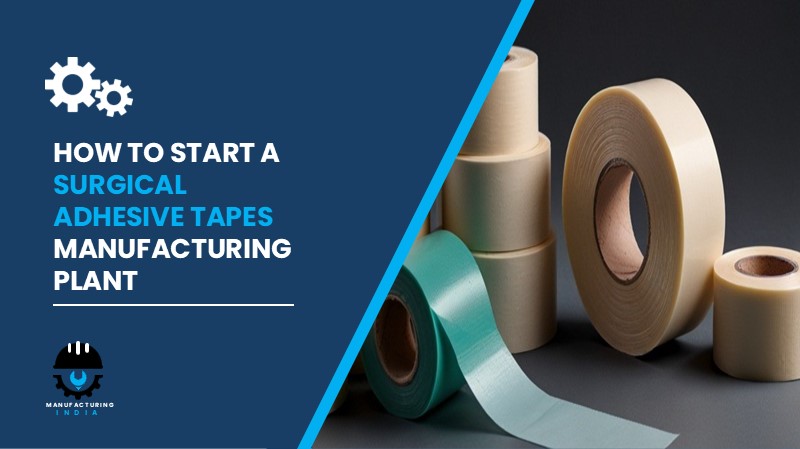
Surgical adhesive tapes are medical-grade tapes used for dressing, catheter, and medical device attachment to the skin, thus providing reliable adhesion without irritation. These tapes are made of biocompatible materials – including non-woven fabrics, polyethylene, or polyurethane – with hypoallergenic adhesives that guarantee good adhesion, easy removal, and breathability, all of which favour proper wound healing and patient comfort.
Surgical adhesive tapes are available in multiple types – cloth tapes, paper tapes, plastic tapes, and elastic tapes – to meet the diverse clinical requirements across different patient demographics and care settings. Their consistent quality, ease of use, and compatibility with medical standards make them an indispensable consumable in hospitals, clinics, surgical centres, home healthcare settings, first aid kits, and emergency care environments. The introduction of breathable, elastic, and waterproof tape variants has further broadened product acceptance across the clinical community.
The primary production method is raw material inspection and preparation, adhesive coating, backing material lamination, cutting and slitting, quality testing, and packaging – a tightly controlled multi-stage process that ensures every roll meets the biocompatibility, adhesion strength, and hypoallergenic compliance standards required by medical-grade customers. End-use industries served include hospitals, clinics, surgical centres, home healthcare, emergency medical services, and pharmaceutical packaging.
Cost of Setting Up a Surgical Adhesive Tapes Manufacturing Plant in India
The cost of establishing this facility depends on capacity, technology selection, plant location, degree of automation, and regulatory compliance requirements.
1. Capital Expenditure (CapEx)
Total capital investment for a surgical adhesive tapes manufacturing plant in India covers land acquisition, site preparation, civil construction, machinery, and pre-operative expenses. The cost of land and site development – including charges for land registration, boundary development, and other related expenses – forms a substantial part of the overall investment. This allocation ensures a solid foundation for safe and efficient plant operations. Investors can reduce land acquisition costs by locating the unit in a medical devices manufacturing cluster, pharmaceutical SEZ, or Special Economic Zone (SEZ), which also provide shared infrastructure and potential state-level incentives aligned with healthcare sector investment promotion.
Civil works and construction encompass the main production building – which must meet cleanroom or controlled-environment standards appropriate for medical-grade manufacturing – as well as raw material storage for nonwoven fabric, acrylic adhesive, and liners, a finished goods warehouse, a quality control laboratory, and an administrative block. All civil infrastructure must comply with food and drug administration facility standards applicable to medical device manufacturing in India.
Machinery costs account for the largest portion of total capital expenditure. Key machinery required includes:
- Adhesive coating machines
- Laminators
- Slitters
- Packaging machines
- QC instruments
Other capital costs include the effluent treatment plant (ETP), advanced process monitoring systems, pre-operative expenses, trial production costs, and commissioning charges. All machinery must comply with industry standards for safety, efficiency, and reliability applicable to medical device and healthcare product manufacturing.
Request a Sample Report for In-Depth Market Insights: https://www.imarcgroup.com/surgical-adhesive-tapes-manufacturing-plant-project-report/requestsample
2. Operational Expenditure (OpEx)
The operating cost structure of a surgical adhesive tapes manufacturing plant is primarily driven by raw material consumption, which accounts for approximately 50–60% of total operating expenses (OpEx). Nonwoven fabric, acrylic adhesive, and liners are the three core raw materials. Securing long-term supply agreements with reliable domestic suppliers of these inputs is essential to mitigate price volatility and ensure consistent production quality. Minimising transportation costs by selecting suppliers in proximity to the facility is a key cost management consideration at the procurement planning stage.
Utility costs – comprising electricity for coating machines, laminators, slitters, and packaging equipment, as well as water – account for 15–20% of total OpEx. Other ongoing operating costs include transportation, packaging, salaries and wages, depreciation, taxes, equipment repairs and maintenance, and other miscellaneous expenses covering quality control testing consumables, regulatory compliance documentation, and waste management.
By the fifth year of operations, the total operational cost is expected to increase substantially due to factors such as inflation, market fluctuations, and potential rises in the cost of key materials. Additional factors including supply chain disruptions, rising consumer demand, and shifts in the global economy are expected to contribute to this increase.
3. Plant Capacity
The proposed manufacturing facility is designed with an annual production capacity ranging between 120 million and 180 million rolls, enabling economies of scale while maintaining operational flexibility. Capacity can be customised per investor requirements based on target institutional and retail healthcare markets, available capital, and degree of automation. Profitability improves materially with higher capacity utilisation, making domestic hospital supply contracts, government tender participation, and pharmacy and home healthcare distribution partnerships a commercial priority from the commissioning stage.
4. Profit Margins and Financial Projections
The project demonstrates healthy profitability potential under normal operating conditions. Gross profit margins typically range between 40–45%, supported by stable demand and value-added applications. Net profit margins range between 15–25%. A comprehensive financial model covering NPV (net present value), IRR (internal rate of return), payback period, liquidity analysis, uncertainty analysis, sensitivity analysis, and a full five-year profit and loss account provides investors with a rigorous analytical framework for assessing financial viability and long-term sustainability across different capacity and pricing scenarios.
Why Set Up a Surgical Adhesive Tapes Plant in India?
Rising Healthcare Demand Driving Consistent Volume Growth. The number of surgeries, hospital admissions, and home healthcare services – all of which require adhesive tapes – is growing rapidly across India. A 2023 analysis by the World Bank found that around 56.9% of all nations reported a 70.8% increase in surgical volumes, reflecting heightened transparency and monitoring of surgical activity globally. This increased focus on surgical procedures is directly boosting demand for surgical adhesive tapes, as hospitals and clinics adopt reliable products to ensure patient safety and effective wound management.
Asia Pacific Dominance Confirms Regional Market Strength. The Asia Pacific region dominated the global surgical adhesive tapes market with a revenue share of 48.0%, confirming that the region – and India as one of its most rapidly growing healthcare economies – is the primary driver of global demand expansion. Domestic producers in India are positioned to capture a growing share of this regional market at cost-competitive manufacturing economics relative to imports from higher-cost producing countries.
Ageing Population and Chronic Disease Growth. Demand is being fuelled by urban migration, the ageing of India’s population, and the growing number of chronic disease patients requiring regular wound care, catheter management, and medical device fixation. These demographic trends ensure a structurally growing patient base for surgical adhesive tape consumption across hospital, clinic, home healthcare, and emergency care settings over the long term.
Institutional Government Procurement Creating Reliable Order Flow. In November 2025, a government tender at All India Institute of Medical Sciences (AIIMS) in West Delhi procured elastic surgical adhesive tapes (V2), highlighting growing institutional adoption and large-scale demand. This government procurement activity underscores the expansion of surgical procedures, the emphasis on patient safety, and the increasing preference for advanced wound care solutions in hospitals and medical facilities nationwide – a reliable institutional demand channel that domestic producers can access through GeM and government hospital tender systems.
Innovation in Product Formats Expanding Market Reach. The introduction of breathable, elastic, and waterproof tape variants has broadened product acceptance across the clinical community. In December 2025, Zhejiang Kekang Medical Technology Co., Ltd. highlighted that antimicrobial surgical adhesive tapes gained prominence as a key tool in preventing surgical site infections – with hospitals and clinicians increasingly selecting actively protective tapes over standard passive materials. This shift toward functionally advanced tape products reflects a growing emphasis on patient safety and improved postoperative outcomes that creates value-added product development opportunities for Indian manufacturers.
Scalable Production with Strong Margin Economics. Surgical adhesive tapes manufacturing requires moderate capital investment relative to the gross margins achievable – 40–45% gross and 15–25% net – and benefits from high-volume production economics at the 120–180 million roll annual capacity range. The ability to customise tapes for medical grade, elasticity, adhesion strength, and hypoallergenic properties across cloth, paper, plastic, and elastic variants further expands the addressable market and supports premium product positioning.
Manufacturing Process – Step by Step
The surgical adhesive tapes manufacturing process uses raw material inspection and preparation, adhesive coating, backing material lamination, cutting and slitting, quality testing, and packaging as the primary production method. Each stage is designed to ensure biocompatibility, consistent adhesion performance, and full compliance with the medical-grade standards required by hospital, clinic, and home healthcare customers.
- Raw Material Receipt and Inspection: Nonwoven fabric, acrylic adhesive, and liners are received at the facility and subjected to incoming quality checks for grade specification, purity, tensile strength, and biocompatibility compliance before entering the production line.
- Raw Material Preparation: Backing materials – including nonwoven fabric, polyethylene, or polyurethane substrates – are prepared and conditioned to the required dimensions and surface specifications for the target tape type: cloth, paper, plastic, or elastic.
- Adhesive Coating: Acrylic adhesive is applied uniformly onto the backing material using adhesive coating machines. Coating weight, adhesive spread uniformity, and drying parameters are precisely controlled to achieve the target adhesion strength and hypoallergenic performance specification for each tape grade.
- Backing Material Lamination: Coated backing material is laminated with the liner layer using laminators to produce a composite tape roll with the correct peel force, liner release characteristics, and dimensional stability required by medical-grade customers.
- Cutting and Slitting: Laminated roll stock is fed through slitters to cut the wide-format material into the specific widths and lengths required for each tape product variant – from narrow catheter fixation tapes to wide wound dressing formats.
- Quality Testing: Finished tape rolls are subjected to QC instruments testing for adhesion strength, peel force, tensile strength, breathability, water resistance, skin compatibility, and dimensional compliance before release for packaging and dispatch.
- Packaging and Dispatch: Approved surgical adhesive tape rolls are packaged in protective outer packaging using packaging machines and dispatched to end-use customers across hospitals, clinics, surgical centres, home healthcare providers, emergency medical services, and pharmaceutical packaging applications.
Key Applications
The surgical adhesive tapes manufacturing plant serves a broad and clinically essential range of healthcare settings and applications across India’s expanding healthcare economy.
- Hospitals and Surgical Centres: Ensures secure and sterile wound management while supporting diverse surgical procedures – from minor outpatient operations to major inpatient surgeries – where reliable and skin-compatible tape adhesion is a patient safety requirement.
- Home Healthcare and First Aid: Patient care and injury management are simplified by using easy-to-use adhesive tapes in home healthcare settings, providing a growing retail and e-commerce distribution channel for domestic manufacturers.
- Emergency Medical Services: Quick and reliable adhesion is provided for trauma and emergency care situations – where ease of application, secure hold, and atraumatic removal are critical performance requirements for paramedic and emergency care teams.
- Pharmaceutical Packaging: Maintains product integrity and secures medical devices during transport and storage – a specialty packaging application where medical-grade tape properties and regulatory compliance are mandatory procurement criteria.
- Wound Care Management: Used in the secure fixation of wound dressings, absorbent pads, and gauze across hospital inpatient, outpatient, and home care wound management protocols, where breathability and hypoallergenic adhesive are the primary selection criteria.
- Patient Monitoring Systems: Applied in securing monitoring electrodes, sensor leads, and wearable medical device components to patient skin – an application segment growing alongside India’s expanding medical technology and patient monitoring equipment market.
Leading Manufacturers
The global surgical adhesive tapes industry is served by several established multinational manufacturers with extensive production capacities and diverse application portfolios. Key players operating in this market include:
- 3M
- Johnson & Johnson
- Smith & Nephew
- Medtronic
- Nitto Medical
All of these manufacturers serve end-use sectors including hospitals, clinics, home healthcare, emergency medical services, and pharmaceutical packaging – the same markets that a domestic Indian surgical adhesive tapes manufacturing plant can target as local healthcare demand accelerates.
Timeline to Start the Plant
Investors should plan for a structured pre-production and commissioning phase covering the following key stages:
- Feasibility study and project report preparation
- Land acquisition and site development
- Regulatory approvals and environmental clearances
- Factory licence and fire safety compliance
- Machinery procurement and installation
- Raw material supplier agreements and supply chain setup
- Trial production and quality testing
- Commercial production launch
Licences and Regulatory Requirements
Starting a surgical adhesive tapes manufacturing unit in India requires several approvals:
- Business registration (Proprietorship, LLP, or Private Limited Company)
- Factory Licence under the Factories Act
- Environmental Clearance from the State Pollution Control Board
- GST Registration
- Fire Safety NOC
- Medical device manufacturing licence under the Medical Devices Rules, 2017 administered by CDSCO (Central Drugs Standard Control Organisation)
- Effluent Treatment Plant (ETP) operational clearance
- Occupational Health and Safety compliance
Key Challenges to Consider
High Capital Requirements. Establishing a fully equipped surgical adhesive tapes manufacturing plant – with adhesive coating machines, laminators, slitters, cleanroom or controlled-environment production areas, packaging machines, and QC instruments – at a capacity of 120–180 million rolls annually requires significant upfront capital investment. Access to healthcare sector manufacturing incentives and MSME credit-linked subsidy schemes can help manage this requirement.
Raw Material Price Volatility. Nonwoven fabric, acrylic adhesive, and liners – which together account for 50–60% of total OpEx – are subject to global petrochemical feedstock price fluctuations and supply chain disruptions. Long-term procurement contracts with reliable domestic suppliers and a diversified sourcing strategy are essential risk mitigation measures for maintaining production cost stability.
Regulatory Compliance. Surgical adhesive tapes are classified as medical devices in India and must comply with the Medical Devices Rules, 2017. Manufacturing facilities require CDSCO licensing, Quality Management System (QMS) certification aligned with ISO 13485, and biocompatibility testing compliance per ISO 10993 standards. Maintaining continuous regulatory compliance and documentation for traceability adds materially to ongoing operational overhead.
Technology and Innovation Pressure. The global market is shifting toward functionally advanced products – including antimicrobial tapes, waterproof elastic variants, and breathable film backings – as evidenced by the December 2025 prominence of antimicrobial surgical adhesive tapes highlighted by Zhejiang Kekang Medical Technology Co., Ltd. Indian producers must invest in product development and clinical validation capabilities to remain competitive with global innovators in premium product segments.
Competition from Global Players. Established multinational manufacturers – including 3M, Johnson & Johnson, Smith & Nephew, Medtronic, and Nitto Medical – set high benchmarks for product quality, clinical validation, and brand trust in hospital procurement decisions. Domestic producers must differentiate through competitive pricing, faster delivery, India-specific product customisation, and participation in government procurement channels through GeM and institutional tender systems.
Skilled Manpower. Operating adhesive coating machines, laminators, slitters, and QC instruments in a medical-grade manufacturing environment while maintaining the documentation and process controls required for CDSCO compliance requires trained personnel. Recruiting, training, and retaining qualified coating process operators, quality assurance technicians, and regulatory affairs staff is a recurring operational challenge in India’s medical device manufacturing sector.
Frequently Asked Questions
1. How much does it cost to set up a surgical adhesive tapes manufacturing plant in India?
Total setup cost depends on plant capacity, location, machinery selection, and automation level. Key cost components include land and site development, cleanroom-compliant civil construction, machinery (adhesive coating machines, laminators, slitters, packaging machines, QC instruments), and pre-operative expenses. A detailed feasibility study is recommended to generate accurate project-specific cost estimates.
2. Is surgical adhesive tapes manufacturing profitable in India in 2026?
Yes. The project delivers strong financial performance, with gross margins of 40–45% and net profit margins of 15–25% under normal operating conditions. The Asia Pacific region dominates the global surgical adhesive tapes market with a 48.0% revenue share, and India’s fast-growing healthcare infrastructure and rising surgical volumes position domestic producers to capture a large and expanding share of regional demand.
3. What machinery is required for a surgical adhesive tapes plant in India?
Essential equipment includes adhesive coating machines, laminators, slitters, packaging machines, and QC instruments.
4. What licences and approvals are required to start a surgical adhesive tapes plant in India?
Required approvals include business registration, Factory Licence, Environmental Clearance from the State Pollution Control Board, GST Registration, Fire Safety NOC, medical device manufacturing licence under the Medical Devices Rules 2017 from CDSCO, ETP operational clearance, and Occupational Health and Safety compliance.
5. What raw materials are needed for surgical adhesive tapes manufacturing?
The primary raw materials are nonwoven fabric, acrylic adhesive, and liners. Together these account for 50–60% of total operating expenses and must be sourced from suppliers meeting biocompatibility and medical-grade material specifications.
6. What are the environmental compliance requirements for a surgical adhesive tapes plant in India?
The facility must obtain Environmental Clearance from the State Pollution Control Board and operate an approved ETP. Advanced monitoring systems must be installed to detect deviations in the process, and effluent treatment systems must minimise environmental impact. Documentation for traceability and regulatory compliance must be maintained throughout operations.
7. What is the best location to set up a surgical adhesive tapes plant in India?
Locations offering proximity to nonwoven fabric and acrylic adhesive raw material suppliers, reliable utility supply, and access to hospital, clinic, and pharmaceutical packaging end-user clusters are preferred. States such as Gujarat, Maharashtra, Tamil Nadu, and Uttar Pradesh – which host major healthcare infrastructure and medical device manufacturing ecosystems – are strong candidates for plant location.
8. What is the break-even period for this type of plant in India?
The break-even period depends on plant capacity, total capital investment, product selling price, and capacity utilisation rate. A comprehensive financial analysis covering NPV, IRR, payback period, and uncertainty and sensitivity analysis is the most reliable method for generating project-specific break-even timelines.
9. What government incentives are available for manufacturers in India?
Surgical adhesive tapes manufacturers in India can access the Production Linked Incentive (PLI) scheme for medical devices, MSME credit-linked capital subsidy schemes, state government investment promotion subsidies in medical device parks, and export promotion incentives under schemes administered by the Ministry of Commerce. Participation in government hospital procurement through the Government e-Marketplace (GeM) provides direct access to institutional demand from AIIMS, state medical corporations, and central government hospitals.
Key Takeaways for Investors
A surgical adhesive tapes manufacturing plant in India offers a high-margin and commercially well-grounded investment opportunity anchored by growing demand across hospitals, clinics, surgical centres, home healthcare, emergency medical services, and pharmaceutical packaging – all of which require consistent and reliable medical-grade adhesive tape products. The project is financially viable across the 120–180 million roll annual capacity range, with gross margins of 40–45% and net margins of 15–25% providing one of the strongest return profiles in the medical consumables manufacturing segment. The Asia Pacific region dominates the global surgical adhesive tapes market with a 48.0% revenue share, and within this region India’s healthcare expansion – driven by rising surgical volumes confirmed by World Bank data showing a 70.8% increase in surgical activity across 56.9% of nations surveyed, and government institutional procurement activity at facilities like AIIMS – is creating a structurally growing and increasingly localisation-oriented demand base for surgical adhesive tapes. For investors seeking exposure to India’s healthcare manufacturing cycle with a scalable, moderate capital intensity, and high-margin medical consumable product, a surgical adhesive tapes manufacturing plant represents a compelling and strategically well-timed industrial venture.
About the Author