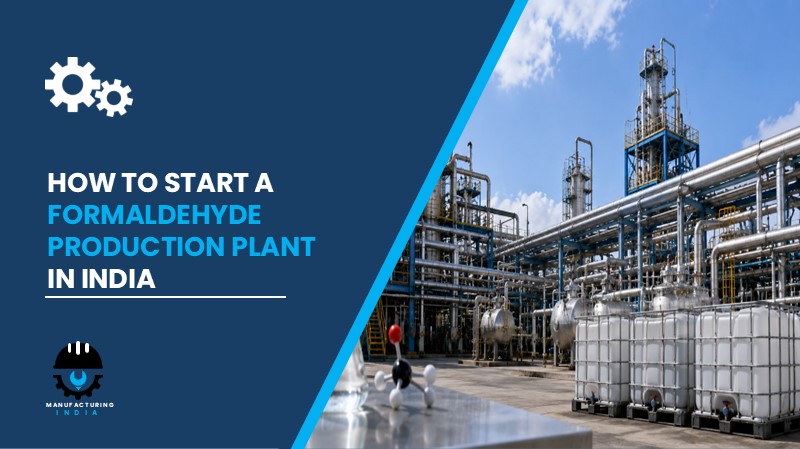
Setting up a formaldehyde production plant in India presents a compelling investment case, anchored by robust and diversified demand from the construction, automotive, furniture, textile, chemical, healthcare, and agriculture industries. Formaldehyde is a foundational chemical intermediate used in the production of engineered wood panels, resins, adhesives, disinfectants, textile finishes, and automotive components, making it an indispensable input across multiple high-growth industrial sectors. As India accelerates its infrastructure development, residential housing rollout, and industrial production capacity, demand for this chemical and its downstream derivatives is expected to grow consistently over the coming decade.
India offers a compelling combination of structural advantages for investors considering this production segment. Rapid urbanisation, an expanding middle class driving furniture and housing demand, and government-led infrastructure projects have collectively created a sustained pull for formaldehyde-based resins and adhesives. The Make in India initiative reinforces domestic chemical production, and industrial clusters in states such as Gujarat, Maharashtra, and Uttar Pradesh offer well-developed logistics networks, reliable utility infrastructure, and proximity to both raw material suppliers and end-use industries. For investors evaluating chemical production opportunities, this investment in India represents a strategically sound and financially viable commitment.
Setting up a formaldehyde production plant in India benefits from strong policy support through Make in India, cost-competitive land and labour, and surging demand from construction, furniture, automotive, and textile sectors. With gross profit margins of 25–35% and a break-even horizon of 3–5 years, the investment case is robust across a range of plant capacities.
What is Formaldehyde?
Formaldehyde (CH₂O) is a colourless, strong-reacting organic chemical with a pungent and notable odour, widely used as a chemical intermediate for production purposes. It is highly water-soluble, acts as a strong reducing agent, and is a fast-reacting material — properties that make it exceptionally valuable as a raw material within resin production due to its excellent binding and preservative qualities and fast cross-linking reactions.
This chemical is primarily marketed and distributed in two forms: as an aqueous solution under the commercial name formalin, and as a captive input within resin production — specifically as urea-formaldehyde resin, phenol-formaldehyde resin, and melamine-formaldehyde resin. The primary production method is methanol oxidation using a silver catalyst-based conversion process, followed by aqueous or vapour absorption. End-use industries served include chemical production, textiles, automotive, construction, healthcare, and agriculture — a broad spread that underpins demand resilience.
Cost of Setting Up a Formaldehyde Production Plant in India
The total cost of establishing a formaldehyde production plant depends on several variables including capacity, technology choice, geographic location, level of automation, and regulatory compliance requirements. Investors should evaluate both capital expenditure (CapEx) and operational expenditure (OpEx) carefully to build a realistic financial plan.
1. Capital Expenditure (CapEx)
Land acquisition and site preparation form a substantial portion of the overall capital investment. Costs include land registration charges, boundary development, levelling, and drainage preparation. Investors may consider locating the facility within a Special Economic Zone (SEZ) or a designated chemical industrial estate to benefit from infrastructure support, reduced utility costs, and regulatory facilitation.
Civil expenditure covers the construction of the production shed, quality control laboratory, raw material and finished goods storage, effluent treatment infrastructure, and the administrative block. Given that the facility handles a reactive chemical intermediate, construction standards must comply with fire safety, ventilation, and hazardous material handling norms.
Machinery costs represent the largest single component of capital expenditure. Key machinery required includes:
- Methanol storage tanks
- Catalytic reactors (silver or metal oxide catalyst systems)
- Vaporizers
- Absorption towers and recovery units
- Distillation columns and purification units
- Cooling systems
- Pumps, compressors, and blowers
- Storage and packaging equipment
- Pollution control devices (scrubbers and emission controls)
- Quality control laboratories
Additional capital items include the effluent treatment plant (ETP), pre-operative and commissioning expenses, and import duties applicable to specialised equipment or catalyst systems sourced internationally.
Request a Sample Report for In-Depth Market Insights: https://www.imarcgroup.com/formaldehyde-manufacturing-plant-project-report/requestsample
2. Operational Expenditure (OpEx)
The operating cost structure of this production unit is primarily driven by raw material consumption. The key inputs are methanol (the primary feedstock), air, and catalysts — either silver-based or iron-molybdenum systems. Methanol alone accounts for approximately 70–80% of total operating expenses. Investors are advised to negotiate long-term procurement contracts with reliable domestic and international suppliers to mitigate price volatility and ensure supply continuity.
Electricity, water, and steam together account for 10–15% of operational expenditure. Given the exothermic reaction profile of the formaldehyde production process, cooling water and thermal management systems are particularly significant utility drivers. The remaining operational cost categories include transportation, packaging, salaries and wages, maintenance, depreciation, taxes, and other overheads. By the fifth year of operations, the total operational cost is expected to increase substantially due to inflation, potential rises in methanol prices, supply chain disruptions, and rising consumer demand.
3. Plant Capacity
The facility covered in the IMARC Group project report is designed with an annual production capacity ranging between 100,000 and 200,000 MT, enabling economies of scale while maintaining operational flexibility. Capacity can be customised to suit the investor’s specific market requirements and financial bandwidth. Profitability improves significantly with higher capacity utilisation, as fixed costs are distributed across a larger output volume.
4. Profit Margins and Financial Projections
The unit demonstrates healthy profitability potential under normal operating conditions. Gross profit margins typically range between 25–35%, supported by stable demand and value-added applications. Net profit margins are projected at 10–15%. Financial projections cover net present value (NPV), internal rate of return (IRR), payback period analysis, income and expenditure projections, and sensitivity analysis across market scenarios. Break-even typically ranges from 3 to 5 years, depending on scale, demand, and operational cost management.
Why Set Up a Formaldehyde Plant in India?
Expanding Construction and Infrastructure Activity. The residential construction industry grew at 6.8% during FY2024–25 and is poised to reach USD 350 billion by 2030. This expansion directly drives demand for plywood, MDF, and particleboard — all of which rely on formaldehyde-based resins as a primary binding input. India’s sustained infrastructure push makes construction a long-term anchor for demand from this type of production facility.
Growth in Furniture and Interior Design. India’s expanding middle class and rising urban housing completions are fuelling growth in furniture and interior design segments. Both sectors are significant consumers of urea-formaldehyde and melamine-formaldehyde resins, reinforcing steady domestic demand for the chemical.
Automotive Lightweighting and Vehicle Production. Automotive lightweighting trends and increasing vehicle production in India contribute to higher consumption of formaldehyde-based plastics and coatings used in vehicle component production. As India cements its position as a global automotive hub, this demand driver will continue to strengthen.
Policy and Regulatory Tailwinds. Government investments in housing, infrastructure, and domestic chemical production under Make in India — along with building material standards and import substitution policies — indirectly reinforce demand across end-use sectors and create a supportive regulatory environment for new entrants.
Cost-Competitive Production Base. India offers competitive land acquisition costs, affordable industrial labour, and a well-developed raw material supply chain. Methanol is available through domestic suppliers and established import channels, enabling production economics that are favourable relative to many competing geographies.
Active Industry Investment. In May 2024, INEOS Oxide and LyondellBasell (LYB) announced the completion of the sale of LYB’s Ethylene Oxide and Derivatives business and associated production facilities in Bayport, Texas, to INEOS — signalling ongoing consolidation and capital deployment in the global chemical intermediate sector, with implications for regional supply dynamics.
Production Process – Step by Step
The formaldehyde production process uses methanol oxidation with silver catalyst-based conversion and aqueous or vapour absorption as the primary method. Each stage involves controlled unit operations, material handling, and quality checks.
- Methanol Handling and Vaporization: Methanol is received, stored in dedicated tanks, and vaporized into gaseous form for the catalytic reaction.
- Air Mixing: The methanol vapour is mixed with air in controlled proportions before introduction into the reaction system.
- Catalytic Reaction: The mixture passes through a reactor — using silver or iron-molybdenum catalyst systems — where partial oxidation and dehydrogenation convert the feed to formaldehyde gas.
- Absorption: Formaldehyde gas is absorbed in water using absorption columns and recovery units to produce an aqueous solution.
- Purification and Concentration: The absorbed product passes through distillation columns and purification units to achieve the required concentration and purity.
- Cooling and Stabilisation: Cooling systems stabilise the product and manage exothermic heat generated during reaction and absorption stages.
- Quality Control Testing: Finished product is tested in the on-site laboratory for concentration, purity, and stability before dispatch clearance.
- Storage, Packaging, and Dispatch: The solution is transferred to dedicated storage tanks and dispatched to end-use industries including construction, furniture, automotive, textiles, healthcare, and agriculture.
Key Applications
This chemical serves a broad range of sectors, functioning as a critical building block across industrial and consumer-facing value chains.
- Chemical Production: Used as a primary feedstock for producing urea-formaldehyde, phenol-formaldehyde, and melamine-formaldehyde resins and adhesives.
- Construction: Integral to the production of plywood, MDF, particleboard, and other engineered wood products used in residential and commercial buildings.
- Textiles: Applied in finishing processes to produce wrinkle-resistant fabrics and improve fabric durability.
- Automotive: Used in the production of formaldehyde-based plastics, coatings, and vehicle interior components aligned with lightweighting requirements.
- Healthcare: Deployed as a disinfectant and preservative in medical and laboratory environments.
- Agriculture: Used in pesticide formulation and agrochemical production.
Leading Producers
The global formaldehyde industry is served by several multinational producers with extensive production capacities and diversified application portfolios across chemical production, textiles, automotive, construction, healthcare, and agriculture. Key players include:
- BASF SE
- Celanese Corporation
- Perstorp Holding AB
- Hexion Inc.
- Dynea AS
- LCY Chemical Corp.
Timeline to Start the Plant
Investors should plan for a structured development timeline of approximately 12 to 18 months from project initiation to commercial launch:
- Feasibility study and project report preparation
- Land acquisition and site development
- Regulatory approvals and environmental clearances
- Factory licence and fire safety compliance
- Machinery procurement and installation
- Raw material supplier agreements and supply chain setup
- Trial production and quality testing
- Commercial production launch
Licences and Regulatory Requirements
Starting a formaldehyde production unit in India requires several approvals, given this chemical’s classification as a reactive and hazardous intermediate:
- Business registration (Proprietorship, LLP, or Pvt Ltd)
- Factory Licence under the Factories Act
- Environmental Clearance from the State Pollution Control Board
- GST Registration
- Fire Safety NOC
- Hazardous and Chemical compliance certifications
- Effluent Treatment Plant (ETP) operational clearance
- Occupational Health and Safety compliance
Key Challenges to Consider
High Capital Requirements. Establishing a production unit at the 100,000–200,000 MT annual capacity scale demands significant upfront capital for land, civil works, catalytic reactor systems, and compliance infrastructure. Securing appropriate project financing is critical to managing cash flow during the pre-revenue phase.
Raw Material Price Volatility. Methanol — the primary feedstock accounting for 70–80% of OpEx — is subject to global price fluctuations tied to natural gas markets and biomass supply chains. Silver and iron-molybdenum catalyst costs can also shift based on commodity dynamics, requiring proactive procurement strategies.
Regulatory Compliance. Formaldehyde’s hazardous chemical classification means environmental clearances, emission controls, ETP certifications, and occupational health standards are subject to rigorous enforcement. Delays in regulatory approvals can extend the project timeline and increase pre-operative costs.
Technology and Innovation Pressure. Regulatory pressure related to emissions and occupational exposure has encouraged producers to adopt cleaner technologies and low-emission resin formulations, shaping modern production strategies. Investors must plan for ongoing technology investment to remain competitive and compliant.
Competition. The global market includes established multinational players such as BASF SE, Celanese Corporation, Perstorp Holding AB, Hexion Inc., Dynea AS, and LCY Chemical Corp., alongside regional producers. New entrants must differentiate on supply reliability, proximity to customers, and cost efficiency.
Skilled Manpower. Operating catalytic reactors, managing hazardous materials, and maintaining continuous-process production equipment requires trained chemical engineers and technicians — particularly in chemical process safety roles — a persistent challenge for new facilities.
Frequently Asked Questions
1. How much does it cost to set up a formaldehyde production plant in India?
Total investment depends on plant capacity, technology, location, and automation level, covering land, civil works, catalytic reactors, supporting machinery, utilities, and working capital. The IMARC Group project report provides detailed CapEx breakdowns customised by capacity and location.
2. Is formaldehyde production profitable in India in 2026?
Yes. With gross profit margins of 25–35% and net profit margins of 10–15%, the business demonstrates healthy profitability. Returns improve with higher capacity utilisation and disciplined raw material procurement.
3. What machinery is required for a formaldehyde production plant in India?
Essential equipment includes methanol storage tanks, catalytic reactors (silver or metal oxide systems), vaporizers, absorption towers, distillation columns, cooling systems, pumps, compressors, scrubbers, storage and packaging equipment, and quality control laboratories.
4. What licences and approvals are required to start a formaldehyde production plant in India?
Required approvals include business registration, a Factory Licence, Environmental Clearance from the State Pollution Control Board, GST Registration, Fire Safety NOC, hazardous chemical compliance certifications, ETP operational clearance, and Occupational Health and Safety compliance.
5. What raw materials are needed for formaldehyde production?
The primary raw materials are methanol (the main feedstock), air, and catalysts — either silver-based or iron-molybdenum systems. Methanol accounts for approximately 70–80% of total operating costs.
6. What are the environmental compliance requirements for a formaldehyde production plant in India?
The facility must obtain Environmental Clearance from the State Pollution Control Board, operate a certified ETP, install emission control systems including scrubbers, and comply with occupational exposure limits as mandated by national and state-level environmental regulations.
7. What is the best location to set up a formaldehyde production plant in India?
Ideal locations offer proximity to methanol suppliers, access to industrial-grade utilities, reliable transport, and proximity to end-use industries such as plywood producers, resin facilities, and automotive component makers. Chemical industrial clusters in Gujarat, Maharashtra, and Uttar Pradesh are typically well-suited.
8. What is the break-even period for this type of plant in India?
Break-even typically ranges from 3 to 5 years, depending on plant capacity, market demand, and the costs associated with safety, storage, and quality assurance for this reactive compound.
9. What government incentives are available for producers in India?
Governments may offer capital subsidies, tax exemptions, reduced utility tariffs, export benefits, or interest subsidies under national or regional industrial policies, including schemes aligned with Make in India and import substitution objectives.
Key Takeaways for Investors
A formaldehyde production plant in India represents a strategically well-positioned investment opportunity, with robust demand from construction, furniture, automotive, textiles, healthcare, and agriculture sectors driving consistent volume growth. The production unit demonstrates financial viability across a range of capacities, with gross margins of 25–35% and net margins of 10–15% achievable under normal operating conditions and a realistic break-even horizon of 3 to 5 years. The global formaldehyde market was valued at USD 8.68 billion in 2025 and is projected to reach USD 14.41 billion by 2034, at a CAGR of 5.51% from 2026 to 2034 — a trajectory that underpins long-term demand sustainability. With urbanisation, infrastructure investment, and industrial expansion in India continuing at pace, the outlook for domestically produced formaldehyde remains compelling for investors who move early in this growth cycle.
About the Author