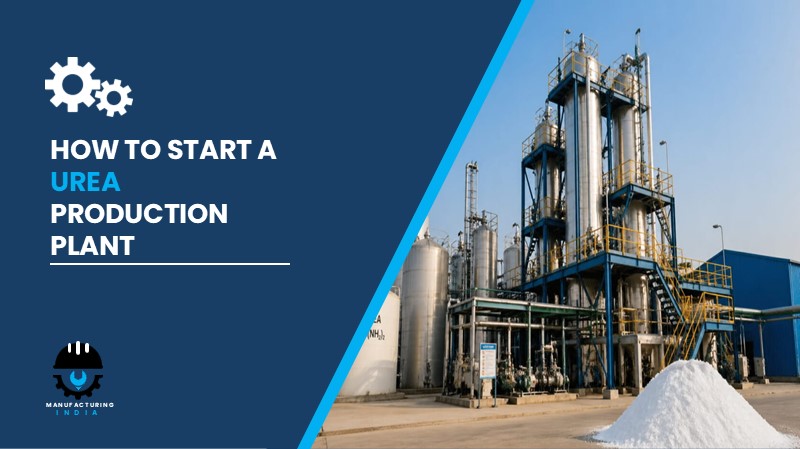
Setting up a urea production plant in India presents a compelling investment case driven by the rise in worldwide nitrogen fertilizers, a larger area under agriculture, governments’ incentives for farmers to grow more crops, and the use of high-efficiency fertilizers. Urea – also known as carbamide (CO(NH₂)₂) – is a concentrated nitrogen-based fertilizer utilised in agriculture to enhance soil fertility and increase the yield of crops. It is the most widely used synthetic fertilizer around the world, valued for its high nitrogen content, low cost, and ease of transport and storage. As India’s agricultural sector continues to intensify its focus on crop productivity, balanced fertilization, and food security, urea remains the foundational nitrogen input for cereals, pulses, vegetables, horticulture, and plantation crops – ensuring a large, institutionally supported, and structurally durable domestic demand base for domestic urea producers.
India’s structural advantages make this a strategically sound investment. An Indian government Comptroller and Auditor General (CAG) audit for FY2022 surveyed farmers in Madhya Pradesh and revealed low awareness of balanced fertilization – with about 83% of farmers receiving no guidance from the agriculture department while 91% lacked training or seminars on proper fertilizer use. This gap supports rising demand for urea as farmers increasingly rely on it to boost crop yields, confirming the structural dependency of India’s farming community on urea as the primary nitrogen source. The government’s subsidies and pro-fertilizer policies back large-scale urea production and distribution, while the global urea market was valued at USD 53.49 billion in 2025 and is expected to reach USD 61.16 billion by 2034 at a CAGR of 1.5% according to IMARC Group estimates – positioning a domestic urea production plant in India to capture consistent and policy-backed demand from one of the world’s largest fertilizer consumption nations.
India’s farmer dependence on urea confirmed by CAG audit data, government subsidy backing for fertilizer production and distribution, and a global urea market growing from USD 53.49 billion in 2025 to USD 61.16 billion by 2034 make a urea production plant a financially sound and structurally well-supported agricultural infrastructure investment. With gross margins of 20–30% and net margins of 8–12% across a capacity of 500,000–1,000,000 MT annually, the project delivers consistent returns aligned with India’s food security mandate.
What is Urea?
Urea, also known as carbamide (CO(NH₂)₂), is a concentrated nitrogen-based fertilizer utilised in agriculture to enhance soil fertility and increase the yield of crops. It is a white crystalline solid, water soluble, and supports quick plant growth and productivity through rapid nitrogen delivery to plant root zones. Urea comes in several grades – prilled, granular, and coated – specifically made for various types of crops and soils. Its application can be done by mixing with soil or in solution form via foliar feeding.
The fact that urea contains a high concentration of nitrogen, is inexpensive, and is easy to transport and store, is the reason why it is the most widely used synthetic fertilizer around the world. Different types of urea – including prilled, granular, coated, and slow-release variants – offer the flexibility of application based on specific crops and areas. Furthermore, urea is not only limited to agriculture but also has a place in industrial chemicals, resin production, and as a feed additive in animal husbandry.
The primary production method is ammonia synthesis, carbamate formation, urea synthesis, prilling or granulation, drying and cooling, and packaging – a multi-stage, high-pressure chemical production process. End-use industries served include agriculture (fertilizers), horticulture, animal feed, and chemical and resin production sectors.
Cost of Setting Up a Urea Production Plant in India
The cost of establishing this facility depends on capacity, technology selection, plant location, degree of automation, and regulatory compliance requirements.
1. Capital Expenditure (CapEx)
Total capital investment for a urea production plant in India covers land acquisition, site preparation, civil construction, process machinery, and pre-operative expenses. The cost of land and site development – including charges for land registration, boundary development, and other related expenses – forms a substantial part of the overall investment. This allocation ensures a solid foundation for safe and efficient plant operations. Investors can reduce land acquisition costs by locating the unit in an industrial estate, chemical zone, or Special Economic Zone (SEZ), which also provide shared utility infrastructure and potential state-level fiscal incentives aligned with India’s fertilizer production investment agenda.
Civil works and construction encompass the main ammonia synthesis, urea conversion, and granulation production building, raw material storage areas for natural gas, ammonia, and CO₂, a quality control laboratory, a finished goods warehouse, and an administrative block. Given that urea production operates under high pressure and involves handling of ammonia and CO₂, civil and structural infrastructure must incorporate appropriate containment, pressure-rated construction, explosion-proof elements, and comprehensive ventilation systems throughout the facility.
Machinery costs account for the largest portion of total capital expenditure. Key machinery required includes:
- Ammonia reactors
- Urea converters
- Prilling towers or granulators
- Dryers
- Coolers
- Screening units
- Automated packaging systems
All machinery must be high-quality and corrosion-resistant, tailored for urea production, and must comply with industry standards for safety, efficiency, and reliability. Other capital costs include the effluent treatment plant (ETP), advanced process monitoring systems, compressors, pumps, heat exchangers, and control systems for automation and safety, pre-operative expenses, trial production costs, and commissioning charges.
Request a Sample Report for In-Depth Market Insights: https://www.imarcgroup.com/urea-production-plant-project-report/requestsample
2. Operational Expenditure (OpEx)
The operating cost structure of a urea production plant is primarily driven by raw material consumption, particularly natural gas (feedstock and fuel), which accounts for approximately 70–80% of total operating expenses (OpEx). Ammonia and CO₂ are the primary derived raw material inputs – ammonia is usually produced from natural gas via steam reforming, while CO₂ is captured as a by-product. Securing long-term supply agreements with reliable natural gas suppliers and minimising transportation costs by selecting nearby suppliers is essential for cost stability and continuous production. Sustainability and supply chain risks must be assessed, and long-term contracts should be negotiated to stabilise pricing and ensure a steady supply.
Utility costs – comprising electricity, water, and steam consumed throughout ammonia synthesis, urea conversion, prilling, and cooling operations – account for 10–15% of total OpEx. Other ongoing operating costs include transportation, packaging, salaries and wages, depreciation, taxes, equipment repairs and maintenance, and other miscellaneous expenses.
In the first year of operations, the operating cost for the urea production plant is projected to be significant, covering raw materials, utilities, depreciation, taxes, packing, transportation, and repairs and maintenance. By the fifth year, the total operational cost is expected to increase substantially due to factors such as inflation, market fluctuations, and potential rises in the cost of key materials. Additional factors, including supply chain disruptions, rising consumer demand, and shifts in the global economy, are expected to contribute to this increase.
3. Plant Capacity
The proposed production facility is designed with an annual production capacity ranging between 500,000 and 1,000,000 MT, enabling economies of scale while maintaining operational flexibility. Mass production with the help of state-of-the-art technology guarantees cost reductions and efficient stock control. Capacity can be customised per investor requirements based on target state agricultural market size, available capital, and chosen production technology. Profitability improves materially with higher capacity utilisation, making domestic supply agreements with state agricultural departments, fertiliser cooperatives, and private agri-input distributors a commercial priority from the commissioning stage.
4. Profit Margins and Financial Projections
The project demonstrates healthy profitability potential under normal operating conditions. Gross profit margins typically range between 20–30%, supported by stable demand and value-added applications. Net profit margins range between 8–12%. Break-even in a urea production business typically ranges from 5 to 7 years, depending on capital investment, operating costs, market pricing, and plant efficiency – with government subsidies and export opportunities able to influence this timeline favourably. A comprehensive financial model covering NPV (net present value), IRR (internal rate of return), payback period, liquidity analysis, uncertainty analysis, sensitivity analysis, and a full five-year profit and loss account provides investors with a rigorous analytical framework for assessing financial viability across different capacity and pricing scenarios.
Why Set Up a Urea Plant in India?
Rising Agricultural Demand Anchoring Structural Growth. The expanding population worldwide and the demand for food are the main reasons for the nitrogen fertilizers market, along with urea. India’s agricultural sector – supporting approximately 55% of the country’s population – is intensifying its use of nitrogen inputs to meet rising food production targets. The CAG audit for FY2022 confirming that 83% of farmers in Madhya Pradesh received no guidance from the agriculture department and 91% lacked training on proper fertilizer use illustrates both the current dependence on urea and the structural upside as extension services improve and farmers adopt more fertilizer-intensive practices.
Government Subsidy Framework Providing Market Stability. The large-scale production and distribution of fertilizers are backed by the government’s subsidies and pro-fertilizer policies. India’s fertiliser subsidy architecture provides price support for urea at the farm level – making it accessible to small and marginal farmers who represent the majority of India’s agricultural land users – while ensuring producers receive consistent and policy-backed revenue, providing a measure of market stability and demand predictability that is particularly valuable for investors planning large-capacity urea production operations.
Expanding Urea Applications Beyond Agriculture. Urea is not only used in agriculture but also has a place in industrial chemicals, resin production, and as a feed additive in animal husbandry. Its use as a feedstock in the manufacture of melamine, urea-formaldehyde resins, and other chemicals creates an industrial demand channel that grows alongside India’s expanding chemical, adhesive, and wood-based industries sectors – diversifying revenue beyond pure agricultural fertiliser sales.
Product Customisation Enabling Value Differentiation. The different types of urea – prilled, granular, coated, and slow-release – offer the flexibility of application based on specific crops and areas. This product range enables domestic manufacturers to serve both the commodity price-sensitive bulk agricultural market and the premium slow-release or coated urea segments, where higher selling prices and improved nitrogen use efficiency are valued by commercial and horticultural growers.
E-Commerce and Organised Distribution Expanding Market Reach. The farmers in remote areas have also got access to urea via the well-organised distribution networks for fertilizers and e-commerce platforms. This distribution evolution creates new and cost-effective market access channels for domestic urea manufacturers to serve previously inaccessible rural and semi-rural farming communities – reducing distribution costs and improving procurement visibility across India’s geographically dispersed agricultural landscape.
Active Global and India-Specific Industry Developments. In December 2025, the Indian government laid the foundation stone of the Ammonia-Urea Fertilizer Project of Assam Valley Fertilizer and Chemical Company Limited at Namrup in Dibrugarh, Assam – involving about INR 11,000 crore investment to build a new plant with annual production of more than 12 lakh metric tons, aimed at improving urea supply, reducing logistics costs, and generating employment in the Northeast of the country. In November 2025, Mitsubishi commenced construction of a major USD 1.3 billion urea production facility in Kiyanly on the Caspian Sea coast in Turkmenistan – expected to produce 3,500 tons of urea and 2,000 tons of ammonia per day once completed between 2028 and 2029, aligning with Turkmenistan’s strategic goal to diversify its chemical production base. These investments confirm the commercial and policy confidence that both governments and global industry leaders are placing in long-term urea production capacity expansion.
Production Process – Step by Step
The urea production process uses ammonia synthesis, carbamate formation, urea synthesis, prilling or granulation, drying and cooling, and packaging as the primary production method. Each stage operates under precisely controlled temperature, pressure, and reaction conditions to ensure nitrogen concentration compliance, granule quality, and full compliance with the fertiliser grade specifications required by agricultural, horticultural, and industrial customers.
- Raw Material Receipt and Inspection: Natural gas (feedstock and fuel), ammonia, and CO₂ are received at the facility and subjected to incoming quality checks for purity, pressure, and specification compliance before entering the process flow.
- Ammonia Synthesis: Natural gas is processed through steam reforming in ammonia reactors to produce synthesis gas (hydrogen and nitrogen), which is then catalytically converted into ammonia (NH₃) under high-pressure and high-temperature conditions.
- CO₂ Capture: CO₂ is captured as a by-product of the natural gas reforming process and compressed for use as the second primary reactant in urea synthesis.
- Carbamate Formation: Ammonia and CO₂ are combined in urea converters at high pressure and temperature to form ammonium carbamate (NH₄COONH₂) – an intermediate compound and the first step in the two-stage urea synthesis reaction.
- Urea Synthesis: Ammonium carbamate is dehydrated under continued high-pressure and high-temperature conditions in the urea converters to produce urea (CO(NH₂)₂) and water – the core synthesis reaction of the entire production process.
- Decomposition and Concentration: Unconverted carbamate and excess ammonia are separated from the urea solution through decomposition stages and recycled back to the synthesis section. The urea solution is concentrated by evaporation to the required melt concentration for prilling or granulation.
- Prilling or Granulation: Concentrated urea melt is either sprayed through prilling towers to form prilled urea as solidified droplets fall through a countercurrent airstream, or processed through granulators to form granular urea of the required particle size and strength specification.
- Drying and Cooling: Prilled or granular urea is processed through dryers and coolers to reduce moisture content and product temperature to within the specification limits required for safe storage, handling, and bagging.
- Screening: Dried and cooled urea is processed through screening units to classify particle size, remove oversized and undersized particles, and ensure consistent granule size distribution meeting the target product specification.
- Quality Inspection: Finished urea – in prilled, granular, or coated form – is analytically tested for nitrogen content, moisture, biuret content, and particle size distribution before release for packaging and dispatch.
- Automated Packaging and Dispatch: Approved urea is filled into bags using automated packaging systems and dispatched to end-use customers across the agriculture sector, horticulture, animal feed, and chemical and resin production industries.
Key Applications
The urea production plant serves a broad and commercially significant range of agricultural and industrial applications across India’s farming and chemical economy.
- Agriculture Sector: Urea boosts the nitrogen level in the soil, thus stimulating the growth of cereals, pulses, and vegetables – the dominant application across India’s cultivated agricultural land.
- Fertigation and Blending Units: Urea allows for the exact application of nutrients via fertigation systems and is mixed with other fertilizers in blending units to fulfil the specific nutrient needs of different crops across India’s diverse agro-climatic zones.
- Horticulture and Cash Crops: Urea assists in the production of large quantities of fruits, flowers, and plantation crops – a growing application segment aligned with India’s expanding organised horticulture sector.
- Industrial Nitrogen Source: Used as a feedstock in the manufacture of melamine, urea-formaldehyde resins, and other industrial chemicals – including as a raw material for adhesive, wood panel, and coating chemical manufacturers.
- Animal Feed Additive: Used as a feed additive in animal husbandry to supplement non-protein nitrogen in ruminant feed formulations – a specialty application segment requiring controlled-release or treated urea grades.
- Hydroponics and Controlled Agriculture: Urea in solution form is used via foliar feeding in hydroponics and controlled environment agriculture applications, where precise nutrient delivery and nitrogen management are essential for crop performance.
Leading Manufacturers
The global urea industry is served by several established multinational producers with extensive production capacities and diverse application portfolios. Key players operating in this market include:
- CF Industries Holdings Inc
- CJ Chemicals
- Dakota Gasification Company
- Koch Fertilizer LLC
- Yara North America Inc
All of these producers serve end-use sectors including agriculture, horticulture, fertilizer blending, and industrial nitrogen supply – the same markets that a domestic Indian urea production plant can target as domestic demand from government subsidy channels and organised agri-input distribution continues to grow.
Timeline to Start the Plant
Investors should plan for a structured pre-production and commissioning phase covering the following key stages:
- Feasibility study and project report preparation
- Land acquisition and site development
- Regulatory approvals and environmental clearances
- Factory licence and fire safety compliance
- Machinery procurement and installation
- Raw material supplier agreements and supply chain setup
- Trial production and quality testing
- Commercial production launch
The timeline to start a urea production plant typically ranges from 24 to 36 months, depending on factors such as plant size, location, technology selection, and regulatory approvals – including time for feasibility studies, design, procurement, construction, and commissioning.
Licences and Regulatory Requirements
Starting a urea production unit in India requires several approvals:
- Business registration (Proprietorship, LLP, or Private Limited Company)
- Factory Licence under the Factories Act
- Environmental Clearance from the State Pollution Control Board
- GST Registration
- Fire Safety NOC
- Hazardous chemical compliance for storage and handling of ammonia and CO₂ under the Manufacture, Storage and Import of Hazardous Chemical Rules
- Effluent Treatment Plant (ETP) operational clearance
- Occupational Health and Safety compliance
Key Challenges to Consider
High Capital Requirements. Establishing a fully equipped urea production plant – with ammonia reactors, urea converters, prilling towers or granulators, dryers, coolers, screening units, automated packaging systems, and supporting compressors and heat exchangers – at the 500,000–1,000,000 MT annual capacity range requires significant upfront capital investment. Access to fertiliser sector financing, government-backed term loans, and state government industrial investment promotion grants can help bridge funding requirements. Break-even typically ranges from 5 to 7 years.
Natural Gas Price Volatility. Natural gas (feedstock and fuel) – accounting for 70–80% of total OpEx – is directly linked to domestic gas allocation policies and global LNG price cycles. Gas price movements can materially compress operating margins without proactive hedging strategies and long-term gas supply agreements with domestic gas producers or importers. This is the single most critical cost management challenge in urea production.
Regulatory Compliance. Urea production involves high-pressure ammonia handling and CO₂ capture operations that are subject to India’s Hazardous Chemicals Rules. Advanced monitoring systems must be installed to detect leaks or deviations in the process. Effluent treatment systems are necessary to minimise environmental impact and ensure compliance with emission standards. Dedicated environmental, health, and safety management resources are non-negotiable operational requirements for any high-pressure fertiliser chemical facility.
Government Policy Dependency. The economics of urea production in India are significantly influenced by the government’s urea subsidy policy, gas price allocation under the fertiliser gas pool pricing mechanism, and import duty structures. Changes to any of these policy levers can impact the commercial viability of domestic urea producers, requiring investors to maintain close monitoring of fertiliser policy developments and engage proactively with industry associations.
Competition from Established Players. Established global and Indian urea producers – including Yara International ASA, SABIC, OCI N.V., Koch Fertilizer LLC, and major domestic players – hold large market positions across state fertiliser subsidy distribution channels. New entrants must compete through geographic market positioning, cost efficiency through technology selection, and reliable supply relationships with state agricultural departments and fertiliser cooperatives.
Skilled Manpower. Operating ammonia reactors, high-pressure urea converters, prilling towers, and automated packaging systems requires certified chemical process engineers and plant operators with specialised high-pressure process experience. Recruiting, training, and retaining qualified technical personnel – particularly for ammonia synthesis and urea conversion process control – is a recurring operational challenge in India’s chemical fertiliser production sector.
Frequently Asked Questions
1. How much does it cost to set up a urea production plant in India?
Total setup cost typically includes land acquisition, construction, equipment procurement – including ammonia reactors, urea converters, prilling towers or granulators, dryers, coolers, screening units, and automated packaging systems – installation, pre-operative expenses, and initial working capital. The total amount varies with capacity, technology, and location. A detailed feasibility study is recommended to generate accurate project-specific cost estimates.
2. Is urea production profitable in India in 2026?
Yes. The project delivers healthy financial performance, with gross margins of 20–30% and net profit margins of 8–12% under normal operating conditions. The global urea market was valued at USD 53.49 billion in 2025 and is projected to reach USD 61.16 billion by 2034 at a CAGR of 1.5% according to IMARC Group, with India’s government subsidy framework and rising agricultural demand providing a structurally secure domestic revenue base.
3. What machinery is required for a urea plant in India?
Essential equipment includes ammonia reactors, urea converters, prilling towers or granulators, dryers, coolers, screening units, and automated packaging systems. Auxiliary equipment includes compressors, pumps, heat exchangers, and control systems for automation and safety.
4. What licences and approvals are required to start a urea plant in India?
Required approvals include business registration, Factory Licence, Environmental Clearance from the State Pollution Control Board, GST Registration, Fire Safety NOC, hazardous chemical compliance for ammonia and CO₂ handling under the Hazardous Chemicals Rules, ETP operational clearance, and Occupational Health and Safety compliance.
5. What raw materials are needed for urea production?
Primary raw materials are natural gas (feedstock and fuel), ammonia (NH₃), and carbon dioxide (CO₂). Natural gas is the dominant cost driver, accounting for 70–80% of total operating expenses. Ammonia is produced from natural gas via steam reforming, while CO₂ is captured as a by-product of the reforming process. Water, power, and catalysts are additional process inputs.
6. What are the environmental compliance requirements for a urea plant in India?
The facility must obtain Environmental Clearance from the State Pollution Control Board, operate an approved ETP, and comply with the Hazardous Chemicals Rules for ammonia storage and handling. Advanced monitoring systems must be installed to detect leaks or process deviations, and regular effluent monitoring, atmospheric emission reporting, and safety audit documentation are mandatory throughout operations.
7. What is the best location to set up a urea plant in India?
The location must offer easy access to key raw materials such as natural gas (feedstock and fuel), ammonia, and CO₂, while proximity to target agricultural markets minimises distribution costs. The site must have robust infrastructure including reliable transportation, utilities, and waste management systems. States with natural gas pipeline infrastructure – including Gujarat, Andhra Pradesh, Uttar Pradesh, and Assam (as confirmed by the December 2025 Namrup plant foundation stone) – are strong candidates.
8. What is the break-even period for this type of plant in India?
Break-even in a urea production business typically ranges from 5 to 7 years, depending on capital investment, operating costs, market pricing, and plant efficiency. Government subsidies and export opportunities can influence this timeline favourably.
9. What government incentives are available for manufacturers in India?
Governments may offer incentives such as capital subsidies, tax exemptions, reduced utility tariffs, export benefits, or interest subsidies to promote urea production under national or regional industrial policies. India’s fertiliser subsidy architecture under the Department of Fertilizers provides per-tonne subsidy support that directly underpins the commercial viability of domestic urea manufacturers. Financing can also be arranged through term loans, government-backed schemes, private equity, equipment leasing, or strategic partnerships.
Key Takeaways for Investors
A urea production plant in India offers a well-grounded and policy-backed investment opportunity anchored by growing demand across the agriculture sector, horticulture, animal feed, and chemical and resin production industries – all of which depend on urea as a critical nitrogen input that is indispensable to India’s food production system. The project is financially viable across the 500,000 to 1,000,000 MT annual capacity range, with gross margins of 20–30% and net margins of 8–12% providing a consistent return framework supported by a break-even horizon of 5 to 7 years at efficient capacity utilisation. According to IMARC Group estimates, the global urea market is set to grow from USD 53.49 billion in 2025 to USD 61.16 billion by 2034 at a CAGR of 1.5%, and India’s government CAG audit data – confirming 83% of farmers in Madhya Pradesh receive no guidance from the agriculture department – illustrates the structural demand floor that government subsidy policy and farmer dependence on urea create for domestic manufacturers. With the Indian government committing INR 11,000 crore to a new 12-lakh MT urea plant at Namrup in December 2025, and with global players such as Mitsubishi investing USD 1.3 billion in new urea capacity in November 2025, the long-term demand sustainability for domestically produced urea is structurally sound across all investment planning horizons.
About the Author