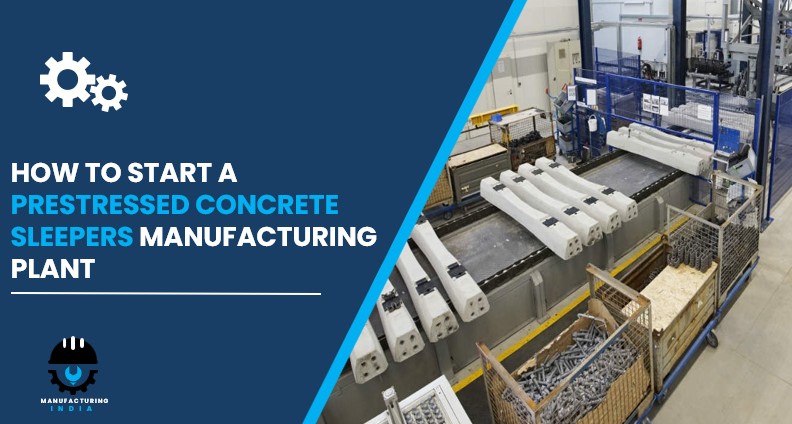
Setting up a prestressed concrete sleepers manufacturing plant in India presents a compelling investment opportunity, driven by accelerating demand from railway infrastructure expansion, metro transit development, high-speed rail construction, and government-backed modernisation programmes across emerging and developed economies. As one of the most critical components of modern railway track systems, prestressed concrete sleepers serve as the foundational structural element supporting rails, distributing load from rolling stock to the ballast bed, and maintaining precise track gauge under conditions of heavy axle loads, high-speed operations, and dynamic vibration stress.
Growth is underpinned by massive capital expenditure commitments from national rail agencies and international development finance institutions, the ongoing replacement of ageing wooden and plain concrete sleeper infrastructure with superior prestressed concrete alternatives, expansion of urban metro and light rail networks in rapidly urbanising cities, and electrification and dedicated freight corridor development programmes in rail-intensive economies including India, China, Southeast Asia, and Africa. The global prestressed concrete sleepers market size was valued at USD 2.79 Billion in 2025. According to IMARC Group estimates, the market is expected to reach USD 4.57 Billion by 2034, exhibiting a CAGR of 5.6% from 2026 to 2034.
The Indian railway sector represents one of the world’s largest and fastest-growing markets for prestressed concrete sleepers. According to the India Brand Equity Foundation (IBEF), Indian Railways achieved a record revenue of Rs. 2,70,000 crore (US$ 31.57 billion) by the close of FY25, with government capital expenditure totalling Rs. 2,52,000 crore (US$ 29.41 billion), underscoring the scale of public investment in rail infrastructure. Continued track expansion, gauge conversion, doubling, and electrification programmes across India’s extensive rail network create structurally stable, long-duration demand for prestressed concrete sleeper supply at commercial manufacturing scale.
With gross profit margins typically ranging between 25 to 35% and net profit margins of 10 to 20%, a dedicated prestressed concrete sleepers manufacturing plant represents both a financially sound and strategically well-timed investment for construction material manufacturers, infrastructure conglomerates, civil engineering contractors, and institutional investors targeting India’s expanding railway and transit infrastructure markets.
What are Prestressed Concrete Sleepers?
Prestressed concrete sleepers are reinforced concrete railway ties manufactured through a precision precast and pre-tensioning process in which high-tensile steel wires or strands are stressed before concrete is poured around them. When the concrete hardens and the tension is released, the steel places the concrete into a state of residual compression, dramatically improving the sleeper’s ability to resist the tensile stresses, bending moments, and dynamic impact loads imposed by passing trains.
Compared to conventional wooden or plain concrete sleepers, prestressed concrete sleepers offer superior load-bearing capacity, dimensional stability, resistance to environmental degradation and biological attack, longer service life typically exceeding 50 years, and reduced track maintenance requirements, making them the standard specification for modern railway construction globally. They are widely deployed in mainline railway tracks, high-speed rail lines, heavy haul freight corridors, metro and light rail systems, bridges, viaducts, and elevated track structures.
Primary raw materials for prestressed concrete sleeper manufacturing include cement (ordinary Portland cement or sulphate-resistant cement), fine and coarse aggregates, water, and high-tensile steel wire or prestressing strand as the tensioning element. Finished products are supplied to national and regional railway authorities, metro rail corporations, engineering procurement and construction (EPC) contractors, and private infrastructure developers across domestic and export markets.
Cost of Setting Up a Prestressed Concrete Sleepers Manufacturing Plant
The total cost of establishing a prestressed concrete sleepers manufacturing plant depends on several variables including annual production capacity (number of sleepers per year), level of process automation and quality control sophistication, geographic location and proximity to raw material supply, site development requirements, equipment technology selection, and applicable regulatory certification and compliance requirements. A thorough feasibility assessment covering all CapEx and OpEx components is essential before committing capital, given the capital-intensive, precision manufacturing, and quality-compliance-dependent nature of commercial prestressed concrete sleeper production.
1. Capital Expenditure (CapEx)
Capital investment for a prestressed concrete sleepers manufacturing plant covers several broad cost heads. Land and site development forms a meaningful part of the overall investment, encompassing land registration charges, boundary development, drainage infrastructure, reinforced flooring for heavy precast operations, and related civil works. A typical commercial prestressed concrete sleeper manufacturing facility requires a land parcel sized to accommodate:
- Raw material receiving, storage, and handling area for cement, aggregate, and steel strand
- Concrete batching plant and mixing area
- Prestressing beds and mould installation zone
- Curing area including steam curing chambers or water curing tanks
- Demoulding, finishing, and inspection zone
- Finished goods storage and dispatch yard
- Quality control laboratory
- Effluent treatment and stormwater management area
- Utility installations and administrative block
Civil works and construction costs cover the prestressing bed foundations with high-precision anchor block installation, concrete batching plant infrastructure, steam curing chamber construction, quality control laboratory, finished goods yard with hardstanding, effluent treatment area, and administrative and welfare facilities. Machinery and equipment costs represent the largest single portion of total capital expenditure. Key machinery and equipment required includes:
- Prestressing Beds and Tensioning Systems: Long-line prestressing beds (typically 100 to 180 metres in length) with cast-in anchor blocks at each end, hydraulic jacking systems for steel strand tensioning to specified pre-stress levels, strand threading and positioning guides, multi-strand tensioning frames, load cells and elongation measurement instruments, and prestressing bed heating systems for accelerated curing compatibility.
- Concrete Batching and Mixing Plant: Computerised weigh-batching concrete mixing plants with aggregate bins and weigh hoppers, cement silos with screw conveyor feed, water metering systems, admixture dosing systems, twin-shaft or planetary concrete mixers for uniform mix production, aggregate conveyors, and dust suppression systems.
- Moulds and Demoulding Equipment: Steel or cast-iron sleeper moulds fabricated to precise dimensional tolerances for specified sleeper types (monoblock, twin-block, or special track sleepers), mould vibrators for concrete compaction, mould release agent application systems, and hydraulic or mechanical demoulding equipment for finished sleeper extraction.
- Steam Curing Chambers: Enclosed or semi-enclosed steam curing chambers with temperature and humidity control systems, steam generation boilers, temperature monitoring and recording instruments, and automated steam curing cycle controllers to achieve the required early strength development within controlled curing schedules.
- Finishing and Inspection Equipment: Shot-blasting or surface finishing equipment, rail seat machining tools for precise rail bearing surface preparation, dimensional inspection gauges and jigs, visual and structural inspection stations, and marking and identification systems.
- Quality Control Laboratory Equipment: Universal testing machines for concrete cube and cylinder compressive strength testing, beam flexure testing rigs for sleeper bending moment capacity verification, ultrasonic pulse velocity instruments, surface hardness testing equipment, chloride penetration and absorption testing apparatus, automated concrete mix workability and slump testing instruments, and calibration standards for all quality parameters to IS, EN, or UIC specifications.
- Concrete Transport and Placement Systems: Concrete transfer skips or belt conveyors, overhead cranes or gantry systems for mould handling and finished sleeper movement, forklift trucks and reach stackers for storage yard operations, and GPS-guided yard management systems for stock control.
- Steel Strand Handling Equipment: Steel strand coil handling reels and de-reeling systems, strand straightening equipment, cutting saws for precise strand length preparation, and strand storage systems.
- Effluent Treatment Plant: Settling tanks for concrete washwater and cement slurry treatment, pH adjustment systems, clarifiers, filter press or centrifuge for sludge dewatering, and water recycling systems for process water reuse in compliance with CPCB and state pollution control discharge norms.
- Utility and Support Systems: Electrical substations and transformers, standby diesel generators, steam boilers for curing operations, compressed air systems for pneumatic tools, process water treatment and supply systems, weighbridges for raw material and despatch vehicle management, CCTV and perimeter security systems, and SCADA-based production monitoring infrastructure.
Other capital costs include utility connection charges, pre-operative expenses, plant commissioning costs, import duties on specialised prestressing equipment or precision moulds not manufactured domestically, and certification and testing fees for initial product type approval under Indian Railways, RDSO, or international rail authority specifications.
Request a Sample Report for In-Depth Market Insights: https://www.imarcgroup.com/prestressed-concrete-sleepers-manufacturing-plant-project-report/requestsample
2. Operational Expenditure (OpEx)
The operating cost structure of a prestressed concrete sleepers manufacturing plant is heavily weighted toward raw material expenditure. Raw material costs, primarily cement and high-tensile steel prestressing strand along with aggregates and admixtures, typically account for 60 to 70% of total operating expenses, making raw material procurement strategy, supplier relationship management, and concrete mix optimisation the primary commercial priorities for cost control. Utility costs, particularly electricity for batching plant operations, cranes, and compressors, and steam for curing cycles, account for approximately 10 to 15% of total OpEx.
Additional operating costs include packaging and protective materials for rail transit and export despatch, outbound logistics and rail or road transportation to site, salaries and wages for civil engineers, concrete technologists, quality control inspectors, prestressing technicians, crane operators, and yard personnel, periodic equipment maintenance and mould refurbishment, laboratory consumables, mould release agents, and process chemicals, applicable BIS, RDSO, UIC, and export certification and renewal expenditure.
3. Plant Capacity
The proposed prestressed concrete sleepers manufacturing facility is designed with an annual production capacity ranging between 1 to 5 million sleepers, enabling meaningful economies of scale while preserving operational flexibility across the full product range, from standard monoblock prestressed concrete sleepers for mainline railway track to special design sleepers for level crossings, points and crossings, bridge approaches, and metro rail applications. Plant capacity can be customised based on the investor’s specific capital availability, target contract volumes from railway and metro rail authorities, available land area, and chosen product mix across standard and special application sleeper types.
Profitability improves considerably at higher capacity utilisation levels, given the significant fixed-cost component of prestressing bed infrastructure, curing chambers, and quality control systems, making early long-term supply agreements with Indian Railways, metro rail corporations, and major EPC contractors strategically important for achieving commercial break-even at pace.
4. Profit Margins and Financial Projections
A prestressed concrete sleepers manufacturing plant demonstrates healthy profitability potential under normal operating conditions. Gross profit margins typically range between 25 to 35%, supported by stable and structurally growing demand from railway network expansion, track renewal and replacement programmes, metro rail system construction, and the progressive transition away from wooden sleeper infrastructure under sustainability and lifecycle cost policies of national railway authorities. Net profit margins range between 10 to 20%.
Financial projections incorporate NPV analysis, IRR calculations, payback period modelling, and sensitivity analysis across plant capacity utilisation, cement and steel price scenarios, utility cost variations, and end-market contract pricing conditions, providing investors with a comprehensive view of long-term financial viability.
Why Set Up a Prestressed Concrete Sleepers Manufacturing Plant?
Critical Infrastructure Component: Prestressed concrete sleepers are a non-substitutable structural component in modern railway track construction. As both a safety-critical and technically specified product, sleeper supply underpins the daily construction and maintenance operations of railway infrastructure authorities serving billions of passengers and massive freight volumes worldwide, making sleeper manufacturing an inherently resilient and structurally supported investment category.
Megatrend Alignment with Rail Infrastructure Investment: The global railway sector is experiencing unprecedented capital investment driven by urbanisation, decarbonisation commitments, freight modal shift policies, and high-speed rail expansion programmes. Government commitments to railway infrastructure spending in India, China, Southeast Asia, Europe, and Africa create long-duration, high-volume demand for prestressed concrete sleepers from established domestic manufacturers with the capacity, quality credentials, and supply reliability to serve large-scale rail construction contracts.
Government and Policy Support: National infrastructure development programmes across key markets provide strong demand visibility for prestressed concrete sleeper manufacturers. In India, the Indian Railways capital expenditure programme, Dedicated Freight Corridor construction, metro rail expansion in major cities, and gauge conversion projects collectively represent multi-year demand pipelines that support long-term plant capacity planning and commercial offtake agreements.
Localized Supply Chain Advantage: Prestressed concrete sleepers are heavy, bulky products with significant transportation cost relative to product value, creating a natural geographic supply radius that rewards proximate manufacturers. Establishing a facility near cement and aggregate supply sources and in proximity to active railway construction zones reduces input procurement logistics costs, minimises finished product transportation costs, and enhances delivery reliability and responsiveness to EPC contractor schedule requirements.
Moderate Entry Barriers for Established Concrete Producers: While sleeper manufacturing requires specialised prestressing equipment, precision mould systems, and rigorous RDSO or international type approval certification, manufacturers with existing concrete production capabilities, civil engineering experience, or construction materials supply relationships face manageable entry barriers relative to the long-term contract value and market scale available.
Scalable Production Platform: A commercial prestressed concrete sleeper facility represents a versatile precast concrete manufacturing platform that can be progressively leveraged for adjacent high-value precast products including railway ballast retaining walls, platform coping units, level crossing panels, track drainage components, bridge beams, and other infrastructure precast elements, enabling long-term revenue diversification without full-scale greenfield reinvestment.
How Prestressed Concrete Sleepers Are Manufactured
The prestressed concrete sleeper manufacturing sequence encompasses raw material receipt and quality verification, concrete mix design and batching, steel strand threading and pre-tensioning, concrete placing and compaction, accelerated steam curing, prestress transfer and demoulding, finishing and inspection, marking and despatch as the core stages of commercial production. Each stage involves specific unit operations, dimensional tolerancing protocols, and quality assurance checkpoints aligned to RDSO, IS 13920, IS 10297, EN 13230, UIC 713, or applicable international railway authority type approval specifications.
- Cement, aggregates (coarse and fine), high-tensile steel prestressing strand, admixtures, and water are received at the plant and subjected to incoming quality inspection and materials testing. Cement is tested for consistency, setting time, and compressive strength. Aggregates are tested for gradation, cleanliness, flakiness, and abrasion value. Prestressing strand is tested for tensile strength, proof stress, elongation, and relaxation properties to IS 14268 or EN 10138 standards. Approved materials are stored in designated silos, covered aggregate bays, and strand storage racks pending production use.
- The concrete mix design is developed and approved by the quality control laboratory to achieve the specified characteristic compressive strength (typically 50 to 60 MPa at 28 days), workability suitable for mechanised placement, low water-cement ratio for durability, and resistance to chloride ingress and sulphate attack where specified. Mix proportions are input into the computerised batching plant control system for automated, weighed batch production with material-specific tolerances strictly controlled.
- High-tensile steel prestressing strands are threaded through the sleeper mould positions along the long-line prestressing bed, anchored at the dead end, and stressed using hydraulic jacking equipment at the live end to the specified jacking force, verified by both load cell reading and steel elongation measurement. Individual strand tensions are checked and equalised, and the stressed configuration is locked off at the live-end anchor frame pending concrete placement.
- Steel moulds arranged along the prestressing bed are cleaned, inspected for dimensional integrity, and coated with mould release agent. Approved fresh concrete from the batching plant is transported by skip or conveyor and placed into the moulds in uniform layers. Mechanical vibration using mould-mounted or immersion vibrators is applied to achieve full compaction, eliminate voids, and ensure complete embedment of the prestressing strand within the concrete cross-section.
- After concrete placement and initial set, the sleepers are subjected to accelerated steam curing within enclosed curing chambers or under tarpaulin enclosures at controlled temperatures (typically between 40 to 70 degrees Celsius) for a specified curing duration, allowing the concrete to achieve the required transfer strength within 12 to 18 hours. Temperature rise rate, peak temperature, and cooling rate are controlled and recorded to prevent thermal gradients causing surface cracking.
- Once the concrete achieves the required transfer compressive strength (typically 30 to 40 MPa as verified by companion cube testing), the prestressing force is transferred from the jacks and anchorage system to the concrete sleepers by controlled strand release at the live end of the prestressing bed. The resulting compressive prestress is transferred into the concrete, placing the soffit zone in compression. Individual sleepers are then demoulded using hydraulic or mechanical demoulding equipment and transferred to the inspection and finishing area.
- Demoulded sleepers are inspected for dimensional accuracy, surface finish, crack freedom, and structural integrity. Rail seat surfaces are checked for flatness and inclination tolerances. Insert positions are verified against drawing specifications. Sleepers meeting all dimensional and visual acceptance criteria proceed to marking with unique production identity, grade, and date information. Non-conforming sleepers are quarantined and assessed for acceptance under concession, rework, or rejection.
- Finished sleepers are transported to the storage yard by overhead crane or forklift and stacked in designated storage bays with dunnage between layers to prevent damage. Standard railway authority acceptance testing including the two-point static load test, centre-negative bending moment test, and rail seat positive bending moment test is conducted on samples from each production lot. Test results are recorded and approved against RDSO, IS, or international specification acceptance criteria before despatch clearance is issued.
Key Applications
Prestressed concrete sleepers manufactured at a dedicated commercial facility serve a broad range of infrastructure end-use sectors, each with distinct product specification, certification, and supply chain requirements.
Mainline Railway Infrastructure
Standard monoblock prestressed concrete sleepers are the primary track component for broad gauge, metre gauge, and narrow-gauge mainline railway construction and track renewal across national and regional rail networks. Indian Railways, as one of the world’s largest railway systems by route kilometres and passenger volume, is a dominant institutional buyer of prestressed concrete sleepers across its track construction, doubling, gauge conversion, and periodic track renewal programmes, representing the single largest demand driver for domestic sleeper manufacturers.
High-Speed Rail Systems
High-speed rail lines operate at axle loads and train speeds that impose extreme dynamic and fatigue loading on track components, requiring specially designed and type-approved prestressed concrete sleepers with enhanced bending moment capacity, tighter dimensional tolerancing, and superior concrete durability characteristics. The development of high-speed rail corridors in India and across Asia and Europe represents a premium product segment for sleeper manufacturers with the engineering capability and type approval credentials to supply to high-speed rail specification.
Metro and Urban Transit Systems
Metro rail, light rail transit, and monorail systems in rapidly urbanising cities across Asia, Africa, Latin America, and the Middle East are major growth markets for prestressed concrete sleepers and specialised precast track components. Urban transit sleepers often require customised designs for embedded track, noise and vibration attenuation, and restricted construction envelope applications in tunnels and elevated viaducts, creating a premium-margin specialised product segment.
Dedicated Freight Corridors
Dedicated heavy-haul freight corridors designed for 25-tonne or higher axle loads require specially engineered heavy-duty prestressed concrete sleepers with enhanced load capacity and fatigue resistance. India’s Eastern and Western Dedicated Freight Corridor programmes, along with similar heavy-haul rail developments in Australia, North America, and Africa, represent major long-duration procurement programmes for sleeper manufacturers serving the freight rail sector.
Special Track Locations
Points and crossings, level crossings, bridge approaches, switch and crossing assemblies, and track transition zones require specially designed prestressed concrete bearers, special sleepers, and switch sleepers fabricated to bespoke dimensional and structural specifications. These special product categories typically command premium pricing relative to standard monoblock sleepers and provide margin enhancement opportunities for manufacturers with precision fabrication and type approval capabilities.
Industrial and Port Railway
Industrial sidings, port and terminal railways, mine access railways, and private siding infrastructure create supplementary demand for prestressed concrete sleepers across a diverse range of industrial end-users beyond the public railway sector, providing additional market diversification opportunities for commercial sleeper manufacturers.
Leading Prestressed Concrete Sleepers Manufacturers
The global prestressed concrete sleepers manufacturing industry is served by a combination of large multinational infrastructure and precast concrete companies, national railway supply enterprises, and regional concrete product manufacturers. Key players include:
- Vossloh AG (Germany) – following its acquisition of Sateba in October 2025, now among Europe’s largest sleeper producers
- Sateba Group (France)
- Top-Werk GmbH (Germany)
- Leonhard Moll Betonwerke GmbH & Co KG (Germany)
- Koppers Inc. (USA)
- Wegh Group S.p.A. (Italy)
- Tekmar Group plc (UK)
- Bansal Group (India)
- DAYA ENGINEERING WORKS (POLES) PVT. LTD. (India)
- KHEMCHAND GROUP (India)
- Prime Concrete Developments (Australia)
- EHD Concrete Sleepers (Australia)
- Adbri Masonry Concrete Sleepers (Australia)
- Hybuilt Retaining Systems (Australia)
- Outback Sleepers (Australia)
Timeline to Start the Plant
Investors planning a prestressed concrete sleepers manufacturing plant should anticipate the following phased development timeline, typically ranging from 12 to 24 months depending on site development requirements, regulatory approval timelines, and the procurement and commissioning lead times for prestressing bed infrastructure, concrete batching plant, curing chambers, and quality testing equipment:
- Feasibility study and detailed project report preparation including site-specific raw material supply assessment and logistics analysis
- Land acquisition, site assessment, and utility availability evaluation including electricity, water, and steam supply capacity
- Regulatory approvals: Factory Licence, Bureau of Indian Standards (BIS) certification under relevant IS standards, Environmental Clearance, Consent to Establish, and utility connections
- Civil construction: prestressing bed foundations, batching plant infrastructure, curing chambers, quality control laboratory, finished goods yard with hardstanding, effluent treatment plant, and administrative block
- Machinery procurement, installation, and commissioning: prestressing beds, hydraulic jacking equipment, concrete batching plant, moulds, curing chamber equipment, cranes, and laboratory instruments
- Raw material supply chain development through qualified supplier agreements with cement manufacturers, aggregate quarry operators, and steel strand suppliers
- RDSO type approval process: submission of manufacturing drawings, concrete mix design qualification testing, production of prototype sleepers, and independent structural testing for Indian Railways type approval
- Plant commissioning, trial production runs, and process optimisation to achieve target production rates and product quality compliance
- BIS certification under IS 13920 or applicable Indian Standards, RDSO approved source listing, and customer technical qualification and supply agreement negotiation
- Distribution channel development, Indian Railways division-level supply agreements, metro rail corporation supply relationships, EPC contractor qualifications, and commercial production ramp-up to design capacity
Licences and Regulatory Requirements
Starting a prestressed concrete sleepers manufacturing unit requires several approvals, which vary by country and jurisdiction. In India, key requirements include:
- Business registration (Proprietorship, LLP, or Private Limited Company)
- BIS Certification under IS 10297 (Prestressed Concrete Sleepers for Broad Gauge and Metre Gauge) or applicable Indian Standards
- RDSO (Research Designs and Standards Organisation) approved source listing for supply to Indian Railways
- Factory Licence under applicable factories legislation
- Industrial Entrepreneur Memorandum (IEM) filing with the Department for Promotion of Industry and Internal Trade
- Environmental Clearance from the relevant national or state authority
- Consent to Establish and Consent to Operate from the relevant State Pollution Control Board
- ISO 9001 Quality Management System certification
- ISO 14001 Environmental Management System certification
- ISO 45001 Occupational Health and Safety Management System certification
- EN 13230 or UIC 713 certification (for export to European and international railway markets)
- CE marking (where required for supply to European Union railway projects)
- EPR (Extended Producer Responsibility) registration for applicable packaging compliance in India
- GST Registration
- Fire Safety NOC
- Electricity Board approval and grid connectivity permits
- Import or Export Code (IEC) for international trade
- MSME registration (where applicable, for access to government subsidy and incentive schemes)
Key Challenges to Consider
Raw Material Price Volatility and Supply Concentration: Cement and high-tensile steel prestressing strand are the two primary raw material cost drivers in sleeper manufacturing, together accounting for the majority of raw material expenditure. Cement prices are subject to regional supply-demand dynamics, fuel cost movements, and competitive pricing behaviour among major cement producers. Steel strand prices track global steel and wire rod markets and are sensitive to international trade policy and energy cost movements. Effective procurement strategy including forward contracts, multi-supplier sourcing, and mix design optimisation to manage cement and steel content is essential for margin stability.
RDSO Type Approval and Customer Qualification Complexity: Supply to Indian Railways requires RDSO type approval, which involves a structured design review, material qualification, and structural testing process that can take 12 to 18 months for new entrants. Obtaining and maintaining type approval status, passing periodic surveillance audits, and meeting evolving RDSO specification revisions represent ongoing quality management obligations for Indian Railway supply market participants.
Capital Intensity of Prestressing Infrastructure: Long-line prestressing beds with precision-engineered anchor block foundations, hydraulic tensioning systems, and associated instrumentation represent significant upfront capital expenditure with long amortisation periods. The economics of this infrastructure are sensitive to capacity utilisation levels, making early offtake agreements and contract pipeline development essential for achieving adequate financial returns on invested capital.
Quality Consistency and Structural Testing Compliance: Prestressed concrete sleepers are safety-critical structural components subject to rigorous ongoing quality testing including concrete compressive strength verification, dimensional inspection, and structural bending moment capacity testing on a batch-by-batch basis to railway authority specifications. Sustained investment in quality management systems, laboratory equipment calibration, and skilled quality personnel is a non-negotiable operational requirement for maintaining supply approvals and customer confidence.
Effluent and Environmental Management: Concrete batching and production operations generate cement-contaminated washwater, alkaline effluent, and concrete slurry that require effective on-site treatment and water recycling to meet pollution control board discharge standards. Steam curing operations generate condensate and wastewater that must be appropriately managed. Proactive environmental management, including wastewater recycling systems and dust suppression for aggregate and cement handling, reduces regulatory risk and supports sustainability credentials increasingly valued by public sector railway clients.
Technical Workforce Availability: Prestressed concrete sleeper manufacturing requires qualified civil engineers, concrete technologists, prestressing specialists, quality control inspectors, and crane and heavy equipment operators. Availability of personnel with relevant precast concrete or railway infrastructure manufacturing experience, particularly at plant locations in Tier 2 or Tier 3 industrial zones, and management of employee attrition in a competitive infrastructure and construction industry talent market represent ongoing workforce challenges.
Competition from Established Approved Manufacturers: The Indian Railway sleeper supply market is served by a number of RDSO-approved manufacturers with established production facilities, long-standing supply relationships, and competitive pricing derived from scale and operational maturity. New entrants must invest in the RDSO type approval process, build demonstrated production quality and reliability records, and compete on price efficiency, geographic proximity to active construction zones, and supply responsiveness to secure initial commercial contracts and build institutional supply credentials.
Project Economics
Capital Expenditure (CapEx) and Operational Expenditure (OpEx) Analysis
Capital Investment (CapEx)
Machinery costs, including prestressing beds, hydraulic tensioning systems, concrete batching plant, precision steel moulds, steam curing chambers, overhead cranes, and quality control laboratory instruments, account for the largest portion of total capital expenditure. The cost of land and site development, including charges for land registration, boundary development, prestressing bed foundation construction, and other related civil works expenses, forms a substantial part of the overall investment, ensuring a solid foundation for safe, quality-compliant, and high-throughput plant operations across the multi-year asset depreciation cycle.
Operating Expenditure (OpEx)
In the first year of operations, the operating cost for the prestressed concrete sleepers manufacturing plant is projected to be significant, covering raw materials (cement, aggregates, prestressing strand, and admixtures, accounting for approximately 60 to 70% of total OpEx), utilities including electricity for batching plant, cranes, compressors, and curing operations, and steam for accelerated curing (10 to 15% of OpEx), packaging and despatch materials, transportation and logistics to railway construction sites, salaries and wages for engineers, technicians, quality inspectors, and yard personnel, depreciation, taxes, equipment maintenance, effluent treatment costs, and applicable quality certification and RDSO compliance costs. By the fifth year, the total operational cost is expected to increase due to raw material price movements, utility tariff increases, labour cost growth, and logistics cost inflation.
Frequently Asked Questions
1. How much does it cost to set up a prestressed concrete sleepers manufacturing plant?
Total setup cost depends on plant throughput capacity (number of sleepers per year), level of automation, chosen product range (standard monoblock sleepers, special sleepers, metro sleepers), geographic location and raw material proximity, and applicable RDSO and BIS certification requirements. Capital investment covers land, civil works including prestressing bed foundations, batching plant, curing chambers, quality laboratory equipment, moulds, cranes, and pre-operative costs. A detailed project report provides capacity-specific cost estimates.
2. Is prestressed concrete sleeper manufacturing profitable?
Yes. Gross profit margins typically range between 25 to 35% and net margins between 10 to 20%, supported by stable and structurally growing demand from railway network expansion, track renewal programmes, metro rail construction, and dedicated freight corridor development. Government capital expenditure commitments to railway infrastructure provide long-duration demand visibility and institutional procurement stability.
3. What machinery is required for a prestressed concrete sleepers manufacturing plant?
Essential machinery and equipment includes long-line prestressing beds with hydraulic tensioning and anchor systems, computerised concrete batching and mixing plant, precision steel moulds, steam curing chambers with temperature control systems, overhead cranes and gantry systems, demoulding equipment, quality control laboratory with structural testing rigs and concrete testing instruments, forklift trucks and yard handling equipment, and effluent treatment plant.
4. What licences are required to start a prestressed concrete sleepers manufacturing plant?
Key requirements in India include BIS certification under applicable Indian Standards, RDSO approved source listing for Indian Railways supply, Factory Licence, Environmental Clearance, Consent to Establish and Operate from the State Pollution Control Board, ISO 9001 and ISO 14001 certification, and GST registration. Export-oriented facilities may also require EN 13230 certification or CE marking for international railway market supply.
5. What are the primary raw materials for prestressed concrete sleeper production?
Primary raw materials include ordinary Portland cement or sulphate-resistant cement, coarse and fine aggregates meeting railway specification gradation requirements, high-tensile steel prestressing strand to IS 14268 or EN 10138, potable or treated water, and concrete admixtures including water reducers, set retarders, and air entraining agents where specified by the mix design. Ancillary materials include mould release agents, end caps or inserts for rail fastening systems, and sleeper identification marking materials.
6. What are the key certifications required for Indian Railway supply?
The primary certification for Indian Railways supply is RDSO approved source listing, obtained through the RDSO type approval process which involves design review, concrete mix design qualification, manufacturing drawings approval, and independent structural testing of prototype sleepers to RDSO specification requirements. BIS certification under IS 10297 or applicable Indian Standards is additionally required. Ongoing RDSO surveillance audits maintain approved source status and production quality compliance.
7. What is the typical timeline to achieve commercial production readiness?
Investors should anticipate a development timeline of 12 to 24 months from project initiation to commercial production, encompassing site development and civil construction, machinery procurement and commissioning, RDSO type approval process, trial production and quality qualification, and customer supply agreement negotiation. The RDSO approval pathway is the critical path item and should be initiated at the earliest opportunity to avoid delays to commercial revenue commencement.
Key Takeaways for Investors
The global prestressed concrete sleepers’ market will experience continuous growth because of rising investments in railway infrastructure development, metro transit system expansions, and high-speed rail construction projects across major economies. The increasing need for robust and durable sleepers comes from urbanisation trends, rail electrification projects, and the ongoing process of upgrading existing rail tracks to accommodate higher axle loads and operating speeds.
The Asia-Pacific region will experience the fastest growth rate because of extensive infrastructure development and government-supported railway construction efforts in India and China. Track expansion efforts in Europe and North America continue to progress because of the implementation of new safety regulations and the development of improved track infrastructure. The market derives advantages from technological progress in concrete technology, high-performance prestressing systems, and the rising demand for dependable rail systems that require minimal maintenance over long service lives.
In October 2025, Vossloh, a leading rail technology company, acquired Sateba, a prominent European concrete sleepers manufacturer, in a transaction that underscores the growing strategic importance of the prestressed concrete sleepers sector within the global rail infrastructure supply chain and the consolidation dynamics emerging among major European producers. This acquisition expands Vossloh’s product portfolio and enhances its operations across the European rail infrastructure market, signalling the continued attractiveness of the sector to international rail technology investors.
With expanding railway networks, modernisation initiatives, and rising demand for long-lasting, low-maintenance sleepers, the prestressed concrete sleepers market is expected to experience steady, sustained growth throughout the remainder of the decade. For investors and manufacturers considering entry into this sector, the combination of structurally growing institutional demand, government policy support, and the essential nature of the product within rail infrastructure construction creates a compelling long-term investment case.
About the Author