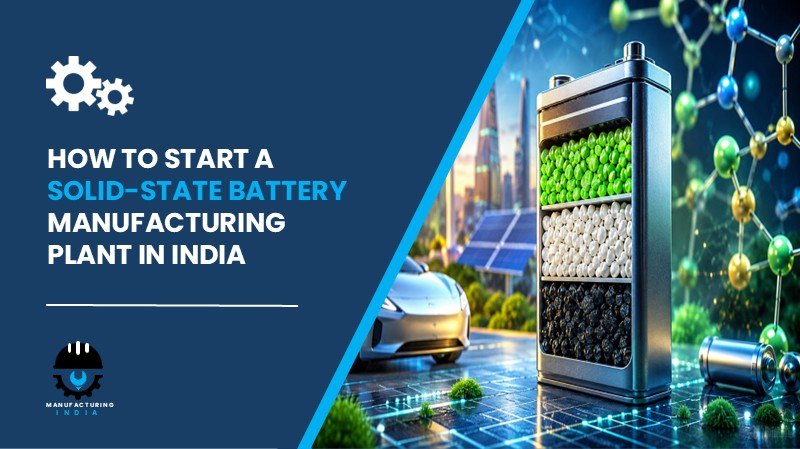
Solid-State Battery Manufacturing Plant in India
Setting up a solid-state battery manufacturing plant in India presents a compelling investment case driven by the accelerating electrification of transportation, growing demand for high-energy-density storage solutions, and rising adoption of consumer electronics and renewable energy systems. Electric vehicles, aerospace systems, consumer electronics, and grid-scale energy storage are the primary industries fuelling demand for solid-state batteries across India and globally. Unlike conventional lithium-ion systems, solid-state batteries offer enhanced thermal stability, improved safety, and superior energy density attributes that are becoming non-negotiable for India’s rapidly evolving mobility and energy sectors.
India’s structural advantages make it a strategically sound location for this investment. Rapid urbanisation, large-scale infrastructure expansion under national programmes, and the Make in India initiative create a fertile environment for advanced battery manufacturing. States like Gujarat and Maharashtra with established industrial corridors, port connectivity, and reliable utility infrastructure offer ideal conditions for setting up capital-intensive, technology-driven facilities. Additionally, India’s cost-competitive land and labour base, combined with growing domestic demand for EV and energy storage products, positions a solid-state battery manufacturing plant in India as a long-term, high-return investment.
India’s policy environment, cost advantages, and surging demand from EV, aerospace, and grid-storage sectors make a solid-state battery manufacturing plant in India a commercially viable and strategically sound venture. With gross margins ranging between 40–50% and net margins of 20–30%, the investment offers strong financial returns. Government support under clean energy and decarbonisation programmes, combined with growing domestic demand, ensures long-term break-even viability.
What is a Solid-State Battery?
A solid-state battery is an advanced electrochemical energy storage device that replaces the liquid or gel electrolyte used in conventional lithium-ion batteries with a solid electrolyte. The solid electrolyte may be ceramic such as sulfide, oxide, or phosphate-based materials polymer-based, or composite in nature. This design enhances thermal stability, reduces the risk of leakage and thermal runaway, and enables the use of lithium metal anodes, significantly improving energy density.
Solid-state batteries offer higher volumetric and gravimetric energy density, improved safety characteristics, extended cycle life, and enhanced operating temperature range. These properties make them particularly suited for applications where compactness, safety, and long service life are critical performance parameters.
The primary production method involves electrode coating, cell assembly, and solid electrolyte integration. End-use industries served include electric vehicles, consumer electronics, energy storage systems, aerospace, medical devices, and renewable energy.
Cost of Setting Up a Solid-State Battery Manufacturing Plant in India
The total cost of establishing a solid-state battery manufacturing plant in India depends on several factors, including plant capacity, technology selection, geographic location, level of automation, and regulatory compliance requirements. A comprehensive financial model must account for both capital expenditure (CapEx) and operational expenditure (OpEx) to derive a realistic investment picture.
1. Capital Expenditure (CapEx)
Capital expenditure covers all one-time investments required to bring the facility to operational readiness. Land and site development costs include land registration charges, boundary development, and infrastructure preparation. Plants located within Special Economic Zones (SEZs) or notified industrial estates may benefit from reduced land costs, single-window clearances, and tax incentives. Civil works encompass the construction of the production shed, quality control laboratory, raw material storage, and administrative block all designed to meet the stringent dry-room and contamination-control requirements of solid-state battery production.
Machinery and equipment represent the largest single component of capital investment. Key machinery required includes:
- Electrode mixers
- Coating machines
- Calenders
- Solid electrolyte presses
- Cell assembly lines
- Sintering furnaces
- Formation and aging chambers
- Dry rooms
Other capital costs include the effluent treatment plant (ETP), pre-operative expenses, commissioning charges, and import duties applicable to specialised equipment not yet manufactured domestically.
Request a Sample Report for In-Depth Market Insights: https://www.imarcgroup.com/solid-state-battery-manufacturing-plant-project-report/requestsample
2. Operational Expenditure (OpEx)
Raw material costs are the dominant driver of OpEx, accounting for approximately 60–70% of total operating expenses. The three primary raw materials are solid electrolyte, lithium metal, and cathode materials. Securing long-term supplier contracts for these inputs is essential to mitigate price volatility and ensure supply chain continuity. Utility costs covering electricity, water, and steam account for a further 15–20% of OpEx, reflecting the energy-intensive nature of sintering, formation, and dry-room operations.
Other operating costs include transportation, packaging, salaries and wages, maintenance, depreciation, and taxes. Operational costs are projected to increase substantially by the fifth year of operations due to inflation, market fluctuations, and potential rises in the cost of key materials, compounded by supply chain disruptions and rising consumer demand.
3. Plant Capacity
The proposed manufacturing facility is designed with an annual production capacity ranging between 1 and 5 GWh, enabling economies of scale while maintaining operational flexibility. Capacity can be customised based on investor requirements and target market size. Profitability improves meaningfully with higher capacity utilisation, as fixed costs are spread across a larger production base.
4. Profit Margins and Financial Projections
The solid-state battery manufacturing plant project demonstrates healthy profitability potential under normal operating conditions. Gross profit margins typically range between 40–50%, supported by stable demand and value-added applications. Net profit margins range between 20–30%, reflecting the technology-driven premium pricing achievable in this segment. A full financial analysis covering NPV, IRR, payback period, gross margin, net margin, and sensitivity analysis is available in the detailed project report. The break-even timeline is informed by capital investment levels, utilisation rates, and prevailing market pricing.
Why Set Up a Solid-State Battery Plant in India?
Enhanced Energy Density Advantage. Solid-state batteries enable higher energy density by utilising lithium metal anodes, allowing manufacturers in India to cater to premium EV and aerospace markets seeking longer operational ranges. This technological edge supports premium pricing and strong gross margins in a competitive landscape.
Strategic Role in EV Transition. As automakers transition toward next-generation EV platforms, solid-state batteries are being integrated into future vehicle roadmaps, creating long-term demand visibility. India’s rapidly expanding EV ecosystem makes domestic solid-state battery production a strategically critical capability.
Improved Safety Profile. The absence of flammable liquid electrolytes significantly reduces risks of leakage and thermal runaway, positioning the technology as a safer alternative for transportation and consumer electronics. This safety advantage is increasingly mandated by regulatory and OEM specifications in both domestic and export markets.
Government Support and R&D Incentives. Various governments, including India, are supporting advanced battery research under clean energy and decarbonisation programmes, indirectly encouraging domestic solid-state battery production. Policy tailwinds from the Make in India initiative and national EV promotion schemes provide additional investment support.
Active Industry Investment. In February 2026, Factorial Inc. announced a Memorandum of Understanding for a strategic manufacturing collaboration with Philenergy, intended to accelerate the scale-up of Factorial’s Solstice all-solid-state battery platform. In October 2025, Sumitomo Metal Mining Co., Ltd. and Toyota Motor Corporation entered into a joint development agreement for mass production of cathode materials for all-solid-state batteries for battery electric vehicles signalling strong global OEM commitment to the technology’s commercialisation.
Cost-Competitive Manufacturing Base. India’s favourable land and labour costs, combined with a growing domestic supplier base for industrial chemicals and materials, create a structurally cost-competitive environment. Local sourcing for utilities, contract services, and auxiliary materials further reduces total cost of ownership for an Indian manufacturing facility.
Manufacturing Process Step by Step
The solid-state battery manufacturing process uses electrode coating, cell assembly, and solid electrolyte integration as the primary production method. The process is a multi-step operation involving several unit operations, material handling, and quality checks.
- Raw Material Preparation: Solid electrolyte, lithium metal, and cathode materials are procured, inspected, and prepared for processing in controlled dry-room environments to prevent moisture contamination.
- Electrode Mixing: Electrode mixers blend active cathode materials, binders, and conductive additives to produce uniform electrode slurries for coating.
- Electrode Coating: Coating machines apply the electrode slurry uniformly onto current collector substrates, followed by drying to remove solvents.
- Calendering: Calenders compress the coated electrodes to the required thickness and density, improving volumetric energy density and ionic conductivity.
- Solid Electrolyte Processing: Solid electrolyte presses form the solid electrolyte layer ceramic (sulfide, oxide, or phosphate-based), polymer, or composite to precise specifications.
- Cell Assembly: Cell assembly lines integrate the anode, solid electrolyte layer, and cathode in a precisely controlled sequence to form the complete cell stack.
- Sintering: Sintering furnaces subject assembled cells to controlled high-temperature treatment to enhance ionic conductivity and interfacial bonding within the solid electrolyte.
- Formation and Aging: Formation and aging chambers apply initial charge-discharge cycles to activate cells and establish stable electrochemical performance baselines.
- Quality Assurance and Testing: Comprehensive technical tests validate energy density, safety, cycle life, and operating temperature range against established specifications.
- Packaging and Dispatch: Finished solid-state battery cells and modules are packaged and dispatched to end-use industries including electric vehicles, consumer electronics, energy storage systems, aerospace, and medical devices.
Key Applications
Solid-state batteries serve a broad range of high-value industries requiring superior energy density, safety, and longevity.
- Solid-State Battery Cells: Utilised for current collectors, internal conductive pathways, and electrode connections in next-generation battery cells.
- Battery Modules: Applied in inter-cell connectors, flexible busbars, and tab connections for module-level battery assemblies.
- Battery Packs: Used in high-current distribution links, grounding straps, and power transfer assemblies for complete battery pack systems.
- Energy Storage Systems: Deployed in power management connections, high-frequency signal pathways, and integrated control wiring for grid-scale and stationary storage applications.
- Electric Vehicles: Integral to next-generation EV powertrains requiring longer range, faster charging, and higher safety standards.
- Aerospace and Medical Devices: Used in aerospace energy systems and medical devices where compact, safe, and long-life power sources are essential.
Leading Manufacturers
The global solid-state battery market is served by several multinational companies with extensive production capacities and diverse application portfolios. Key players in the industry include:
- Toyota Motor Corporation
- QuantumScape Corporation
- Solid Power, Inc.
- Samsung SDI Co., Ltd.
- LG Energy Solution Ltd.
- Panasonic Energy Co., Ltd.
Timeline to Start the Plant
- Feasibility study and project report preparation
- Land acquisition and site development
- Regulatory approvals and environmental clearances
- Factory licence and fire safety compliance
- Machinery procurement and installation
- Raw material supplier agreements and supply chain setup
- Trial production and quality testing
- Commercial production launch
Licences and Regulatory Requirements
Starting a solid-state battery manufacturing unit in India requires several approvals:
- Business registration (Proprietorship, LLP, or Pvt Ltd)
- Factory Licence under the Factories Act
- Environmental Clearance from State Pollution Control Board
- GST Registration
- Fire Safety NOC
- Hazardous/Chemical compliance (applicable given use of lithium metal and sulfide-based electrolytes)
- Effluent Treatment Plant (ETP) operational clearance
- Occupational Health and Safety compliance
Key Challenges to Consider
High Capital Requirements. Establishing a solid-state battery manufacturing plant in India demands substantial capital investment in specialised dry-room infrastructure, sintering furnaces, cell assembly lines, and quality systems — creating a high entry threshold for new investors.
Raw Material Price Volatility. The cost of solid electrolyte, lithium metal, and cathode materials which account for 60–70% of OpEx is subject to global supply-demand fluctuations, geopolitical factors, and mining output variability, posing a material risk to margin stability.
Regulatory Compliance. Battery manufacturing involving lithium metal and chemical electrolytes is subject to stringent hazardous materials handling regulations, ETP requirements, and environmental clearances, requiring dedicated compliance infrastructure and expertise.
Technology and Innovation Pressure. Rapid advancements in solid electrolyte materials including sulfide and oxide-based systems and precision manufacturing requirements mean that manufacturers must continuously invest in R&D and process upgrades to remain competitive.
Competition from Global Players. The presence of established global manufacturers such as Toyota Motor Corporation, QuantumScape Corporation, Samsung SDI Co., Ltd., and LG Energy Solution Ltd. creates competitive pressure on pricing, technology, and supply chain access for new entrants.
Skilled Manpower. The advanced material science and precision manufacturing requirements of solid-state battery production demand a specialised workforce with expertise in electrochemistry, ceramics processing, and battery engineering skills that remain in limited supply in India.
Frequently Asked Questions
1. How much does it cost to set up a solid-state battery manufacturing plant in India? The total setup cost depends on plant capacity (1–5 GWh range), location, technology, and automation level, covering land, civil works, machinery (including electrode mixers, sintering furnaces, dry rooms), and pre-operative costs. A detailed cost breakdown is available in the project feasibility report.
2. Is solid-state battery manufacturing profitable in India in 2026? Yes. The project demonstrates gross profit margins of 40–50% and net profit margins of 20–30% under normal operating conditions, supported by stable demand from EV, aerospace, and energy storage sectors.
3. What machinery is required for a solid-state battery plant in India? Essential machinery includes electrode mixers, coating machines, calenders, solid electrolyte presses, cell assembly lines, sintering furnaces, formation and aging chambers, and dry rooms.
4. What licences and approvals are required to start a solid-state battery plant in India? Required approvals include business registration, Factory Licence, Environmental Clearance, GST Registration, Fire Safety NOC, hazardous/chemical compliance, ETP operational clearance, and Occupational Health and Safety compliance.
5. What raw materials are needed for solid-state battery manufacturing? The primary raw materials are solid electrolyte, lithium metal, and cathode materials, with solid electrolyte constituting the dominant cost component within the raw materials budget.
6. What are the environmental compliance requirements for a solid-state battery plant in India? Plants must obtain Environmental Clearance from the State Pollution Control Board, operate an approved Effluent Treatment Plant, comply with hazardous materials handling regulations, and implement advanced monitoring systems to detect process deviations and ensure emission standard compliance.
7. What is the best location to set up a solid-state battery plant in India? Locations offering proximity to raw material suppliers, robust transportation and utility infrastructure, and access to skilled labour are preferred. Industrial corridors in Gujarat and Maharashtra, as well as SEZs offering regulatory and tax advantages, are strategically favourable options.
8. What is the break-even period for this type of plant in India? The break-even period is determined by capital investment levels, capacity utilisation rates, and prevailing product pricing. A detailed payback period analysis, NPV, and IRR are provided in the full project feasibility report.
9. What government incentives are available for manufacturers in India? Various governments, including India, support advanced battery research under clean energy and decarbonisation programmes. The Make in India initiative, national EV promotion policies, and potential PLI (Production Linked Incentive) schemes provide financial and regulatory support for domestic solid-state battery production.
Key Takeaways for Investors
A solid-state battery manufacturing plant in India represents a high-value investment opportunity anchored by demand from electric vehicles, aerospace systems, consumer electronics, and grid-scale energy storage sectors that are growing at an accelerating pace both domestically and globally. The investment demonstrates strong financial viability across a 1–5 GWh capacity range, with gross margins of 40–50% and net margins of 20–30% supporting robust returns. The global solid-state battery market was valued at USD 2,397.35 million in 2025 and is projected to reach USD 30,074.49 million by 2034, at a CAGR of 32.45% from 2026 to 2034 underscoring the scale and durability of the growth opportunity. With increasing OEM commitments, government clean energy support, and accelerating EV adoption global electric car sales are on track to surpass 20 million units in 2025, exceeding a quarter of all cars sold globally demand for solid-state batteries is structurally sustained for decades ahead.
About the Author